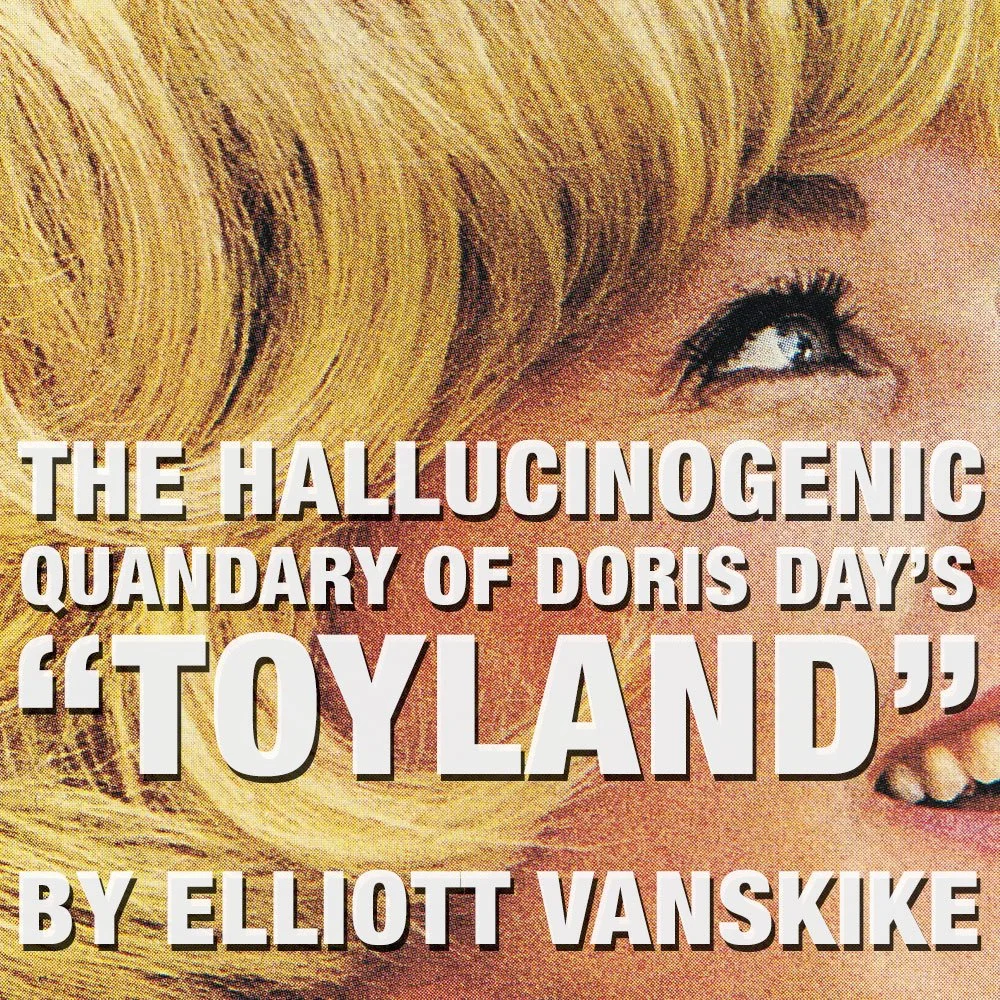
The Hallucinogenic Quandary of Doris Day’s “Toyland” by elliott vanskike
Christmas is a weeks-long hallucination. It’s other things, too, of course. But it’s never not been a distorted, garish fever dream. Maybe it’s just me, but I suspect it’s not. I was raised in an evangelical Christian household and was told from birth that Santa was a lie; Christmas was really about Jesus being born. We hung stockings, put up a tree, made Christmas cookies, watched Rudolph on TV, had a fruitcake in a red tin delivered from Texas every year, and got plenty of presents, but the experience was schizophrenic, divorced from reality. My mom participated in all the yuletide excess grudgingly, because, really, Christmas was about Christ. The welter of commercialism in stores, on street corners, and on TV was intense even 50 years ago. But all of it—even the presents we got—was understood to be dross, evidence of a degraded, secular bacchanal that was hyped up to distract people from the reality of Jesus’ birth.
Even if my sisters and I had wanted to get carried away celebrating the birth of a perfect baby—the savior of humanity—heralded by angels, nestled in hay, with the cattle moaning approval and adoring shepherds and rich kings ringing the manger, we were always reminded that Jesus, almost like a character in a song by Lana Del Rey or Johnny Cash, was born to die. His tiny perfect baby-ness was already haunted by the specter of his trusted colleagues betraying him, crowds spitting on and mocking him, soldiers nailing him to a cross and stabbing him with a spear, and his own father (God, in this scenario) turning his back on him and refusing to help.
Your hallucinatory mileage may vary depending on whether the Christmas mashup of secular and religious tipped toward the tragic and gory or the tinseled and frosted. But even with the holiday admixture of Jesus and Santa dialed toward the latter, Christmas can be pretty weird. It’s like the yearly arrival of an impossibly massive object that bends and warps everything near it. A green-and-red black hole that keeps coming back around. It seemed weird when I was 8 years old sitting in Wednesday prayer meeting and staring at the Sears catalog page devoted to the electric football set I wanted for Christmas. It seemed weird when I was the kid on the playground telling the other kids Santa wasn’t real (I know!). On Christmas Eve, it seemed weird when my sisters and I winkingly put out beer and cheese and crackers “for Santa,” knowing it was my dad’s favorite snack and the presents were from our parents. And it seemed weird when, as an adult (decades after ditching religion), I pulled up NORAD’s Santa Tracker so my kids and I could trace St. Nick’s progress across the globe.
*
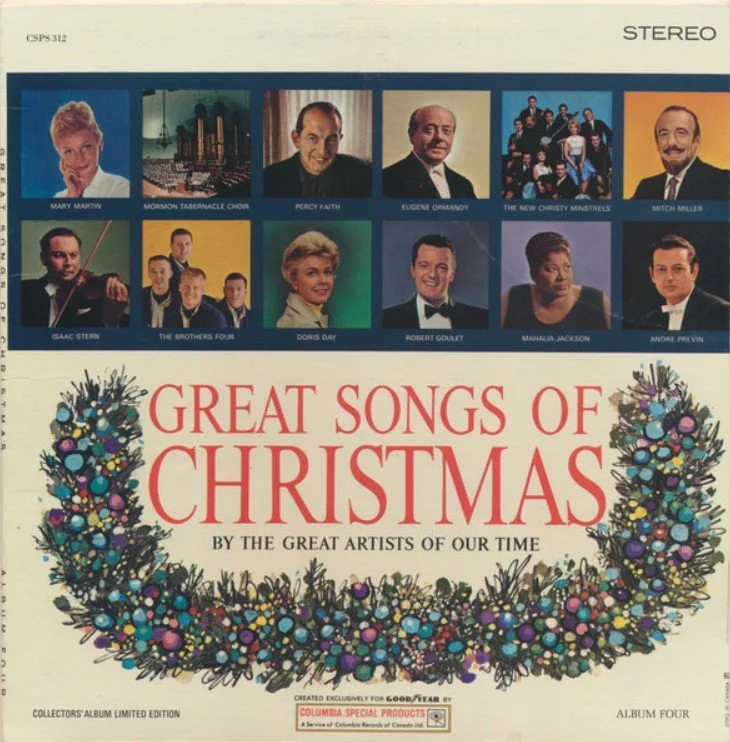
Doris Day’s version of the Victor Herbert song “Toyland“ always came across to me as a little unhinged. Even as a child, it was woozy and upsetting, like the whole recording was somehow narcotized. In the 1960s and 1970s, tire manufacturers Goodyear and Firestone would release annual Christmas albums that were sold in their service centers. They featured traditional carols, classical recordings, spirituals, and modern Christmas songs. Doris Day’s version of “Toyland” was on “Great Songs of Christmas Volume 4” from 1964, and I grew up hearing it.
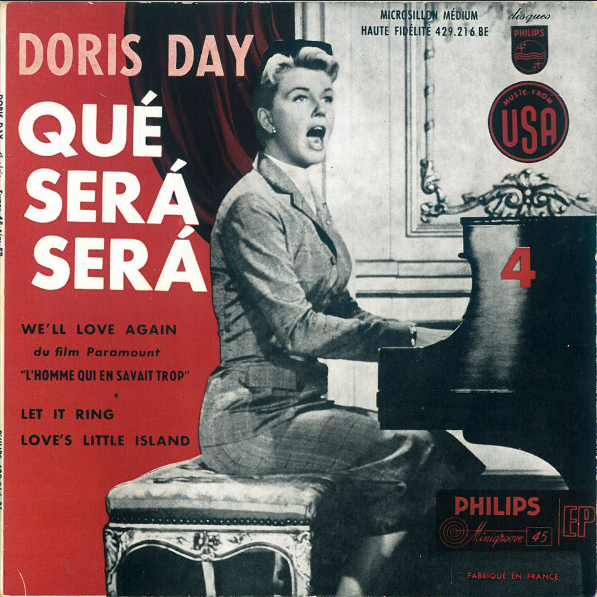
I’ve always assumed the hallucinatory quality of Doris Day’s “Toyland” was due at least in part to her overblown mezzo-soprano, perhaps heard most famously in her signature song, “Que Será Será.” The song was introduced to the world in Hitchcock’s 1956 film The Man Who Knew Too Much (a remake of his own 1934 version of the film). Day plays a talented singer whose young son is kidnapped and—as the film winds toward its conclusion—is being held in an embassy in London. With the goal of locating the room where the boy is secreted, the ambassador (of which country we never learn) organizes an impromptu concert. Day belts out “Que Será Será” with increasing intensity and volume in the hopes that her son will hear her voice and whistle along (as he has been known to do), so that the London police can find him. To my ears, Day’s singing is always a little forceful, even if it’s not as frenzied as it is in the conclusion of the film.
But it turns out pretty much every version of “Toyland” sounds unhinged. Maybe there’s a fine line between enchanted and creepy and—as with the religious vs. secular distinction—your mileage may vary. But every version of the song I’ve heard seems to be sung from some snow-covered uncanny valley formed by Mt. Whimsy on one side and Mt. Eerie on the other. For starters, unlike many secular Christmas songs, “Toyland” is slow. It’s usually sung in a plodding 6/8 played so slowly that it sounds like a 4/4 on the nod. It’s supposed to be dreamy but comes off like a dirge. Perry Como’s version starts off with a rush of flutes and strings, but quickly settles into an arrangement that features Como’s buttery baritone and a languorous backing choir. Johnny Mathis’s rendition starts with a swell of strings and slightly discordant glockenspiel before his quavery, ethereal voice enters. Throughout, the production seems to insist on an otherworldliness, almost like the song is soundtracking a dream sequence from A Very Barbarella Christmas. Even Goofy’s version from Disney’s very much on-the-cheap “Jingle Bell Fun,” which includes a bizarre skat section in the middle, can’t duck the weirdness of “Toyland.”
*
And that’s because weirdness is in the song’s DNA. Victor Herbert’s operetta Babes in Toyland was written in the wake of Herbert’s massive success with staging a musical version of L. Frank Baum’s The Wizard of Oz in January 1903. So keen was Herbert to cash in on that hit that he composed the songs for Babes in Toyland and had the production up and running in Chicago a mere 6 months later in June 1903. The concept for the operetta was to weave together various characters and stories from Mother Goose, but the result sounds more like the unexpurgated and bloody Brothers Grimm. The two “babes” of the title—Alan and Jane, both orphans—are in constant peril. There are two attempts on their lives (intentional shipwreck, poisoning). They’re abandoned in the Forest of No Return and menaced by a giant spider. They seek shelter in Toyland, only to discover that it’s a hellscape ruled over by the sadistic Master Toymaker, who designs toys that maim and kill children. When the toys turn on the Toymaker and kill him, Alan gets blamed and is sentenced to be hanged. Feeling Christmas-y yet?
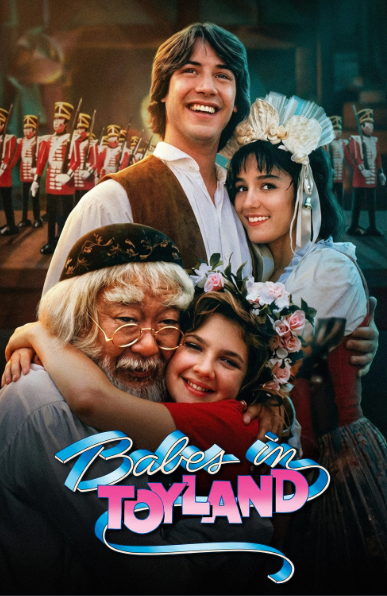
It’s no wonder that subsequent stagings and movie and TV productions have sometimes kept the operetta’s songs but always softened the plot. The 1961 Disney movie stars Ray Bolger as the Toymaker (misguided but not sadistic) and Annette Funicello as Mary Contrary. A major plot point involves a toy gun that shoots a red liquid that can shrink objects. It’s echt Disney midcentury froth with a touch of Sid and Marty Krofft. The 1986 version broadcast on TV in the U.S. but released theatrically elsewhere stars Keanu Reeves and Drew Barrymore, with Pat Morita as the Toymaker. It ditches almost all of the original songs and totally rewrites the plot. (Fun fact: The film is set in Cincinnati but was filmed in Munich.) A truncated version of “Toyland” soundtracks Barrymore’s transition, by way of a car crash/sledding accident, from the snowy Midwest to bright and happy Toyland. (But before Barrymore soars to Toyland, please enjoy Keanu and company singing about their civic pride in Cincinnati while driving through the outskirts of Munich.)
*
While every subsequent version of Babes in Toyland has toned down the weirdness of the original, the song “Toyland” abides and its weirdness is irreducible. Even if you avoid surrendering to the maziness of the song’s arrangement and production, there’s no escaping the lyrics. First stanza, so far so good:
Toyland, toyland
Little girl and boy land
While you dwell within it
You are ever happy there
Toys make kids eternally happy. No shit, Santa. A little weird to make loving toys a place that you can move to, but, hey, it’s a whimsical metaphor. Until you get to the second stanza:
Childhood’s joy land
Mystic merry toyland
Once you pass its borders
You can ne’er return again
Now Toyland has borders that only seem to work in one direction—less FAO Schwarz than Hotel California. And, since the borders are apparently being policed (how else are kids prevented from leaving or reentering?), the tone has suddenly shifted. I get that the perspective is supposed to be that of an adult passing on the wisdom that childhood is a magical, fleeting time. The metaphor is still there, but the whimsy has vanished. There’s something disturbing about being trapped forever in a “mystic merry toyland” or being cast out of it, like Adam and Eve at the point of a flaming sword.
*
I’m writing this essay six miles from the White House amid our current state of fascism. If I’m being honest, I can’t resolve what started as a detached, ironic take on a 60-year-old Doris Day Christmas song the way I’d planned: with shrewd call-backs to my religious childhood and my need to revisit the dead weight my upbringing still exerts. Invoking borders and children, how is it possible to go on talking about Christmas? Knowing that, if you read the Gospels straight, Jesus came to help and defend those who had nothing and were nothing in the eyes of the state, how do I just grope for the words that will cleverly consolidate what precedes this into a nice rhetorical package? It can’t be done. It shouldn’t be done. How can I avoid acknowledging that my government is marshaling the forces of the state to harm children and punish people it deems less worthy, people it doesn’t even see as people? Children are being ripped from their parents so that those who espouse family values can feel better about their wealth and their whiteness. They have power and they want more. They think that hurting the defenseless will make them stronger. It won’t. They’re filled with hate. But even more, they’re filled with fear. As it happens, fascism is also a black hole that distorts and perverts everything around it. In the Beatitudes, Jesus said, “Blessed are the meek, for they shall inherit the kingdom of Earth.” He also said, “Blessed are the peacemakers, for they shall be called the children of God.” But it’s hard for me to see the way this country treats anyone who needs help and imagine Jesus or any feeling human not saying, “Fuck anyone who punches down.”

Elliott Vanskike lives and writes in Maryland, DJs at 94.3 WOWD-LP (the “LP” stands for “low power”), and is sick of swallowing bile.