
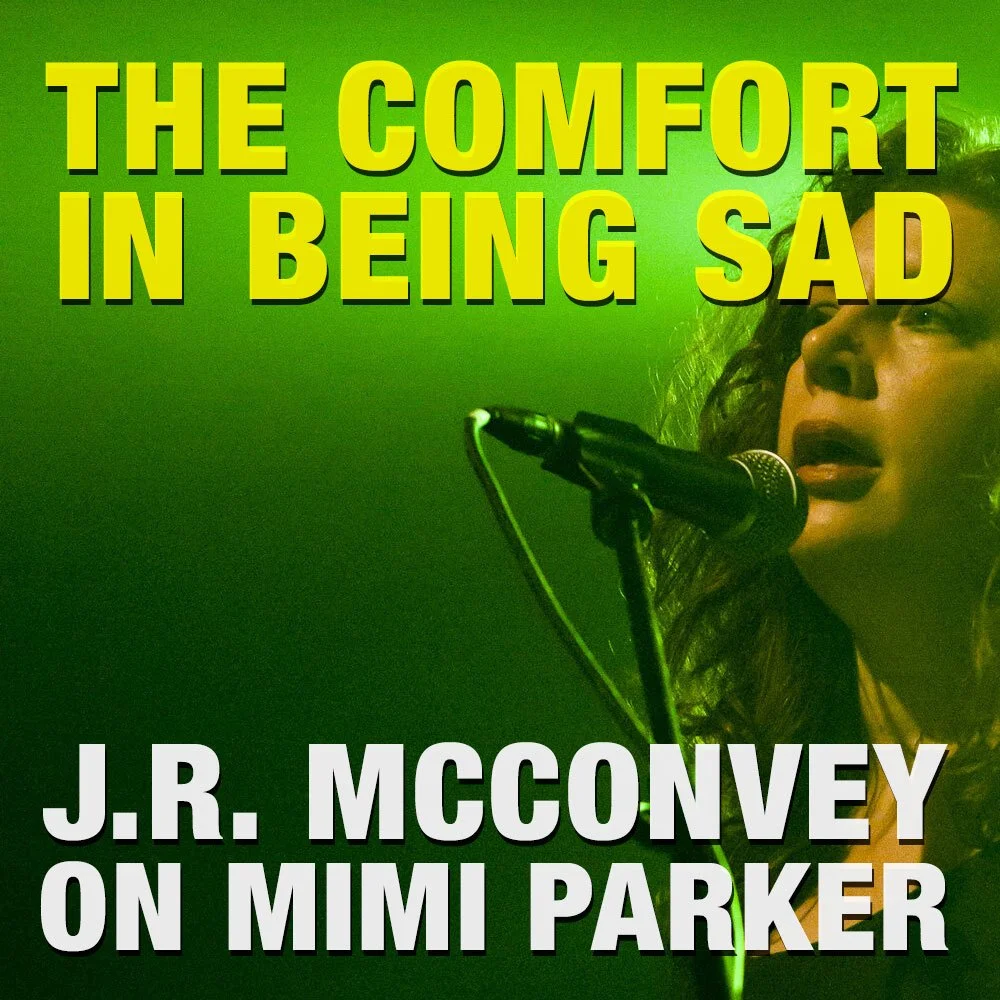
The Comfort in Being Sad: J.R. McConvey on Mimi Parker and Low’s Lullaby
As their name would have it, the Duluth, Minnesota band Low is synonymous with sadness. So much so that they inspired a whole genre defined by it: slowcore, sadcore, whatever you want to call the minimalist style of guitar music that emerged as a response to the angry riff n’ growl of grunge, Low was its center, whether they liked it or not. For that reason alone—the way the band’s sound evoked a universal dolor that no one had captured quite so perfectly before—one can’t really talk about sad music in the 1990s without talking about Low.
“Lullaby,” from their 1994 debut I Could Live in Hope, encapsulates what makes Low formidable. A glacial dirge that clocks in at just under 10 minutes and features exactly 38 words, “Lullaby” is a gorgeous bummer. Instrumentally, it’s built on three arpeggiated chords and a droopy bassline, joined by an austere drumbeat—just brushes on cymbal and snare—at around 2:50. The song is an exercise in dynamics, drawing out the same droning progression into the closest Low ever gets to a frenzy of reverb-drenched strumming. It’s a statement that says, this is going to take time.
But what it is, above all, is the grand debut of Mimi Parker, the band’s drummer and co-lead singer, whose voice is its soul: an instrument of almost unendurable grace. Although Mimi takes lead vocals on “Slide,” which comes before “Lullaby” on the record, the latter is the first time we hear her voice highlighted as the music’s load-bearing element. Two minutes in, she gives us the spare, sad chorus: “Lullaby was not supposed to make you cry; I sang the words I meant.” Every time I hear it I think, what a gift.
Which brings us to the other reason that, for me, any true talk about sadness in music must involve Low: on November 5, 2022, Mimi Parker—the voice that made their music holy—died from ovarian cancer at age 55.
*
I was en route to Minnesota for the first time when I heard. A friend’s post on Facebook clued me in: a brief statement on the irreplaceable beauty of Mimi Parker’s voice. I knew she was gone.
It was my first trip to Minneapolis, where I was filming a segment for a documentary series. The next day, in an empty dance studio near Loring Park, I put my laptop down on a dusty upright piano and played Low’s “Laser Beam” out loud as a kind of prayer, listening to Mimi’s voice dissipate into the fading November light. It was a necessary ritual: I had been granted a chance to mourn her in her home state, to share in collective sadness with Minneapolis. Low’s origins in Duluth were a convenient part of their legend: it’s north, it’s cold, it’s dark. After weeks in the south, Minneapolis felt familiar to my Canadian soul, and I felt lucky to know it, even briefly, since it helped me understand Low just that little bit more.
Musicians die and people celebrate their contributions, some more than others. Mimi Parker wasn’t famous by Hollywood standards. But the outpouring of love for her when she passed away was significant. It came from artists of the highest pedigree; Robert Plant dedicated a cover of Low’s “Monkey” to Mimi in tribute. People remembered Mimi’s no-bullshit personality, her sense of humour, her love for her kids.
But most of the praise and the gratitude focused on her voice. Jeff Tweedy of Wilco nails the overarching sentiment: “it rings the clearest to me of any voice I’ve ever heard in my life.”
Can you be in love with a voice? I think I fell in love with Mimi Parker’s. To try and describe it is to rob it of its indescribable quality. You end up with absurdities: silent tears collected in a jar and pressed into a vinyl record to be played for God. A translucent dove hovering over a trembling lavender moon. It is amazingly consistent across Low’s records; if anything, Low’s second and third periods—marking the time from the release of 2001’s Things We Lost in the Fire to their final record, 2021’s HEY WHAT—sees Parker singing with more confidence and volume than their intensely mopey early period allowed. (One of her greatest performances is on “Especially Me” from 2011’s C’mon; another is “Holy Ghost” from 2013’s The Invisible Way, which Tweedy produced.) But everything is already there on “Lullaby.” The vibrato that sounds both impossibly fragile and completely controlled. The way her voice is sonorous and immaterial at the same time. The way it cradles you. The clarity of it. The strength.
“Lullaby” is, on their Spotify page, Low’s most popular song by a long shot, with more than 23.5 million streams. I suppose it’s the closest the band has to an anthem. But this could have been about any of the songs that showcase that voice, the one that’s gone but will last forever.
Alan Sparhawk, the other half of Low’s core and the father to Mimi Parker’s two children, knew that. When I went searching for an origin story about “Lullaby”—something about the writing process, or tales from the recording sessions for I Could Live in Hope—I arrived at this post on the band’s Instagram page, which is worth quoting at length:
The moment Mim would go in and do vocals would become a recurring moment, as we went to do other records—an unknowing engineer would set up the mic and get her headphones working, go back and settle in at the desk, they’d hit record, Mim would start singing, and a very obvious and visible quake would run through the room as the engineer would first hear her sing. They would sit up suddenly, instinctively reaching for knobs and faders but then wouldn’t touch anything, as this arc would flow over them and they would slowly settle back, staring at the speakers as if to figure out what was coming out of them. Then they would turn and very soberly look at the rest of us with a silent, “Oh, I see what’s going on here.”
Mimi Parker’s voice was not, in itself, sad. But it evoked sadness in a way that was deeply moving to millions of people. Why? Not, why was her voice so transcendent—but why do we reach for sad songs when we are feeling, as the case may be, low? How can sadness sound so beautiful? How is what ruins us part of what heals us?
The answer is in the essence of Mimi Parker’s voice. Low’s music can be profoundly sad. But the heart of it, the thing that gives it its fundamental quality, is love.
Sadness, as it happens, is a product of love. If you don’t care, you’re not sad; that’s despair, which Low never trafficked in. Kurt Cobain (who succumbed to despair) sang of the comfort in being sad, a phrase that nicely sums up what it’s like to listen to Low, and an idea that feels missing from today’s culture, which wants everyone to look happy and successful on their social profiles and has embraced, as its soundtrack, sandblasted pop and autotuned country music for bad drunks. There’s a reason a certain warped macho mindset says real men aren’t supposed to cry: expressions of sadness are expressions of love, and prayers to beauty. The men working the levers of power at present hate both of those things, and dismiss them as weak, in part because they cannot access them. I do not believe Donald Trump has ever felt true sadness, because I do not believe he has the capacity to love.
Most people who aren’t psychopaths feel sadness over what we’ve loved and lost. Mourning is inevitable. I don’t usually cry when artists pass away; the wind blows, the wheel turns, the art endures. But there are exceptions for those whose voice has threaded into the fibers of who I am. I wept for Leonard Cohen. And in an empty dance studio in Minneapolis, as winter sun gave way to shadow, I wept for Mimi Parker.
The deep, aching connection between sadness and love is right there in Lullaby’s skeletal lyrics. “We all want, we all yearn. Be soft, don’t be stern. Lullaby was not supposed to make you cry. I sang the words I meant. I sang.” It’s also there in the statement Sparhawk released to tell the world Mimi was gone. “Share this moment with someone who needs you. Love is indeed the most important thing.”
What, after all, is a lullaby? A sweet, simple tune to soothe a restless mind. A melody to calm tears. An act of love against distress. A promise that the hurt will end. So, while “Lullaby” claims the title, the name applies just as well to any song graced with Mimi Parker’s holy voice. They’re all lullabies now.

J. R. McConvey is a writer from Toronto, Canada. He has published a novel, False Bodies (2024), and a short story collection, Different Beasts (2019); he has been writing about music, culture and nature since last century. His essay on “Chariots of Fire” made it to round two of the 2023 March Fadness 80s Edition tournament. Minneapolis is his favourite U.S. city.