
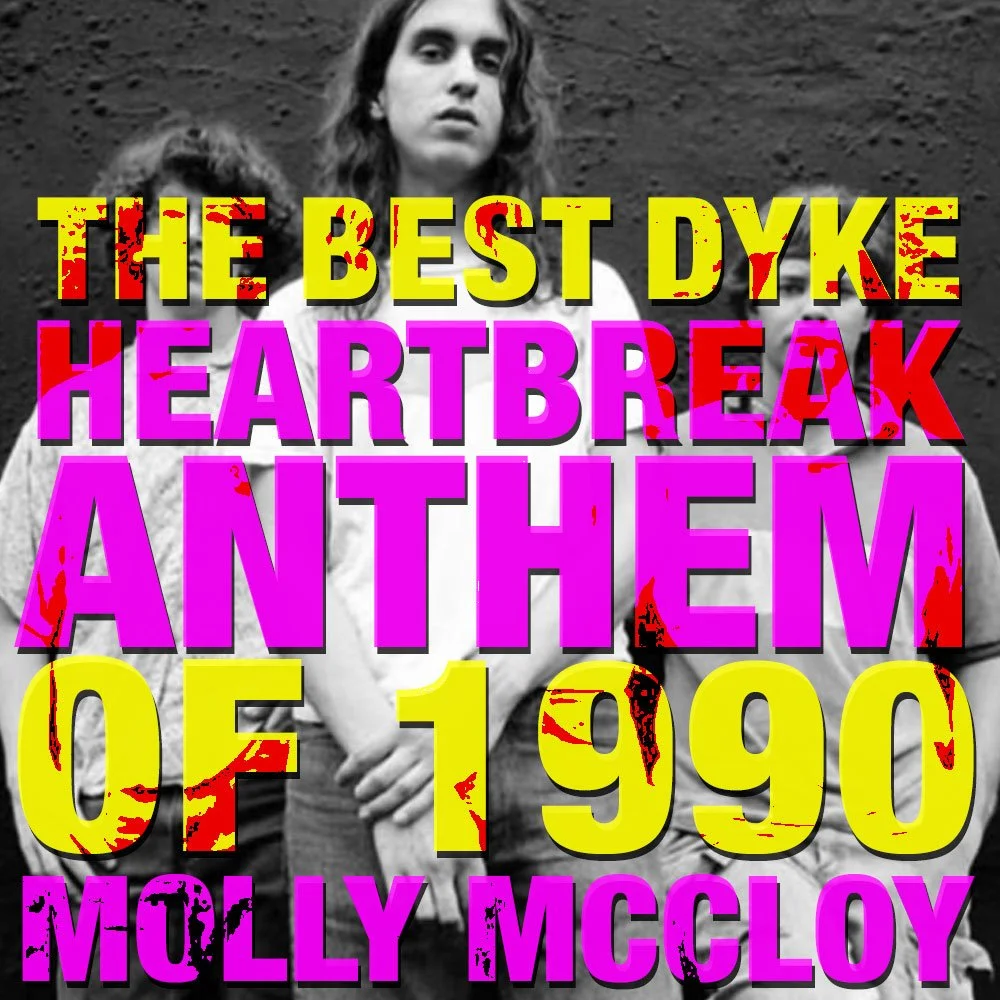
How a Dinosaur Jr. Cover Became The Best Dyke Heartbreak Anthem of 1990 and Why You Should Care Even if You’re Straight
by molly mccloy
Author's 2026 update note: I don't want to say "I told you so" but, you know, Target has pulled back their Pride displays, the federal government removed the pride flag from the Stonewall National Monument, and there is just a general vibe that straight people want to act like dicks again with their book-banning bullshit, so the doubts expressed in this 2024 seem justified. My book with the word "dyke" in the title comes out in September, so let's see what happens. After all, the pride flag at Stonewall is flying again…for now.
I.
The first time a woman wanted me, we spoke in code. We had to. It was 1989.
Home in Phoenix on spring break from college, my new friend Elle and I changed into our swimsuits in my recently vacated bedroom, its walls still plastered with my high school rock posters. Six years older, Elle was the music expert, always quizzing me. “So, you like…” she started, her big green eyes flitting from poster to poster filled with heavy metal dudes until she found platinum-buzz-cut Annie Lennox wearing a blindfold and black leather gloves. “…the Eurythmics?”
“‘Here Comes the Rain Again’ is a great song,” I answered. Had I given Elle the correct passcode? I’d always read the song’s lyrics as an invitation to queerness: “I want to walk in the open wind/I want to talk like lovers do/Want to dive into your ocean/Is it raining with you?/So, baby, talk to me/Like lovers do.”
I heard Dinosaur Jr. for the first time that year. A friend mail-ordered Bug from her SST catalogue. Small-label bands weren’t played on the radio, so I was thrilled when the album was plunked onto the dorm-room turntable and the jangly opening chords of “Freak Scene” rang out.
Bug hit my target just shy of bull’s eye. At age 18, I liked the relentless pulse of punk, but I didn’t love it the way I’d loved the soaring melodies of heavy metal when I was an eighth grader. I liked Agent Orange. And the Sex Pistols. The Pixies. These bands all grazed the edge of the sweet spot. Dinosaur Jr. was finally giving me those shredder guitar solos I’d missed so much, without the cheesy devil-worshipping or hair-band glitz.
Meanwhile, the Cure’s Kiss Me, Kiss Me, Kiss Me posters were plastered over my friends’ dorm-room walls. I appreciated the band’s catchy pop sound. But I hadn’t fallen in love with a person yet, so I couldn’t love the band. I liked “Just Like Heaven.” But I didn’t understand it. Not yet.
“Show me, show me, show me how you do that trick
The one that makes me scream," she said
”The one that makes me laugh," she said
And threw her arms around my neckShow me how you do it
And I promise you, I promise that
I'll run away with you."
I was indifferent to these perfectly metered, sensitive lyrics because I was still sleeping with guys. My high school boyfriend Scott. Pat, the record store clerk who got me into the Pixies. A German exchange student who wore leopard print speedo underwear. A blonde cowboy. An oddly submissive frat boy. A dude who had a job gassing up airplanes.
Sex with men was fun. Physically, most guys could take me where I wanted to go. Emotionally? I loved my long-term boyfriends, but it felt too…familial, an affection for someone I was obligated to tolerate. I wouldn’t be running away with any of them.
Meanwhile, my lesbian education was three minutes of video: the two women from Prince’s band making out in the video for “1999,” the lesbians in The Rocky Horror Picture Show, and Catherine Deneuve seducing Susan Sarandon in The Hunger.
The women in Prince’s video don’t kiss. They press their bodies together for a few seconds, one woman’s hand overlapping the other’s as they play the keyboards. I saw this video at age fourteen and was glued to the TV whenever it came on. When a friend taped the Purple Rain album for me, I finally heard the voice intro for the song “Computer Blue”:
“Wendy?”
“Yes, Lisa.”
“Is the water warm enough?”
“Yes, Lisa.”
“Shall we begin?”
“Yes, Lisa.”
This tidbit kicked off some desperate cross referencing. Did this mean that the keyboardists from the 1999 video were named Wendy and Lisa? Which one was which? Were they really gay or was this just an enticing Prince gimmick? Was I imagining all the queerness around me? Was it real?
I knew Elle was watching me when I stripped off my t-shirt.
Of course she was. She had been observing me the whole day. Her gaze made me feel deliciously unsteady. She liked to tip my balance. I liked it too.
When I crossed my arms in front of my chest and lifted the hem of my shirt, Elle stood across my high-school bedroom from me, under my Rolling Stones poster, her clothes still on, swimsuit draped over her arm. Her style was androgynous like mine, a t-shirt with one horizontal stripe across the chest, Levi’s, shoulder length brown hair like mine but with bangs.
I had all of Elle in this moment, her sly alto voice asking the teasing questions, her big green eyes brimming with schemes, her world-class lips so full and lovely. I had wild Elle who hitchhiked and backpacked through Mexico. I had expert Elle who would play me records from the hundreds of them lining her apartment walls. I had beautiful Elle looking right at me. Her gaze owned me wholly, Elle’s brazen confidence that I was hers to study. I had Elle in my room…and I had no idea what to do.
I didn’t know yet that years later Elle would say of this moment, “It took me by surprise, your sexy bra under that t-shirt. With you, it was total fucking lust.”
I’d been in love with her since that fall day when she pulled up to my freshman dorm on her motorcycle and took me for a ride into the aspen groves. Since the day that I saw snow fall for the first time and she put her arm around me while we watched the snowflakes drifting down.
I fell for her this hard: In that summer of ’89, when she graduated and planned to move with her boyfriend to Seattle, I dropped out of college in Arizona and moved up there first.
But we didn’t even kiss that day in my old bedroom. Elle looked at my Who poster and asked, “Do you like Pete Townshend’s solo work?”
A bi woman asking me about the only out-bi rock star in 1989. Bisexuality. One of the trickier queer codes.
Dinosaur Jr. released their cover of “Just Like Heaven” in 1990. I saw some incredible shows in Seattle that year. The Fluid. Soundgarden. Nirvana at the pre-Grohl Motorsports show. There was an exuberance in the air, everyone wondering which SubPop band would achieve national stardom. Nevermind, still a year in the making, would eventually find what most of the Seattle bands were seeking. Love. Love at a stadium-crowd level. On Bleach, Nirvana’s “Love Buzz” and “About a Girl” had already raised the bar. Most bands struggled to pull together every piece required for grunge love: emotionally-resonant lyrics that the audience could decipher, a relentless beat, catchy melodic hooks, and any sentimentality masked by blasts of feedback whine and buzz.
That year I read some poems to open a basement show for the Idaho band Treepeople who covered the Smiths’ “Big Mouth Strikes Again.” This cover was a shrewd shortcut to grunge genius: take a pop hit’s proven melody, speed it up, scream the lyrics, add distortion.
Dinosaur Jr. cut a similar corner with their “Just Like Heaven” cover. As a music fan, I loved the grunge tactic. As a queer woman, I loved the cover itself. J. Mascis and Lou Barlow had brilliantly translated a Cure song that previously meant nothing to me.
I decided the Cure version was meant for straight men, like Elle’s boyfriend Steven. “I promise that I’ll run away with you,” is a promise that she kept with him, easily, all their friends and family gathered for a wedding send-off to Seattle in August 1990. Their marriage was a song that everyone loved.
I was heartbroken. And alone in my grief. I had no other queer people to talk to, and many straight friends thought I was delusional, a queer weirdo in love with a normal straight woman.
The world had ripped me off.
Finally, I had fallen in love. After years of faking it, I finally understood the love songs, the romantic movies, and my straight friends’ desperate impulses and rash decisions. I had finally experienced that full-body exuberance, that electric craving of another person’s body and their whole being, that need of nearness to Elle at all cost. Because I loved Elle, I made a choice. I had to leave the safe but meaningless straight world and take on the world’s insults. Being openly queer meant letting the rest of the world call me a sick monster. “Fine, I’m a dyke,” I had to say, that hard “K” sounding tougher and stronger and more appealing each time I did.
What a sad irony it was to finally experience love at full power, but to have nowhere for that love to go. I watched the rest of the world stuck in the Cure version of the song, when I was finally at full weight and dimension. The straight world looked like a pastel movie backdrop I could rip my fingers through. Mainstream society was bouncing along to the twinkling piano riffs of “Just Like Heaven,” all of these breeders in that tableau from Seurat’s “Sunday Afternoon” as I stomped by in my Docs and “Loser” T-shirt, saying, “I’m not going to wear your bonnet and hoopskirt, motherfuckers.”
I loved how the Dinosaur Jr. cover parodied straight love and powered through the song with angst and rage. I hadn’t found my fellow queers yet. But I did have this cover song to cry along with. A song that understood me.
"Why are you so far away?" she said
"Why won't you ever know that I'm in love with you
That I'm in love with you?"
You
Soft and only
You
Lost and lonely
You
Strange as angels
Dinosaur Jr.’s version begins like the original, a buzzier bassline but the same jangly strumming. Then the main melody blasts through, not gauzy and whisked-in like The Cure’s piano and orchestral synthesizers. Instead, Mascis’s wah-wah-pedaled guitar wails, each catchy riff a sublime crying fit, especially the mournful whine that echoes all five beats of “I’m in love with you.” Then comes the power-chord chorus. No British politeness. No poetic sweetness. Lou Barlow slugs the pain home by shouting the word “you” like his heart is being ripped from his chest.
When I played the song in my Seattle apartment, the shouted “YOU” on “you, soft and only” was Elle who told me that spring she was marrying Steven. “YOU!” like the blast of a blow torch.
“YOU!” on “You, lost and lonely,” was Elle saying “Why didn’t you tell me sooner? I would have been tempted,” when I professed my love to her, pre-wedding.
And “YOU!” on “You, strange as angels,” was, two years later, the Elle who danced with Steven on New Year’s Eve and spent New Year’s Day fucking me.
I wanted New Year’s Eve.
But I would never have it.
I wanted to be with her every minute of every day.
I stole only the briefest moments.
When recording “Just Like Heaven,” Dinosaur Jr. ran out of tape, so the song cuts out abruptly before the final chorus. The recording goes silent in middle of “YOU!” instead of arriving at “You, just like heaven.” This break-off perfectly mirrored the anguish of my own impossible situation, as if J. Mascis were saying, “This love is so painful that I can’t even finish this song.”
II.
Now, here we are, in 2024. Lately folks in literary circles and entertainment marketing have floated the notion that Lesbian stories like mine might reach a larger audience. Well-meaning leftists have voiced a commitment to diversity. Maybe a dyke like me could write about love and be believed, not only by other queer people, but a mainstream populace. As someone who came out in 1990, I have my doubts about this rosy scenario.
The worst part about being a dyke in love in 1990 is that no one believed that what I was feeling was love. I’m not referring solely to the well-documented cultural cruelty and constant punishment for queerness, though there was plenty. There was no access to legal marriage for gay couples. Gay men were mocked via national television and radio even as thousands of them were dying of AIDS. Sodomy laws were intact and supported by the U.S. Supreme Court. Gay teachers were fired from their jobs. Sons and daughters were disowned by their families. All of this agro-heterosexist policing was bad enough. What hurt even more was that people I encountered every day decided that I was mentally ill, or deluded, or sinful and headed straight for the fire pits of hell. My campus psychologist. My own straight friends. I was lucky to have a dad with a gay brother and a mom with a gay sister, so my parents were cool, but even my own brother thought I was a sinful gender criminal willfully self-destructing.
Now, here we are, in 2024. I’m a woman who has been happily married to another woman for twenty years. Can I be believed about love now, finally? I’m testing out that notion by writing about just one love song. Which happens to be a cover song. Which is how straight people see queer people anyway. As an imitation. Let’s flip that script.
Cover songs get a bad rap. Historically, cover artists have been found guilty of translating original music into more palatable versions for the masses, as in the case of white musicians covering black rock n roll. In contrast, Dino Jr.’s cover of “Just Like Heaven” takes the original out of the commercial realm and puts it in the hands of counter-culture fans. It unsells the song. Dirties it. Makes it less popular. And more personal.
A few weeks ago I tried to make this case for the Dinosaur Jr. cover to the straight dude at the record store who doubted my preference. The guy was seven inches taller than me, so I didn’t immediately confront him when he said, “I don’t know if you’re right about that. I’m a big Cure fan.”
What could I say to that? I could’ve matched his faulty logic with “Well, I’m a big Dinosaur Jr. fan.” But that would have felt childish. Like trying to win at checkers or tic-tac-toe.
There’s nothing sillier than two of us nerds arguing over which version of a song is better. Let’s do it anyway. I’ll take on the straight-guy Cure fan. In the name of love.
Robert Smith is quoted in a 1992 Chicago Tribune article, saying, “I love Dinosaur Jr.’s version of the song, and they’ve influenced how we play it.” He also says he admires how “passionate” the Dinosaur Jr. version is.
Plenty of straight men have chimed in on how they like Mascis’s cover better than the original. I don’t mean to do that here. I mean to do more. I want to say that the cover is better because it’s dykier than the original. I’d like to make J. Mascis an honorary Lesbian. I’d like to make “dykey” an aspirational aesthetic for all artists, straight or queer. It’s 2024, folks. It’s about time. It’s time to experience the world as I see it. Want to prove you are truly committed to diversity? Be careful what you ask for.
In my world, the best possible iteration of human life is to be a woman loving other women. In my world, queers don’t merely subsist in some dark corner. My world in 2024 is a continuous blast of pure sunshine where I reign joyfully as a badass queen of radical dykedom. Come join me here. Let’s talk about love. Let’s talk about our love of music. Let’s talk about love songs. And dyke anger. If you dare.
First things first. The Cure was never dykey enough for me. By this I mean that The Cure’s version of love was never angry and defiant enough for me. It wasn’t transgressive enough. The Cure is a great band. Robert Smith is a talented musician and songwriter. All my friends attending their post-pandemic shows say the band plays their favorites for hours. I can empathize to a point. But I was never a fan.
When I first saw Robert Smith in 1987 with his eyeliner and lipstick I decided he was either a closeted gay man or a straight musician cynically manipulating gay tropes for a marketing edge. Was Smith like the dudes from Wham! who were obviously gay but were being sold in Tiger Beat as heartthrobs to teen girls? Or was he was like Vince Neil, Grace Jones, and Annie Lennox, who used gender-bending imagery to win over gay fans who had nowhere else to go? Vehemently straight artists were always using queer images to sell a sexy rule-breaking vibe along with their music. At the same time, queer artists were always hidden. By the time I was eighteen and the Cure’s “Kiss Me, Kiss Me, Kiss Me” came out I was vigilantly skeptical about the ways queerness was always sold out or straightened out in the media.
And then there were the fans. When I was in high school, the goth culture of Cure fans mystified me, all these low-energy kids with that Adam’s Family corpse vibe. I looked at their white makeup and dyed black hair and wondered, “Why are these rich kids so sad?” All their families had more money than mine. I was jealous, of course. I couldn’t tap into my own vulnerability deeply enough for goth’s public wallowing. I had a strong preference for rage over sorrow. For me, sadness was equivalent to weakness. As a kid in a family breaking into the middle class, I couldn’t afford to show any weakness.
Even in college I would have told you that it’s much better to be an irate-dyke Dinosaur Jr. fan than a mopey straight-guy Cure fan. I can see now that these are just two versions of the same gender dynamic, a similar decoding of the 80s music sold to us. Anger was a taboo emotion for me as a girl and I loved to find it in my music, first heavy metal, then punk, then grunge. A straight guy exploring his own forbidden sadness with The Cure was simply the flip side of my coin. One of The Cure’s first hits was “Boys Don’t Cry.” That song title says it all. The Cure offered sensitive emotional expression to young men starved for it.
So, yes, I can see now that “Just Like Heaven” is lyrically perfect. Robert Smith wrote a beautiful song. But he produced it in a flaccid, out-of-date style. For me, “Just Like Heaven” needed some necessary dyke anger added to it. And I didn’t know that until Dinosaur Jr. poured on the angst.
I know. I know. Dykes get a bad rap for being angry, dour, and unfashionable. So let’s just take on anger for now. In 1990 it was a shared anger. A nondenominational anger. I was angry in mosh pits alongside a lot of straight men and women who raged at the world for similar generational reasons. We were ditched by our parents to fend for ourselves as latchkey kids at age 10. The world only wanted us as consumers, but we had no money. We’d hit puberty in middle of the AIDS crisis, so sex was essentially criminalized as this dangerous and dire act just at the moment when we became sexual beings. We all hated anorexic Nancy Reagan and her just-say-no bullshit. We were tired of being sold shitty music. We were tired of cheesy network television. We’d gone from being happy, low-income androgynous kids in Levi’s and Chuck Taylors in the 1970s to being metalheads picked on by rich preppy kids to being pissed-off punks on the outer edges of that scene.
To put things in perspective, one of my favorite punk band names in the mid-eighties was Jodie Foster’s Army, J.F.A. for short. The name, coined just after Hinkley’s failed assassination attempt on Reagan, was a brilliant joke. Yeah, after eight years of Ronald Reagan’s uptight Jerry Falwell moral-majority sermonizing that spanned our entire adolescence, we all wanted to kill the bastard. And what better, perfectly absurd way to assassinate a president, than as a collective tribute to Jodie Foster? We’d emulate the Travis Bickle character in Taxi Driver, who made his political assassination attempt to impress Jodie Foster’s character; and at the same time we’d emulate Hinkley who shot our 40th president to imitate Bickle and impress the actress herself. This time we’d come after that son-of-a-bitch as an army. We were bitter, sarcastic nihilists. Our mockery of parents, authority figures, and cheesy corporate entities was a violent release. And our mosh pits were even more violent and cathartic.
It’s not lost on me, of course, that Jodie Foster is a Lesbian. But is she a dyke? For such a powerful, rich woman to wait until 2013 to finally come out seems like too timid a move for true dykekind. But let’s give her a temporary membership card for the duration of this essay, because she’s pretty, and she makes my point that dykes are so admirable that straight people are willing to kill each other for us. She also makes my point that we’ve always been here all along. And that straights have been copying us all along.
I’ve already claimed J. Mascis. But what about Tom Petty? Anger is dykey. Defiance is dykey. Rebellion is dykey. I’d say Tom Petty is a dyke in “Here Comes My Girl” when he sings, “Yeah, man when I got that girl standing right by my side, you know, I can tell the whole wide world to shove it.” He’s a dyke singing about her girlfriend.
And really, plenty of straight guys love having sex with dominant, powerful women. With what I’d call dykey women. Men don’t talk about this in public, but they definitely enjoy it in private. For reference see the metrosexual pegging craze of 2005. See the fact that Brigitte Nelson was a half foot taller than her boyfriend Sylvester Stallone. See any guestbook at any dominatrix’s lair.
And what about everyone’s favorite trio who melded the melody of heavy metal and 70’s hard rock, then drilled it through with the power of punk to forever change rock music as we knew it in 1992? When every member of Nirvana, especially Kurt Cobain, shredded their way through Nevermind and then toured it around the world—these three men were dressed as dykes.
The plaid flannel. The t shirt. The jeans. The Chuck Taylors. You can only chicken-egg men’s fashion vs. dyke fashion. Who’s to say that Kurt Cobain didn’t spot the Indigo Girl’s Amy Ray sporting her Husker Du concert t-shirt under a flannel and then decide to do the same with his Flipper t-shirt?
Everyone was wearing the same thing at grunge shows in 1990. Girls. Guys. Gays. Straights. No wonder I felt so at home in the grunge scene. Which we didn’t call grunge, by the way. Before Nirvana hit the charts in 1992 and the Northwest’s little secret was blasted out to the world, the scene was all ours, this great place for a dyke to belong: body positive and androgynous kids in flannels and jeans, “kids” is what we called ourselves. We preferred understated to glam and others mistook this as dirty and called it grunge, but it was really 1970s nostalgia.
I was out to most of my friends in this scene but when I came out to them, they’d tell me I should listen to KD Lang. I didn’t want to separate myself from my own scene. In 1990 what I trusted most was music made by straight men. Because that’s what most of it was. And it was what I was used to. And I wasn’t a feminist yet.
I couldn’t find my queer longing in the music made by women in 1990. The Sinead O’Connor line, “Nothing compares to you!” rang out in coffee houses, but this was a pop song about a dude. I loved that piercing sound O’Connor made on “thing” in “nothing,” like a punk rock flautist. I loved her one syllable.
K.D. Lang sang Canadian country music. L7 are a fantastic live act to thrash to and I read the visual code of their name as a Lesbian 69, but their lyrics were rote punk, so I bought L7’s mosh-pit tickets, not albums. Tracy Chapman and the Indigo Girls had lesbian audiences but neither act had created my perfect song. The Indigo Girls didn’t come out when they put out their first album in 1988. They never would have experienced that initial success as out Lesbians. They came out, soon after, in 1991 and even then, with the low level of media coverage, it was difficult to find this information. Was it possible to produce a definitively queer song in the late eighties and maintain the straight audience base necessary for financial survival? No one dared to test the market. Queer musicians couldn’t be out. There was gender bending and insinuation, but nothing direct. So, out of this void, Dinosaur Jr.’s “Just Like Heaven,” a cover song played by a band of straight guys for an audience of straight guys, became my favorite dyke heartbreak anthem of 1990. Which makes it the best love song ever made.
Do you believe me yet? About love? Can we agree on what it means to love a song? I’d say that loving a song is better than loving a person. Yeah, eventually that Dinosaur Jr. cover was better than Elle herself. More comforting. More giving. More satisfying. Loving a song is better than just about anything else. It’s like loving an atmospheric god. And I believe that the best songs love you back.
My first love was “Gimme Shelter” by the Rolling Stones. When I was twelve I liked to play it on my back porch in the Arizona summer right as the first monsoon storm rolled in. Those initial haunting chords and the ghostly “oooh oooh oooh” synched with a dust devil swirling through the yard as the dark gray clouds close in. “Ooh, a storm is threatening my very life today…” After sixty days of blistering heat, finally, finally, the first few raindrops splatter on the rooftop, and the temperature plummets. 110 to 90 to 80 to 75. The storm feels like wild ecstatic relief after months of steady roasting, that relentless sun beating on me at noon at the unsheltered bus stop, all that heavy joylessness, and all that painful glare, and all that heat throbbing through my body—this is what is being lifted from me by the glorious storm as the back-up singers wail, “It’s just shot away, hey, hey, hey!” The mesquite trees bend and thrash. The lightning flashes. The thunder cracks. This song about a storm is itself a storm. A song that understood me. A song that celebrated with me. A song that filled the world and gave me access to my desperation and uncontrolled rage. What I felt deep in my gut and my heart was made into sound, and the storm itself made that sound a visual frenzy, so that the world around me finally matched what was inside me. The song affirmed my messiness and confusion and angst, all of it whipped into the wind, all of it thrashing the trees.
I’ve never been interested in quiet music. In music that exhibits restraint. I’m realizing something just now as I write this—I have loved only the songs that have howling in them. If you can’t howl about it maybe it’s not worth singing about at all. Maybe The Cure didn’t howl enough for me. Maybe that was my problem with them.
The Meat Puppets understood me. These hometown Phoenix musicians grew up in the desert too and sang about monsoon storms. For me, “Look at the Rain” was their “Gimme Shelter,” a song about a storm that was itself a storm—crying out, “Look at the Ray-ay-ay-ain!” as we all danced ourselves into a frenzy at a bar called The Sun Club.
I loved plenty of songs made at the same time as Cure songs and in the same style, that if we’re honest, was still just New Wave. I liked “Boys Don’t Cry,” but I loved “Yin and Yang(The Flower Pot Man)” when I heard Love and Rockets for the first time as a teenager. My two brothers blasted it from the backyard boom box one afternoon while they lifted weights, bare-chested, their heads thrown back in laughter, reveling in their newfound strength. “Beauty-Beauty-Beauty-Beautiful!” the words rang out, the jangly song driven by a stampede beat. “Beauty-Beauty-Beautiful!” There they were: my beautiful brothers who had found strength and courage and came home with tales of punching jocks at desert keg parties, my skater-boy brothers laughing, loving themselves and this sunny afternoon and this song that made the world theirs.
I liked Echo and The Bunnymen’s twisty-rhyme lyrics better than The Cure’s, but didn’t love either band. I did love the song “Run and Run” by the Psychedelic Furs. I would play this song in my Oldsmobile as I sped down a desert hill and then purposely hit a bump to fly into the air. The song launched my car into space, an escape from my shitty little city of chain restaurants and small-minded fuckwads. “Run run run run away-hey!” I loved hearing this song that made my outer world match my inner fantasy of flight. This song threw my heart into the sky.
So fight. And flight. And howling. There are many more songs that I’ve loved, too many too list. But the Dinosaur Jr. cover is the one I loved the most.
If anger as armor wasn’t so important to me in my early twenties, and if anger weren’t such a constant component of queerness, then I might have loved the Cure more. There is one song that I might have loved more than the Dinosaur Jr. cover. I was at the bar at the dark, cavernous OK Hotel drinking a cup of coffee and writing in my journal one afternoon in 1992 when this haunting tune crackled from a radio somewhere in the kitchen, the guitar wavering and ghostly, its notes floating ominously through the lonely room. “No, I-I-I,” came the howl, and I was thankful for the “no,” because I was then absolutely sure that the next word was “don’t.” “No, I-I-I don’t want to fall in love…with you.” Chris Isaak’s “Wicked Game” caught me at a soft moment and pierced me to the heart. I didn’t want it anymore, this love with Elle that held me helpless, this secondary, hidden love which was never going to be primary and out in the open and what I wanted it to be. If the straight world hadn’t been so cruel to me, this softer pop tune might have been my number-one cry-along track. I could’ve been as sensitive as a straight-guy Cure fan.
In the cruel nineties I needed to keep my setting dialed on defiant anger in order to keep myself safe. There was no other choice. And so, Dinosaur Jr.’s “Just Like Heaven” was it for me. It had the rage and angst. And the mockery of mainstream pop music. And the feel of the mosh pits full of straights and gays and whoever wanted to experience that atmospheric god of anger, our misunderstood inner rage finally outed and celebrated en-masse. When I’d listen to my Dinosaur Jr. song alone I felt loved like this, my hatred for the great homophobic rip-off understood, my anger a communal mass of sweaty bodies slamming and shoving, my howling alive in the throats and lungs of a hundred kindred strangers.
Now, in 2024, dykes are not considered to be sick, so much as…silly. I’m left wondering whether this really is an upgrade in social status or just a lateral shift to another type of disdain. We endure the straight world’s scissoring jokes and the mocking of our hairstyles and fashion sense. There is the eternal question of what we do in bed…which is best answered by the sociological study that compared orgasm rates of straight and queer women and found lesbians have a 16% satisfaction advantage. Clearly we do what works. That should be the stereotype.
Now that the Stonewall Bar has been turned into a National Park, maybe straights can stop diminishing queer love and classifying it as an imitation or aberration. Maybe this love that queers have thrown bricks for, have rioted against cops for, have fought like warriors for…maybe it can finally be seen by everyone as the fierce love that every queer knows it is. Dykes like me have something worthy to say about the love we’ve fought so hard for. Straight people might benefit from our wisdom.
It's funny. Now that I’ve been with my wife for twenty years, my favorite love song is not something by Brandi Carlile as you’d expect. I love Carlile, but it’s the Avett Brothers’ “Kick Drum Heart” that speaks for me these days and has yet to be replaced by a current hit. I’ve been letting straight male artists speak the universal truth to my dyke heart for years. Finally, just this past year, while I was writing this essay, those tables turned. Luke Combs covered Tracy Chapman’s “Fast Car.”
There was some initial resistance to the cover, and, yes, the complaints about the racism of the country music world need to be heard. But from a queer perspective, I knew the tribute was sincere as soon as Combs sang the words “check out girl” instead of changing the lyrics to match his gender. A male country artist was willing to queer himself in order to cover a queer artist’s song? This move surprised and delighted me. This tribute would have never flown in the 90s. I loved it when the two artists played together at the 2024 Grammies. Combs ceded the stage to Chapman who looked radiantly gender-queer and triumphant at age sixty.
So, yes, please. More of this. Maybe the culture is slightly better now. To close this essay, I’m still tempted to reveal that my relationship with Elle eventually outlasted her marriage and to delve into the details of that reckless adventure. I want so badly for you to understand that our love was really love. That our cover song was better than the original. But maybe that’s just my old 90s mentality. Maybe, finally, I have nothing left to prove.
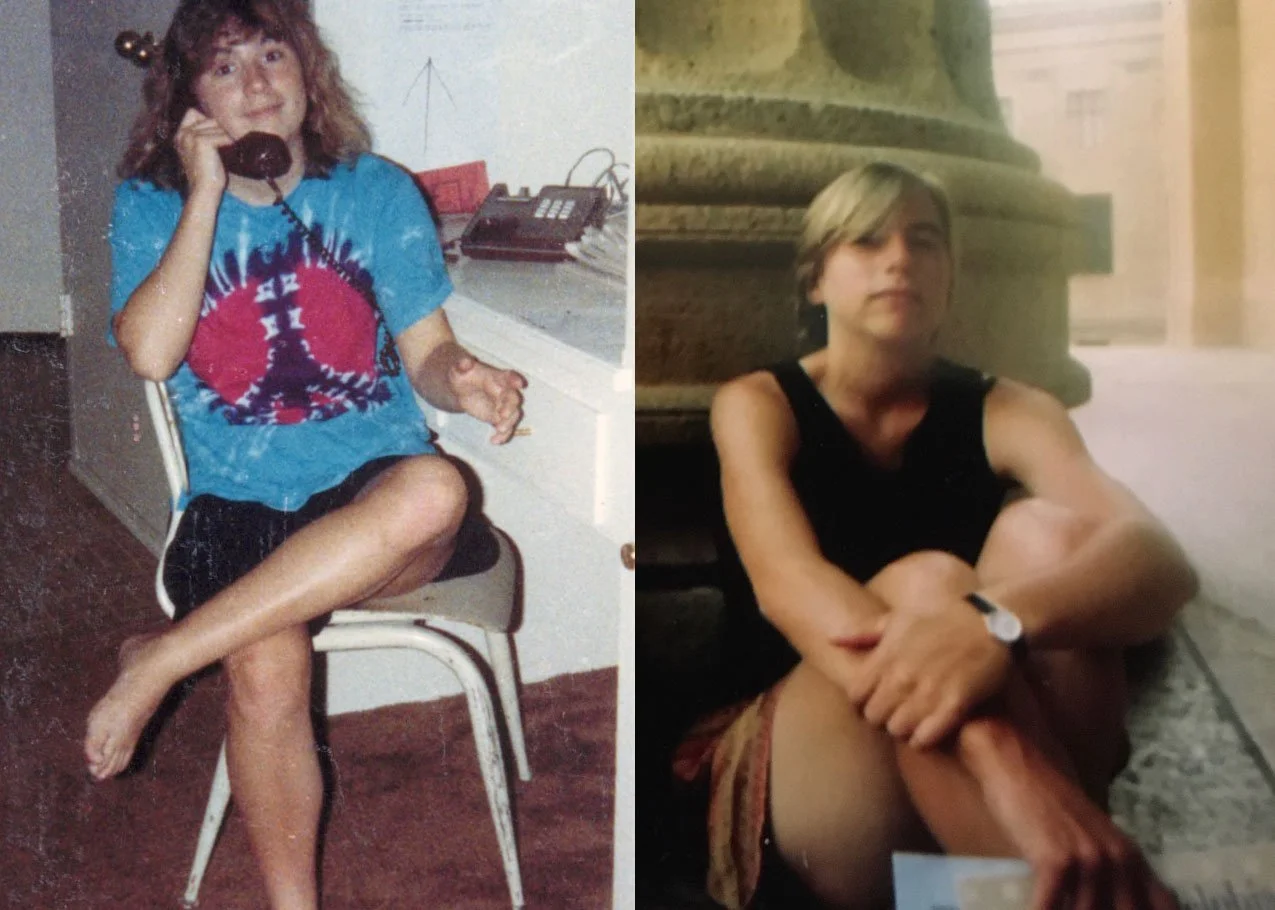
The before and after photos of the Elle affair: me at 19 and then at 27.
Molly McCloy is a four-time Moth StorySLAM winner and Lambda Literary Fellow. She won the Book Pipeline contest for Nonfiction and the Quill Prose Award for her memoir Nine Grudges: The Spiteful Origins of the Happiest Dyke on Earth, available for pre-order from Red Hen Press. Her work has been featured in O magazine, excerpted in the Blue Mesa Review and Foglifter, and broadcast on The Best of Risk! podcast. She earned an MFA from The New School and teaches writing for the awesome students of Pima Community College. Reveling in the bright sunshine of a joy she once thought impossible, Molly lives in Tucson with her wife Rebecca and their dog, Princess Pinwheels of the Purple Mountains. Find out more at mollymccloy.com