
No Matter Where You Choose to Be: Kristine Langley Mahler on Tim McGraw’s “Everywhere”
I am a terribly homesick person. The problem is that I’m homesick for so many places. I’m sick over my childhood home (Oregon) because my childhood felt idyllic, I’m sick over my adolescent home (North Carolina) because it taught me so much about myself I didn’t know I was learning until I was gone, I’m sick over my high school home (Indiana) because I finally felt like I belonged somewhere so firmly that I still can’t drum up enough drama about living there to write the essay I know I need to write to round out the book proposal I’ve been working on for over eight years (the book is already called HOME TRAP). I’m even homesick for the home where I’ve lived for nearly eighteen years now (Nebraska). Every time the plane passes over the Woodman and drops over the river I know like my own backbone, I’m flooded with happiness that I get to live here. I missed it so much while I was gone!
Home is a hum like the blood in my thumb that turns white when I press it, a pressure that goes back to normal when I release. What if I never release? What if I miss every home I’ve ever known; what if every home I’ve ever known holds the potential lives I did not get to live and they’re running parallel right now—I’m running parallel to myself, a vision of who I might have been and was on my way to being but did not become because I left? All I ever wanted was to stay at home—all I ever wanted was a partner to stay at home with me. Tim McGraw’s “Everywhere” is one of the most devastating songs I’ve ever heard.
Not Michelle Branch’s “Everywhere,” not Christine McVie’s “Everywhere,” but the one that breaks hearts across the country: Tim McGraw’s “Everywhere,” about the everywhere that is the worst to face because it is a song about all the lives you did not claim.
I said it is one of the most devastating songs I’ve ever heard! And that is saying something, coming from someone who spent her teens crying to the crooning of Sarah McLachlan! Someone who absolutely refused, during the ‘90s, to hear the pain inside a country song! I thought country music was maudlin, a bunch of corny warbling about bad-hearted women and dogs that died and boots that didn’t fit anymore and how Daddy sold the farm!
But Tim McGraw sang “Everywhere,” a song about how he and his ex split up because he wanted to experience living in places other than their hometown, and she just wanted to stay at home. That premise—that she wanted to stay in the place she called home, and she could— broke me up on its own because that’s what I’d wanted too. I wanted to stay put in the places that I’d considered home. When I could not, I made each new place I lived into a “home” of sorts, but I never truly owned anywhere as a “home” until I left it. For me, home was always the place I could not be.
The narrator in “Everywhere” was born and grew up with his girl in “this little town,” and he says he was “counting every single day until we made our getaway.” The key point is that he was the one counting down the days—not necessarily her—but he thought he would leave with her; he called it our getaway.
She refuses to leave, the girl. She says she “could never see [herself] trying to make a life anywhere else—this would be [her] home.” The second key point: trying. And so the narrator leaves town without his girl, though he tells her, “You would be surprised all the places you have been.” That line, delivered just before the first chorus, is kind of shattering in its kindliness, because the narrator is indicating that his (now ex-) girl is choosing to keep her life small by staying in the place where she’s from—though, honestly, I would argue she’s just doing the one thing nearly every other country song tells women to do, which is STAY HOME IN YOUR SMALL TOWN.
Tim McGraw sings, “No matter where you choose to be, in my heart I’ll always see you everywhere.”
He left their hometown and, in doing so, also left her, but he can’t stop thinking about the life they didn’t have together—and yet he cannot return to her because he wants more for his life outside of the place where she chose to stay.
The key word: chose.
As I just mentioned, there’s a trope in many country songs—sung by men—about how their women leave home, but wisely come back to settle down with their man who stayed behind. He’s always happy to welcome her back in—she got her taste of city life, but she had to learn there’s nothing quite like the place where you grew up, the place where people know you.
I listened to those songs for decades, vacillating between my annoyance that a girl couldn’t just leave a place without everyone hollering OH YOU’LL BE BACK! and, quietly, rocking through my utter emotional wreckage because I could never be one of those girls. I had forfeited that by moving once, then compounded my loss by moving another handful of times. And I was certain no amount of reclamation—or attempted reclamation—of the places I called home would ever make those who never left welcome me back like a prodigal.
“Everywhere” is a distillation of the damage I did to myself, imagining what would have happened if I had stayed in one place (WHICH WAS WHAT I WANTED!) and married my childhood sweetheart (WHO NEVER EXISTED!). “Everywhere” is also a cereal box prize pulled out by my college sweetheart (WHO I DID MARRY!) when he introduced the song to me in the midst of my (unvoiced, unshared) severe panic that he was going to leave me for an ex-girlfriend.
He did not leave me for her, but he began to tell me, years later, once we were comfortable and settled and committed and must have agreed that we could talk about these sorts of things now, that he had thought of breaking up with me when we were in college. And that he thought I would not have been able to handle it well, and that’s why he didn’t.
That was disturbing to hear from my partner, who I’ve known for 24 years of the 43 years I’ve been alive. It perturbed me to hear him talk—to me—about a breakup—with me—that he did not carry out, because he wasn’t telling me about it in a way that made me insecure about our future, or that made me think that he was telling me about his college breakup plan to feel me out because he was planning on divorcing me. My partner brought it up so matter-of-factly that I thought I must have somehow blanked out certain parts of our early years together. Even though I remembered recording them into my memory because, at the time, I thought I would need to, I would need to remember them so that I could injure myself with those memories later because he was the love of my life and I knew he always would be.
But he talked about not-breaking-up with me like I knew he’d thought about it, which I did not know.
I feared most of all, during those early years, that he would break up with me and he would return to the girls of his hometown, the girls he had known growing up, the girls I could never be simply by the obvious vagaries of life placing me where they did and placing him where they did, and us not meeting until we were nineteen years old. Yes, I know that sounds like we basically did meet each other during our childhoods. We basically have been childhood sweethearts.
But it’s not the way that I envisioned a childhood sweetheart, not the fantasies that I had of being one of the sort of long-time hometown loves they talked about in those country songs. I write about them all the time, those phantom girls of hometowns I did not get to become, because they are the realest and truest representations of a person I thought I could have been. I resent that those girls do exist for my partner. I abhor that I could not be a childhood sweetheart for anyone. When Tim McGraw sings about missing the life he didn’t have with a girl whose memory he brought with him everywhere on the road, it makes me sad because I think about the girls whose memories I have brought on the road with me; girls who don’t really exist the way I imagined that they did; girls who don’t, actually, have the meaning to my partner that I thought they did, and it makes me so sad to remember how hard I used to injure myself imagining they did.
“Everywhere” is one of the saddest songs I have ever heard because it reminds me of how scared I was. I wrote a lot about one of my partner‘s former girlfriends because I did see her everywhere: I saw her in our apartment (old letters between the two of them, stashed in boxes), I saw her underwear in my partner’s childhood bedroom (found in his desk drawer), I saw her name on Amazon with the Klutz book that she apparently co-wrote (yes I Googled her, DUH), but most of all I saw her name on an email left open on the computer in my own bedroom two months before my partner was supposed to move with me to Omaha; he had asked his ex-girlfriend if he was doing the right thing by going with me and not hunting her down instead.
I carried her with me everywhere, I carried her with me for such a long time that even when I stopped, I felt her.
I did not think this essay was going to be about her. I did not think this essay was going to be about my partner. I thought it was going to be another essay in which I moan about home and how much the concept of a home hurt me, because that was the version I had started to write.
But she came creeping in, like she always did, And when I was voice-texting to myself—not feeling subconscious about the way the words looked on the screen because I couldn’t reread them to myself; I was driving up I-680 to pick up my second daughter from high school and holding the phone up to my lips because this is the main way that I write now; when I’m at home, I’m too self-conscious, when I’m at home, I’m doing other work—I started thinking about that girl, and the memory that comes through when I also think about Tim McGraw in “Everywhere” taking a girl with him everywhere, whether she wanted to come with him or not. That girl came with me everywhere. I wanted her with me.
I wanted her with me very badly because I wanted to use her both to injure myself and to create a shadow-girl upon which I could blame any failures of my relationship with my partner. I had been wronged, and it excited me to be actively wronged. Because that meant anything I might do to injure him, or to irreparably damage our relationship myself, could be traced to the real wrong—which had occurred to me, undeniably, when he sent an email to his ex-girlfriend!
And yet. I lost the moral high ground over the ensuing years because I absolutely emailed my ex-boyfriend and tried to keep something alive there. I felt like I had earned it, I felt like my partner’s behavior justified mine. Especially because I wasn’t asking my ex anything like “should I still be with my partner?” and because, when my ex finally wrote me back, I wound up deflecting insults he made about Omaha, the place I chose to live with my partner.
It was awful because I still saw my ex-boyfriend in many places where I traveled with my partner. My ex-boyfriend and I had never even traveled anywhere together! We were sixteen and sixteen when we ended! But there was a line in the James Taylor song about “kissing your existence goodnight” that my partner once heard me sing along to, and it had prompted him to ask me if there was anyone whose existence I still kissed goodnight. I told my partner of course, of course, all the people I’ve ever loved, but I was uneasy because at that moment I had been, actually, thinking about my ex-boyfriend.
In “Everywhere,” Tim McGraw says, “Nowadays when I’m passing through, the conversation always turns to you; I hear you’re doing fine, living out by the county line.” It must be acknowledged that I passed through my ex-boyfriend’s hometown for years on my way to see my parents, as I wrote about in another Xness extracurricular. Yes, it is the same ex-boyfriend. And after he left his hometown, I tracked his whereabouts down for years. I will not tell you everything I know about him now because I do not want anyone to know how much I know about him now, it embarrasses me to know it all myself.
The narrator in Tim McGraw’s song passes through their shared hometown, but he does not go see his ex. He talks about her with someone else, perhaps at a bar a few blocks away from her house. My ex-boyfriend once emailed a crumb of his life to me, mentioning in passing that he would be taking a train to Colorado to go skiing. I knew which train—that train traveled along the track three blocks away from my house in Omaha. I wanted to tell my ex that he would be that close to me, but instead I wrote him a mean email because I was still hurt that he did not see me everywhere. My ex was on his way to a town near Telluride—another Tim McGraw song that absolutely slays, another Tim McGraw song about a love that ended, a nineteen-year-old working at a local bar belting out, “It was a dream we were living in, I was the happiest I’d ever been!” When I was nineteen, my partner and I had begun learning each other, and it was the happiest I’d ever been—we drove to Denver, we drove to New Mexico, we had all those sleepless nights because we couldn’t stop talking to each other (we still can’t).
My ex-boyfriend and I could not find anything to say to each other when we were together; I used to try to fill the void by kissing him, but even that veneer wore thin.
It is so sad it is to hide from yourself how little a person ultimately meant to you, how sad it is to keep your claws hooked on a fantasy of what it had been like.
What do I do with my desire to have someone pining for me, and my concomitant desire to only be with the partner I love?
I wanted the pain of believing a person was out there in the world thinking of me, but I did not want to become my partner’s ex. I wanted the pain of being that person out there in the world thinking of an ex, but I did not want to be the leaver.
So I decided to believe, instead, that my partner was thinking of someone else. He had left a breadcrumb trail and I followed it right back to the fears that I kept secret from him.
I am doing fine now, and I am, actually, living out by the county line. I do have a man that’s home every night; I’ve got a couple of kids and the kind of life I always wanted to lead. I am living out almost every part of my fantasies about what my life would look like one day, so much so that it scares me sometimes because I am waiting for the other shoe to drop, for someone to swell orchestral and remind me that even though he and I made our choices all those years ago, I’ll still see her everywhere.
I thought of myself as Tim McGraw, that I would be the one leaving my partner behind in his hometown. My ex-boyfriend stayed in his hometown for another decade after we split apart; my partner spent the first ten years of our relationship magnetized toward his hometown, a place I did not want to live. I was prepared to carry them both with me, and to warn them that no matter where they chose to be, I would carry them with me anyway, I would see them everywhere. It was the best threat I could think of—they could not stop me! It was the best threat I could think of because it was the most painful to me: they got to be the ones staying in a hometown.
They would be floating on every highway just behind the high-beams, only for me, only I could see them. That would be the best way to carry them with me because I would never have to confess it. Carrying a ghost of a memory with you is the best form of masochism because the phantom never gains visibility, and so you get the double pleasure of the pain itself, and the pain at having an injury no one knows to ask about.
In “Everywhere,” I still wince at the break in the line “Dallas, Texas: isn’t that where we/always said we would like to try? Never did, so maybe that’s why.” When Tim McGraw says “Isn’t that where we/” it is where the song splinters, because the narrator turns to face his ex directly—he asks her a question, and he does not wait for the answer.
It’s the possibility that lingers before the rest of the line—what could exist after “isn’t that where we—” and then the horrible heartbreak of the admission he makes: at one point, they dreamed this dream together. We always said we would like to try. It was, once, the two of them. But she changed her mind.
I knew I would write this essay for “Everywhere” long before my number wasn’t called for the Sadness tournament. I started voice-texting it to myself on my regular Sunday walk on the day when the March Sadness lottery was being drawn. It is a walk I take every Sunday: I listen to my astrological forecast, and I think about the future and what I can bring to it. My partner and daughters were at home working in our yard, cleaning up the nectarine branches I’d lopped off the tree, picking up the fallen apples that were still dropping even though June drop was long over. They were tending our home, those people who, if I ever left, I would see everywhere.
That sounds too misleading. I don’t ever want to leave them.
I love my partner and my daughters tremendously, and the four of them anchor me in a way I never imagined; I never thought I would be anchored to anyone more strongly than I was to my own parents and siblings. I should not be thinking about leaving through the Final Exit—I am only 43 now, but I’ve been reading Edward Abbey‘s Desert Solitaire, and I’m bothered by how lightly he treated death and the end of one’s life; how he wrote that when it’s your time to go, you should be grateful if you do it somewhere other than in a hospital room tied up with tubes. But I like hospital rooms. They make me feel safe—they make me feel like someone will keep me here.
I feel my mortality desperately. I am not afraid of physically dying—that part does not scare me; I know that the greatest relief sits on the other side because I will no longer have the unpredictability of death to fear. But I am so terrified of leaving my children without a mother that I will do anything to stay alive for them. Long past when they are teenagers, long past when they have established their own families or communities, I will not want to leave them because one of the things I fear most is my own parents’ deaths. I cannot imagine being alive without my parents. I would see them everywhere.
My best friend from high school‘s father died ten years ago. I took a flight to Indianapolis, and my best friend drove an hour over to pick me up. I still cannot imagine what that must have been like for her, having to perform regular duties when grieving, but she did it because she wanted me with her. On our way back to Terre Haute, a shooting star fell on the road right in front of us. We both saw it clear as day. Even though it was night. We either said at the time, or we said later, because we were both thinking it, that the shooting star was sent from her father.
Ever since then, whenever I see a shooting star, I think of her father. Ten years later, I still see him everywhere. I cannot imagine how often she sees him if I still see him this much.
Is there anything worse than seeing someone you loved everywhere?
Is there anything better than seeing someone you loved everywhere?
I see the places I have lived and loved everywhere. I see versions of myself that I didn’t grow into, and they are walking down the street in one of my old neighborhoods, pushing their children in a stroller, they are stopping to talk to a neighbor, they are raking leaves in their front yards. I see them because I do literally return to the places where I once lived so I can injure myself with memories. But the worst part is that I am always eaten alive with envy when I see people in the parallel lives I felt were stolen from me. I had consoled myself by believing that time moved everybody forward.
I’m more glad than ever to be writing an extracurricular instead of a tournament essay. I don’t know how you’re going to do it—pressing down on your pain to show that the blood takes the longest to come back from your bruise, which is your song, which is the Saddest. How can I argue that I miss home most of all when every memoirist in the world already knows the term “nostalgia” means home-pain, every memoirist who memoirs will, at some point, cite 1688 and Johannes Hofer and the homesick soldiers who nearly died because they were so sad that they weren’t home. And then there’s me, and my sadness about my nostalgia is so much more poignant because ______.
I see all the homes I have lost everywhere. I see myself trying to make a life anywhere else. I see his ex and my ex, and they would be surprised all the places they have been. I see my partner and my daughters driving across the prairie. I see me everywhere, because everywhere is where I choose to be.
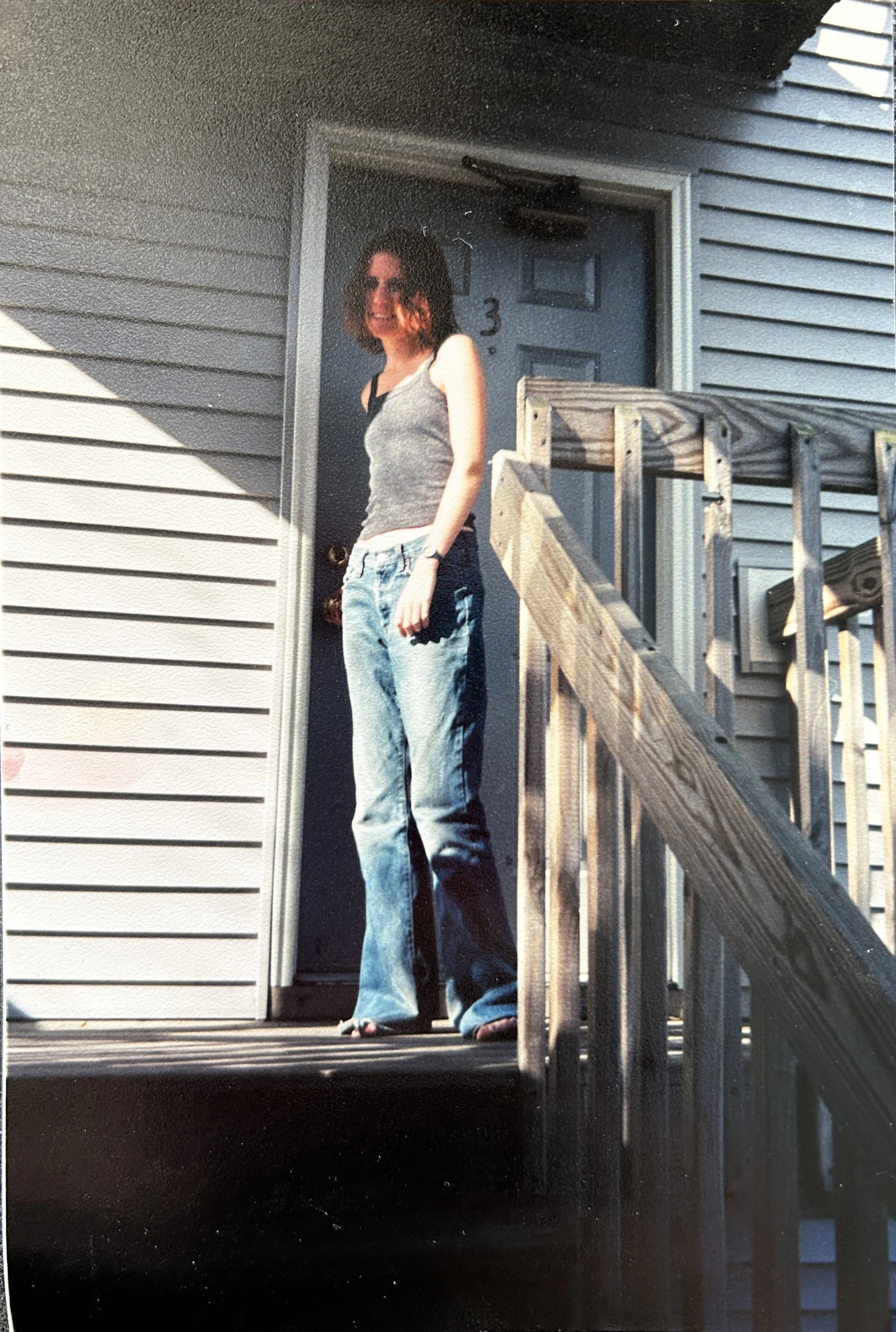
A memoirist obsessed with home who just broke her own rule of never mentioning Hofer in an essay, Kristine Langley Mahler is the author of three nonfiction books: Teen Queen Training (forthcoming February 2026), A Calendar Is a Snakeskin, and Curing Season: Artifacts. Find more about her projects at kristinelangleymahler.com or @suburbanprairie