
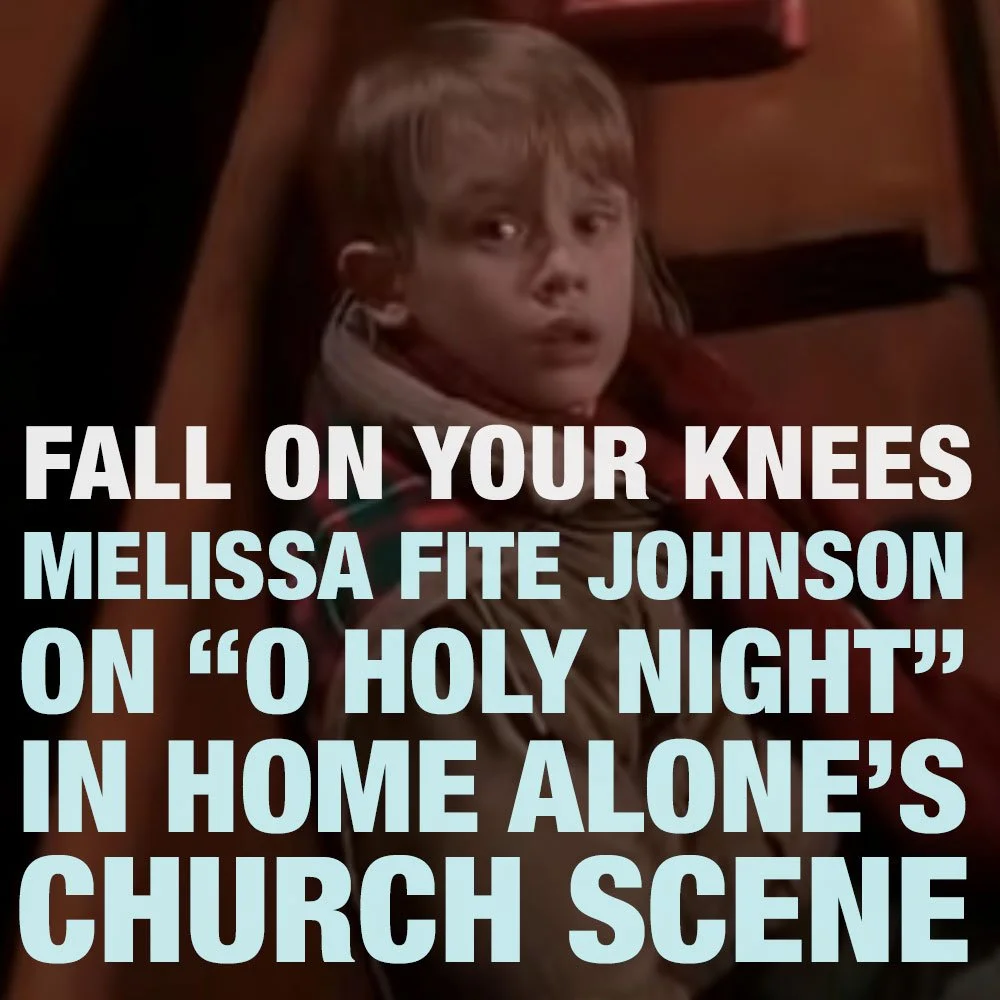
“Fall on Your Knees”: Melissa Fite Johnson on “O Holy Night” in Home Alone’s Church Scene
My introduction to the concept of estrangement was Home Alone. Macaulay Culkin is one year older than I am, so I imagine we were the same age when he filmed the movie, the same age when he filmed the scene in the church. In 1990, we sat facing each other—Macaulay as Kevin McCallister inside the screen, in a pew beside character actor Roberts Blossom; me below the screen, in a theater seat beside my mother. Neither of us understood what Old Man Marley was telling us about why families sometimes fall apart.
*
The scene begins outside the church as Kevin walks by slowly, kicking at the snow. When he hears a children’s choir faintly singing “O Holy Night” inside, he stops. He swivels around and looks in the direction of the church. At what exactly, it’s not clear—maybe the enormous stained glass window or the ornate door, both evoking an invitation. Maybe the nativity scene on the lawn, the suggestion of family he’s finally admitted he misses. The camera stays on his face for a full eight seconds; after the first three, he looks down and almost takes a step forward, but then he stops and stares for five more. In a film only around 100 minutes long, a film for kids and their short attention spans, the choice to linger on Kevin’s face here fascinates me. All his sarcasm, all his pretense and bravado, has gone. This isn’t Macaulay Culkin hamming it up, literal slapstick, hands smacking his face as he sounds his aftershave yawp all over his house. This is a reverent moment in which a child’s thoughts and feelings are taken seriously. After silently weighing whatever it is he’s weighing—the film never spells this out, which I love—he trudges a path to the door.
When he walks into the back of the church, the camera isn’t on him but the children’s choir. Outside, “O Holy Night” was a quiet song he—and the audience—had to strain to hear. Inside, it’s a powerful swell, his entrance timed with the line “Fall on your knees.” Kevin looks especially small framed in the back, and then when the camera catches up with him, his expression is so world-weary it’s almost startling. The way he smooths off his gloves, bows to remove his hat—these are the gestures of someone much older. As he walks to take his seat, we flash back and forth—the camera on him, then inside him. We look through his eyes at statues and painted glass. He doesn’t seem to be regarding it all with wonder, but with a heaviness kids his age are not yet meant to know.
Kevin sits down, pulls at his scarf, and then senses someone watching him. He looks over his right shoulder and meets eyes with Old Man Marley, the neighbor his brother Buzz has told him is the South Bend Shovel Slayer. Suddenly, he’s a kid again. He gasps. His eyes widen. When Old Man Marley walks over only to say “Merry Christmas,” Kevin can’t hide his confusion. Already, he is learning some people are not what they seem.
*
Of course, I didn’t watch that scene so closely as a kid. At the time, I probably found it a little boring and was anxious to get to what followed, the surprisingly violent booby traps for the robbers that my friends at school had told me all about. While I remember loving that whole sequence—which my mother’s horrified expression revealed she hadn’t known about—my favorite moment in Home Alone was the hug between Kevin and his mother at the end. It was the part I could relate to, the part I understood best.
In 1990, sitting beside my mother on our side of the screen, we watched their tearful reunion erase everything that came before it—the cruel comments, the abandonment, all wiped from memory and meaning. This was how love worked. Sometimes my mother became angry and that anger turned her into someone else, someone no one outside our home saw, but I understood this wasn’t the real her. Just as Old Man Marley’s neighbors talked about him, our neighbors talked about my mother. Only they didn’t say she murdered people and kept their bodies in a garbage can full of salt to mummify them. They said she was the kindest person they’d ever met. From their front porches our neighbors saw my mother help my disabled father into our car’s passenger seat. At potlucks our neighbors hoped my mother would bring her famous oatmeal chocolate chip cookies. When I blinked and my mother broke plates at my feet because I forgot to empty the dishwasher, I knew I only had to blink a second time and she’d be herself again, smiling with tears in her eyes and reaching for me like Kevin’s mom at the end of the movie.
*
After Old Man Marley asks to sit with Kevin, he points to a red-haired girl, his granddaughter. For a moment, we hear her voice above all others. While the rest of the choir gazes straight ahead, the old man’s granddaughter looks right at me, right at Kevin. For a moment Kevin and I are on the same side of the screen.
Old Man Marley tells Kevin he doesn’t have to be afraid. He says, “There’s a lot of things going around about me, but none of it’s true.” He explains he’s there watching the choir rehearse because he won’t be invited to see his granddaughter’s real performance that night. He’s not welcome. Kevin asks, “At church?” Old Man Marley clarifies that he’s not welcome with his son. He says, “Years back, before you and your family moved on the block, I had an argument with my son…We lost our tempers, and I said I didn’t care to see him anymore. He said the same, and we haven’t spoken to each other since.”
Kevin asks the same question I would have as a kid: “If you miss him, why don’t you call him?”
Kevin and I loved our mothers, and our mothers loved us. Neither of us questioned this, and the movie takes great care to show he is right not to question it. Kevin is home alone not because of neglect, but because of a series of mistakes. A power storm. A sleeping arrangement. A neighbor’s head counted instead of Kevin’s. No one’s fault. He is only unsafe in his home when his parents aren’t there. When his parents are there, he can say he wishes they would disappear and his only punishment is to sleep in the attic. When a child associates family with safety and love, estrangement doesn’t make sense. If you miss your family, why wouldn’t you call them? I wondered this right along with Kevin, and I had reason to know better. In real life, we both did.
We don’t see Old Man Marley call his son, but he must. He has a tearful family reunion of his own outside his home, which we witness through Kevin’s eyes and living room window. The position Home Alone takes on estrangement is clear. Kevin says in the church, “No matter how mad I was, I’d talk to my dad.” But in real life, Macaulay Culkin hasn’t talked to his father in more than thirty years.
Kevin doesn’t ask the questions I’d ask now:
What was the fight about?
What made you and your son lose your tempers?
Does your son finally understand that your anger doesn’t actually turn you into someone else?
*
Tonight, listening to “O Holy Night” on the Home Alone soundtrack, I place my mother and me in the church pew inside the screen, layer us over Roberts Blossom and Macaulay Culkin, an action that reminds me of when my elementary teachers accidentally placed two transparencies at once on the overhead projector. Some of Old Man Marley’s and Kevin’s lines bleed into the conversation I imagine my mother and I having, three years after our estrangement:
My mother: You can say hello when you see me. You don’t have to be afraid.
Me: I’m not afraid. But I don’t care to see you anymore.
My mother ignores that remark, changes the subject. As Old Man Marley points to his granddaughter up on the altar, my mother points to me.
My mother: You’ve been good this year?
Me: I’ve been good every year of my life, but you made me feel I wasn’t.
My mother: Well, this is the place to be if you’re feeling bad about yourself.
Me: I’m not feeling bad about myself.
My mother: I don’t know why you wouldn’t feel bad. It’s Christmas, and you won’t even call your own mother.
Me: You pretend you don’t know the reasons I won’t call you, but you know why. Are you feeling bad about yourself?
My mother: No.
As Old Man Marley and my mother talk, they are turned toward us, their heads lowered to us, conspiratorial. Kevin and I look straight ahead.
My mother: How you feel about family is a complicated thing.
Me: “Complicated” was the word I used for us because I was too afraid to call it abuse.
My mother: Deep down, you’ll always love me. But you can forget that you love me.
Me: I haven’t forgotten. But the way you love is destructive.
My mother: You can hurt me, I can hurt you. That’s what love is. You better run along home where you belong.
Old Man Marley and my mother extend their hands. Kevin takes his and shakes. I don’t. Instead, I look at my mother for a long time, my own eight-second scene. It’s not clear what exactly I see or what I’m weighing, only that this is a reverent moment in which a daughter’s thoughts and feelings are taken seriously. Kevin and I stand and fasten our scarves tight against our necks. He smiles and tells Old Man Marley “Merry Christmas.” I don’t smile, and I have nothing left to say. We both walk, then run at the church bell’s ring, up the aisle, out of the church, away. The children’s choir is singing “Carol of the Bells” now, with its insistent rhythmic conviction. “O Holy Night,” with its chance of forgiveness and redemption—falling on our knees, feeling a thrill of hope for a new and glorious morning—is over. It has actually been over for a while.
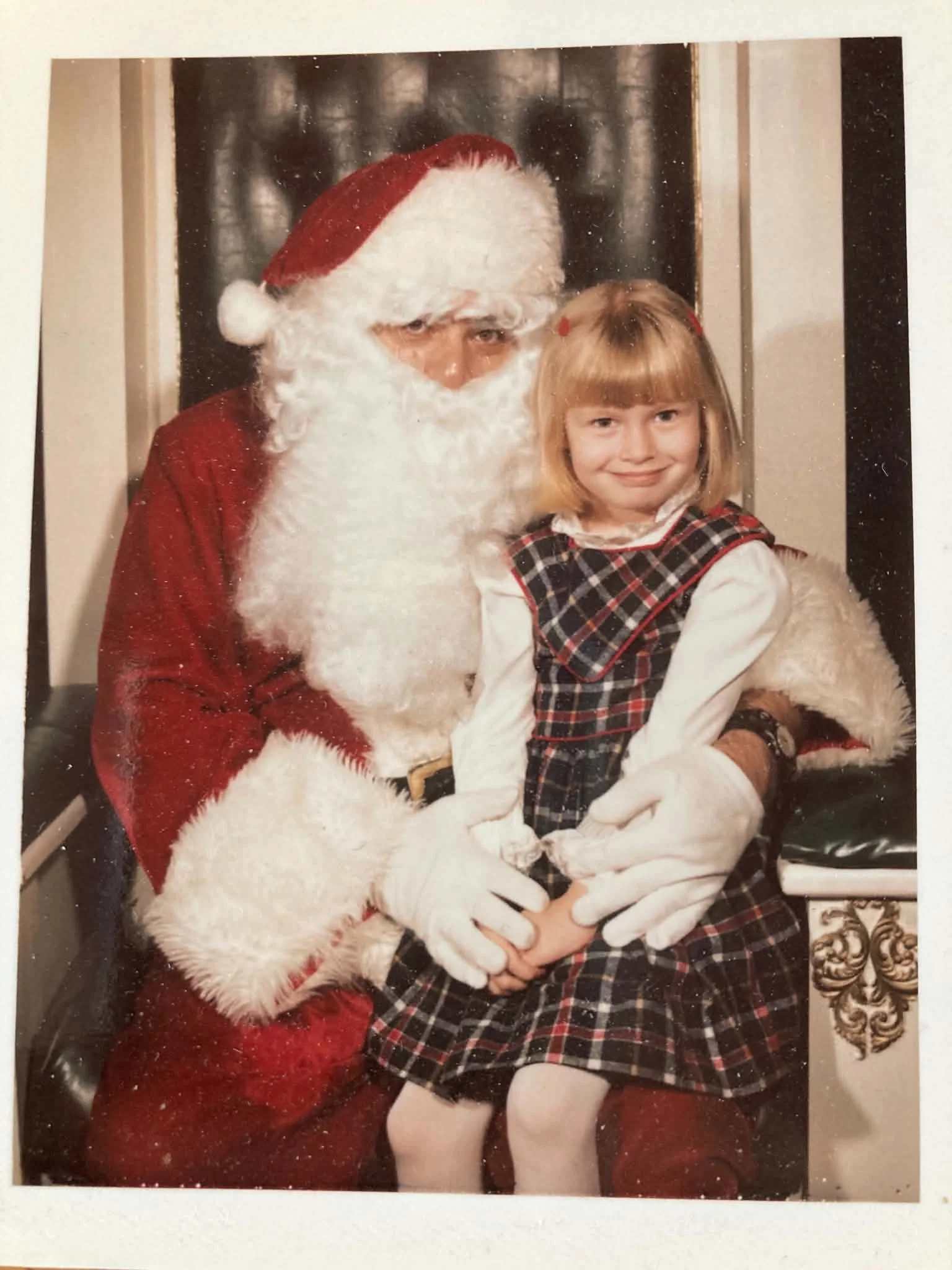
Melissa Fite Johnson is the author of three poetry collections, most recently Midlife Abecedarian (Riot in Your Throat, 2024). Her work has appeared in Ploughshares, Pleiades, The Southern Review, Poet Lore, DIAGRAM, and elsewhere. Perhaps most importantly, she is the March Sadness 90s champion for her essay on Celine Dion’s “My Heart Will Go On.” Melissa, a high school English teacher, is a poetry editor for The Weight Journal for high school students, and the co-founder of a new pop culture-centered journal, Forget Cool. She and her husband live with their dogs in Lawrence, KS.