
sweet 16 game
(3) Counting Crows, “Round Here”
vs
(10) Wilco, “Via Chicago”
Read the essays, listen to the songs, and vote. Winner is the song/essay with the most votes at the end of the game. If there is a tie, we will play a one-hour overtime (and repeat until we have a winner). Polls close @ 9am Arizona time on 3/20/26.
A Ghost into the Fog: Melissa Faliveno on Counting Crows’ “Round Here”
Lately, I’ve been watching the crows. When the mornings are warm, I sit on the front porch of my little house in the woods, drinking coffee, watching from a white wooden rocking chair. When it’s cold, I watch from the living room window, in an old cat-shredded chair that’s crossed several state lines, said cat and her claws curled in my lap. This morning, I watch from my office, and the cat watches too, her little black paws on the windowsill. She’s black like the crows, and nearly the same size. The crows are huge. Together we watch them, their big, black bodies poking along the ground beneath the feeder, their iridescent feathers flashing indigo in the sun. Sometimes, if they get so bold, they jump onto the feeder, making it sway wildly beneath their weight, seed spilling for their friends. They’re social creatures, the crows; they move in packs, they talk to each other, their sounds filling up the still morning air.
It’s a little on the nose, but some days I count them. Some days there’s a half-dozen in the yard. They show up early, before the rest of the birds, and any movement startles them. They rise up in one great, winged mass, swinging high into the loblolly pines. Today, there are only two, pecking beneath the feeder, and I notice how close they stay to each other. One will wander a few paces away, to see what treasures await in the deeper woods, but always circles back. The crows are never alone.
My mother once told me that if you feed the crows, they’ll bring you gifts. Shiny objects like feathers and stones, things that flash like they do, bright in the sun. I’ve been sitting here on my porch, at these windows, trying to play it cool, waiting to see if they’ll bring me something shiny, decide I’m a friend.
When I started watching the crows it was fall, a season that comes late in North Carolina, where I live now. The trees turn only a muted brown, not the bright reds and yellows of home. It was Halloween, and I sat on the porch with a cauldron of candy, leaning fully into my crone era, waiting to see if the kids would come, thinking about the Halloweens of my Midwestern past, bundled up in winter coats over costumes, traipsing through snow. The kids didn’t come, but the next morning the crows were back. And now, somehow, it’s winter, and time is slipping by fast. But the sun is out, and the weather is mild, and I’m watching the crows, and I’m thinking about home. About the last time I went back, in August, a season when the windows of my childhood bedroom are always open, and the morning breeze blows in, and I get up from bed and sit on the deck with my dad. My mom sleeps late these days, so it’s just me and him, drinking coffee, not talking much, listening to the birds. My dad likes to mimic them, and does a good impression. On the ground, the crows hop around in packs. Some birdsongs are sad—here the mourning dove, whose low cry sounds so much like longing. But the crows don’t sound sad at all. They caw and caw, calling to each other, a community whose collective word feels far too violent for its nature. Sometimes their calls might sound like warning, sometimes they sound a little insane. But most of the time, they sound happy.
When I was a teenager, I was sad. Like many teenagers in semi-rural small-town America, I also spent a lot of time driving around. Mostly at night, and in my memory almost always listening to Counting Crows. In particular, their 1993 platinum debut, August and Everything After. Sometimes I drove with friends—we’d spin around the backroads, which roped out beyond our little town, snaking between cornfields, then back down the single-stoplight Main Street—waiting for something to happen. To find a party at someone’s house, or at the rock quarry outside town. Back before anyone had cell phones, we’d drive with the windows down, shouting to other kids as we passed, pulling up to packs of cars idling at the Cenex, trying to find something—anything—to do. Something—anything—to be, other than what we were.
But most of the time, I drove alone. At night, heading anywhere or nowhere, I’d pass the turn to my house and keep going. Drive out beyond the town limits, where the streetlights end and the houses turn to cornfields, where the hills and trees stretch on forever. I had a destination, where I slowed but never stopped, winding in sharp S curves down to a valley, dense with fog at night. I’d slow down and look in my rearview, up to a house on the hill, then press on. I’d pull over a few miles up the road, turn around and pass the driveway again, wondering what life might be like up on that hill, inside the yellow house, which you could see from the road back then, soft light burning in the windows against the dark.
What feels arguably stalkerish now felt like desperation then: colossal, compulsive, all-consuming. Sometimes, on that drive, I listened to This Desert Life—Mrs. Potter’s Lullaby another sad song we both loved, me and the man who lived in that house, and I put it on a mixtape for him. But it was that first album that played most in my Chevy Cavalier—an album so sad, so full of longing, I could wrap it around me and wear it. I could sing along with Adam Duritz, his voice sadness and longing incarnate; I could sing and cry with the windows down, where no one could hear, my voice swallowed up by the cool Midwestern night.
Round here, I’d sing, she’s always on my mind. Round here, we’ve got lots of time.
I knew we didn’t have time. That time, in fact, was spinning on, and soon I would be gone; that I’d leave this town, and the man inside the house on the hill—who I loved so much and shouldn’t; who I loved so much I thought I’d die; who I loved before I knew what love really was. That I’d leave my home, and the house in which I lived, a house defined back then by sadness and silence, which I couldn’t bear to be inside. And I would find a new home, a new life, somewhere far away.
“Round Here” is a song about Los Angeles, but it could be a song about anywhere. It’s about a girl, Maria—who shows up in several Counting Crows songs, a composite of a real girl Duritz knew and of Duritz himself—who goes to LA to be someone. Maybe it’s a song about the crush of desires and dreams. Maybe it’s about leaving home. Mostly, I think, it’s a song about being deeply sad, and deeply unwell; about how both can create a distance so vast it might never be crossed, how the loneliness on the other side of that chasm can eventually kill you.
I grew up in one place, but I’ve lived far away, in several places, for a long time. I find myself, these days, writing a lot about distance. Duritz, who moved around as a kid and spent a lot of time driving across the country, writes about distance too.
“I’m obsessed with the scope of this country, the sheer size of it,” he said in an interview with Route magazine. “What it takes for people to cross it. The distances people will go to be with each other, and the distances people will go and be separated from each other.”
For Duritz, who long suffered from depression and dissociative disorder, his songs are also about isolation, disconnection, and the desire to connect.
“By the time I got into adulthood,” Duritz said, “I didn’t really have a sense of myself outside of the here and now. Like, this is where we are, and the future seems very uncertain; the past seems like a blur that has no permanence…. I looked for ways to get out of the solitude and connect with people. When you write a song you feel like it could connect with everybody, which might connect you with somebody.”
Round Here is a song for anyone, anywhere, who’s ever found themselves on the other side of the chasm. For anyone who’s tried to carve out their name—in some new place, in some new life—in the hope they might be found. Like we did when we were kids, in the trees of the woods near my house, with our Swiss Army knives, carving letters in bark, circling our names with another in a heart, saying We were here. Or, Come find us. Or, Please don’t forget us.
There’s a sadness specific to adolescence. Not every teenager is sad—I had a few happy friends, but their happiness was mystifying to me. I couldn’t talk to them about my sadness. My sadness—much like, I’d wager, any sad teenager’s—was a sadness far greater than any sadness before it. My sadness was a mountain, a massive looming thing I scaled alone. It was too big, too secret, too inarticulable for anyone to understand. I did tell one friend, eventually, a girl who knew sadness too. But she was the only one who knew.
Maria says she’s dying, through the door I hear her crying
Why, I don’t know
I listen to the song now, and try to access the sadness I felt then. But while I can locate threads of it—can’t you see my walls are crumbling?—I can’t quite pull the knot. I suppose it’s a gift, that I don’t feel sadness like I used to. That I don’t think about dying, like I used to. I know some people who still do, who white-knuckle it through life and eventually let go—their leaving itself a kind of sadness that threatens to pull me under.
The difference, these days, is that I eventually resurface. The difference is that I want to. When I was young, I swam in the deep end of sadness. I luxuriated in those murky waters, and whatever might dwell in their depths. I let my body go limp, liked the weight of the water as I sank. I liked the sinking. I sought it.
She looks up at the building, said she’s thinking of jumping
She said she’s tired of life, she must be tired of something
I knew that feeling once. I listen, try to find it, inhabit it again. I hear the crescendo and crash, Adam’s voice like a wave that breaks and he lets it. I try to sink with him, but just keep treading the surface. I play the song again.
It’s August—two Augusts after a person I loved very much let go, after I heard his voice calling across an ocean, and then he was gone—and I’m home in Wisconsin, the place we lived together, both a blink and a lifetime ago, when I still felt everything so deeply. I turn the volume up and roll the windows down and the song starts from the beginning, and I hear those first lonely guitar notes, the riff that echoes like a ghost through the song, but the distance just can’t be crossed. There are too many miles between then and now, and no matter how long I drive, I never get to where I’m going, can’t remember where I’ve been.
“A lot of my songs are about looking at things that have gone,” Duritz says, “trying to come to grips with what it means to have done something, and try and remember it, that a part of your life that is not here today, even just yesterday, but especially a year ago or ten years ago. What all of those things have to do with you now, because they never seem to leave you, but they’re also not here with you, you know what I mean? And I think that sense of displacement has just been embedded in everything from the beginning.”
When I think of Round Here, I have this image in my mind. It’s a cornfield in summer, and it’s dawn, and the fog hangs heavy above the stalks, suspended like a painting, like something permanent—not something that will be burned away by the sun. It could be Wisconsin or North Carolina, New York or Ohio, all the places I’ve lived, where I’ve seen this very image. It could be anywhere, in this vast country, where the same landscape passes as a highway cuts through it. Maybe there are two crows perched atop the corn, their bodies in mist, here and then gone. It’s melodramatic, I know. Maybe that’s the point. I hear the opening lines—Step out the front door like a ghost into the fog / where no one notices the contrast of white on white—and they feel a lot like this attempt to access the past, the feeling that lived inside it. I step out the front door like a ghost into the fog and try to peer back through time, but all I can see are pale yellow lines, the dark silhouette of trees, and in between the words—would you catch me if I’m falling, catch me if I’m falling?—I squint, but the fog is too thick. I can’t see nothing, nothing.
Counting Crows have released eight studio albums, but it’s only the first three I loved—1996’s Recovering the Satellites is excellent, and 1999’s This Desert Life is perfect, both made of perfect sad anthems. But Duritz often speaks about the lasting impact of August and Everything After, and specifically Round Here.
“This is the song, to me,” he says. “The song that made the band. I think it’s what keeps people coming back for thirty years.”
It’s the song to me, too. It’s hard to pinpoint the saddest song on that saddest record—let us also give sad props to Perfect Blue Buildings, Time and Time Again, Raining in Baltimore, and Sullivan Street, the latter which was once my own sad favorite. It’s all the kind of sad that sinks into itself, and invites you to sink too; the kind of sad that says I’m almost drowning in her sea, and lets itself drown. But Round Here is so sad that sometimes I can’t listen. So sad I skip ahead to Omaha. So sad I can’t resist dipping my toe in the water anyway, and eventually step in.
The last Counting Crows CD I bought was their fourth, 2002’s Hard Candy, but I didn’t listen much. At some point, I stopped listening altogether. I’m not sure why. Maybe my tastes changed, and I got into indie rock, snobbishly eschewing the pop-rock of my past. Or maybe those first three records meant so much to me that I wanted to preserve them, and the sadness they allowed me to feel so fully—back when there was still a sharpness to everything, before time began to dull the edges. When music gave me the space to feel what I couldn’t feel elsewhere, by which I mean it made me feel less alone. I think of August and Everything After, and Round Here, like the fog that sits in the valleys, that settles above the corn, where the crows will perch at dawn—suspended across the distance—and hold onto everything I can.
It’s morning in North Carolina, and I’m sitting in my office, and the cat is on my desk, her head on my arm, her paws on the keyboard. I have to keep sliding them off the space bar as I watch the video, and she yells at me as Adam sings. Outside, the sun is coming in bright through the trees, and I can hear the crows in the yard. One for sorrow, two for joy. I’m watching the 1997 performance of Round Here at New York’s Hammerstein Ballroom, recorded for the live album Across a Wire. I’ve heard the recording, but I’ve never seen the video. It’s a nine-minute version of the song, which I normally wouldn’t tolerate, but time is passing quickly. As is common for Duritz’s live performances, there’s a lot of improvisation. He adds new lyrics, gets creative with rhythm. Like the band’s 1994 performance of Round Here on Saturday Night Live, which sent them sailing forty spots up the Billboard charts, it’s mesmerizing. It’s like jazz, watching Duritz sing. There’s something so alive in it. Maybe the kind of alive that knows death—knows how close we are to it, what a miracle it is to survive. Near the halfway mark, he offers a whole new verse—I was out on the radio, just starting to change / somewhere out in America, it’s starting to rain—and something is happening here, miles and years away from there. I can see the way he wore his sadness then, and I remember the way I did too, hoping for someone to see. I watch it move through his body and into the air, out to the audience, and he’s trying to tell them something, give them something of himself, hoping they’ll take it, hoping they’ll listen.
There’s another new line at end, and he repeats it again and again. And I’m sitting at my desk with the cat on my arm, and outside my window the crows are in the yard. They’re in the trees. I hear them calling.
Could you tell me, they say, one thing you will remember about me?
On that last trip home, in August, I meet up with three high school friends, including the one who knew my secrets, who knew sadness like me. We all played softball together back then, and we meet at the field on the hillside—in the summer ‘neath the sunshine, I am feathered by the moonlight, that bright refrain of Murder of One, the last, hopeful track on the album, playing in my head—and below us we can see the dugout and the chain-link fence through which we once threaded our fingers, the empty scoreboard and the sand and the ghosts of white lines between bases, fading in the dusk. There’s live music playing, and when the band wraps and the stage is struck, the town packs up and heads home. And as the sun sets, we stay.
We stay here on the hill, camp chairs in a circle, as the summer night turns dark. We’re wearing hoodies like we did in high school, though we’re over forty now, the chill working its way up our sleeves and into our skin, but we don’t mind—we’re here together, and we’re telling stories and laughing. At one point, I have to pee. There are bathrooms down the hill, the ones we used back then, adjusting our hair and makeup before games, but it’s too far away and far too dark, so I scuttle over to a nearby hill and squat, my friends laughing behind me, and it seems like no time has passed—like I’m seventeen and hanging out at the softball field at night, and my friends are threatening to shine the flashlights of their phones on me, though we didn’t have phones back then. And I jog back to our circle and we laugh some more, and then they have to get home and put their kids to bed, and we fold up our chairs and say goodbye.
And I drive back home the way I always did, down Main Street, through the single stoplight, and in the CD player is August and Everything After, and Round Here starts to play. I pass the bar where I worked, the house where I went to a party and remembered nothing—round here, we always stand up straight / round here, something radiates—past the antique shop and gas station, then left on 78. Past the cemetery and funeral home, the streetlights few and then gone, past the turn to the house where I grew up, past the cornfields and into the trees, the route I know by heart. I follow the S curves and Adam sings into the night, and I sing along—I walk in the air between the rain through myself and back again / where? I don’t know—and the windows are down and the music is loud, and I’m trying to find the feeling, the longing that was bone-deep, blood-deep, that pulsed to the rhythm of my own young and beating and brightly living heart, hammering against my chest like morse code, shining in the dark like a lighthouse, like a beacon calling into the night, waiting for someone to call back. And in that call, a longing to be seen, or loved, or saved, or known. More than anything, I think, to be taken care of.
I fly down the hill and into the valley, where the fog sits heavy and thick—exactly where I knew it would be, exactly where I left it. I glance in the rearview as I pass—she walks along the edge of where the ocean meets the land—then pull over on the shoulder and turn around. I drive past again, one last time, peering through the dark and up the drive. But the trees have grown over now, and I can’t see the house at all.
So I head back the way I came, winding up the S curves again, past the house where a girl who was once my best friend lived, where her dog was hit by a car that day when we were twelve, before we disappeared from one another’s lives for reasons I no longer remember. I drive on, Adam’s voice high and lonesome like wheels on the road—she says, it’s only in my head—which has been newly paved, the old gray asphalt now shiny and black, the yellow lines bright against my headlights. I drive on, and wonder if these roads and this place remember me like I remember them, or if my leaving has become permanent, the memory of me gone, a distance too far to cross, and I’m just another name etched into a dying tree, a ghost into the fog, drifting around these back roads, past these cornfields, where in the morning the crows will perch upon the stalks, just like they do where I live now. I drive on in the dark until the streetlights come, and the town where I grew up is almost in view, and Round Here is playing loud, and Adam is trying to tell me something, and I know I can hear it if I just listen closely enough, but as I get to the old neighborhood I roll the windows up and turn the volume down, and I flip on my signal and turn, like I always eventually do, down the road that takes me home.
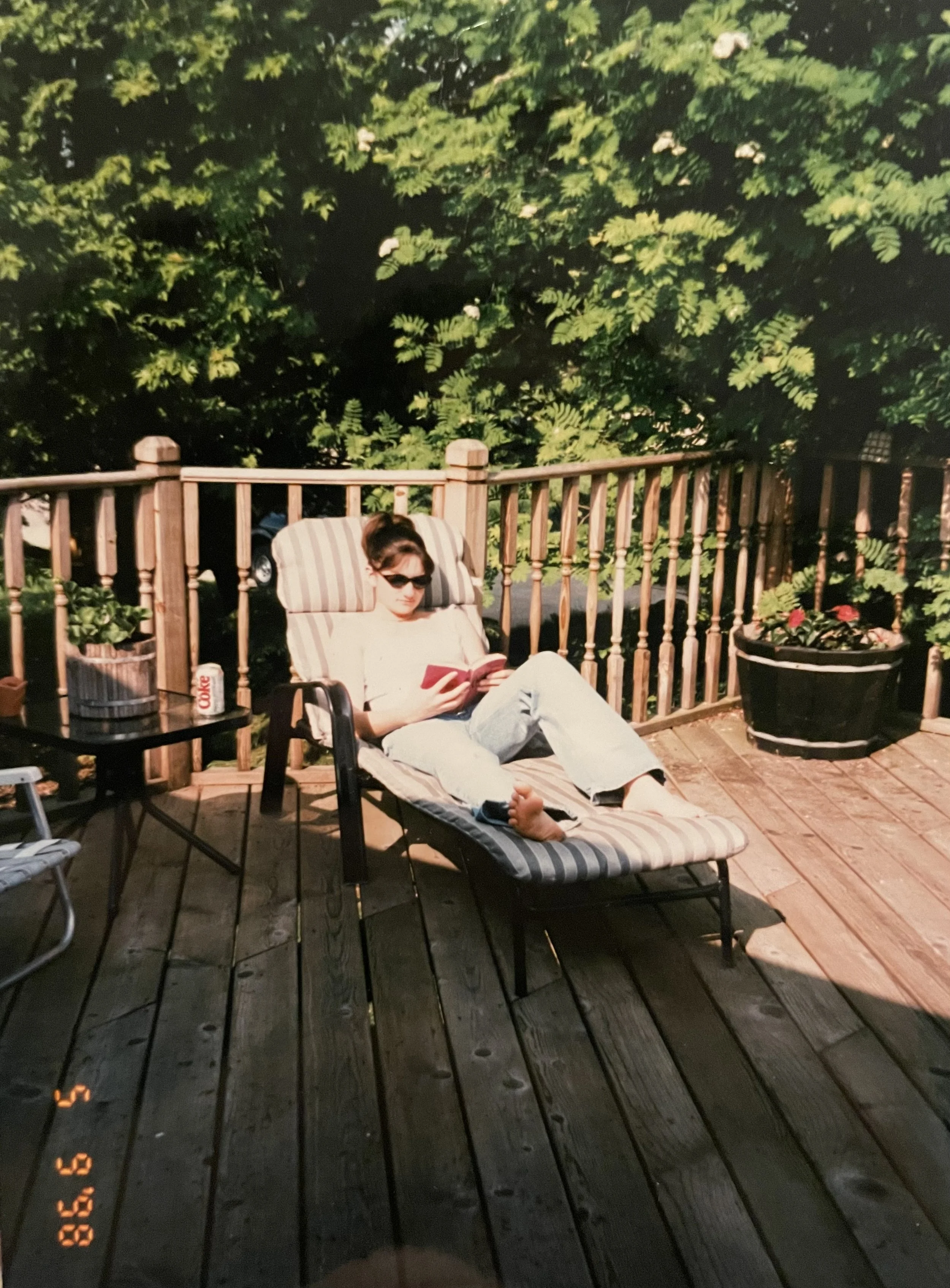
Melissa Faliveno is the author of the novel Hemlock, just out from Little, Brown, and the essay collection Tomboyland, named a Best Book of 2020 by NPR, New York Public Library, Oprah Magazine, Electric Literature, and Debutiful, and recipient of a 2021 Award for Outstanding Literary Achievement from the Wisconsin Library Association. Her work has appeared in Esquire, Paris Review, Kenyon Review, Literary Hub, Prairie Schooner, Brevity, Diagram, and Brooklyn Rail, among others, and in the anthologies Sex and the Single Woman and Hit Repeat Until I Hate Music. She is an assistant professor of creative writing at the University of North Carolina and lives in the woods outside Chapel Hill. www.melissafaliveno.com
After everything falls away, what's left? christopher l. keller on On Wilco's "Via Chicago" and the responsibilities of mirrors
“Today, for instance, I am particularly oppressed by one memory of a distant past. It came back vividly to my mind a few days ago, and has remained haunting me like an annoying tune that one cannot get rid of. And yet I must get rid of it somehow. I have hundreds of such reminiscences; but at times some one stands out from the hundred and oppresses me. For some reason I believe that if I write it down I should get rid of it. Why not try?” —Notes from the Underground, Fyodor Dostoyevsky
*
I dreamed about killing you again last night
And it felt alright to me
Dying on the banks of Embarcadero skies
I sat and watched you bleed
As a young man, my father found his future home in a slice of pie and a cup of coffee at an airport diner in Madison. I do not doubt that even then, he had searched far and wide for reliable food and reliable service in every diner and restaurant he visited. I saw it all the time growing up. I heard his comments about the quality of the coffee and the warmth of the food. In this case, it surely didn't hurt that the cute waitress appeared to remember him, but didn't know his backstory or about the small-town roots that threatened to entangle and keep him on the farm. Dressed up in a uniform for a now-defunct airline that operated out of O'Hare International Airport in Chicago, he'd tell her a joke and leave a nickel or two as a tip. It's how small-town boys get women in the city to remember them.
It's how you stand out.
The cute waitress, my mom, saw that airport diner as just another stop in another town she had moved to after her father died. There would be more waitressing jobs, more cat calls, and more stingy tips. A college dropout, she made a living from tips in the big city, or at least cities only slightly larger than the small central Wisconsin towns she shifted between. As a middle child, she became used to a certain level of anonymity. That changed when she started to wait tables. People noticed her.
That's the origin story my sister and I heard growing up in the same small town that our dad came from. But there's so much more we're left to guess at. There are gaps we won't be able to fill in because we never asked, and now, our parents are gone, along with that restaurant. A gift shop currently occupies the space, and I bought a couple of shirts there a couple of years ago as I was flying back to where I had arrived from.
One said, "Nah, I'm Good." The other had a screen-printed image of the state of Wisconsin.
Above it read "This is Home."
*
Buried you alive in a fireworks display
Raining down on me
Your cold, hot blood ran away from me
To the sea
An unmistakable feeling of sadness often accompanies memories of my childhood in small-town Wisconsin. It's a sadness I kept bottled up and hid behind a forced smile and a serious demeanor. It felt less like something was missing and more like something had been taken. What remained was a space that never quite filled in. In a town of 3,000 people, where everyone not only knows each other, but most everyone is related somehow, other people offer a reflection of who you are. They provide the adjectives that serve as a kind of shorthand for your identity. You're the "Athletic" one or the "Pretty" one. Or the "Smart" one. The one who causes "Trouble."
Maybe you don't have a descriptor. Or you don't like the one you have. What then? You're left at a persistent fork in the road. Down one path, you just play it safe, all day, every day. Conformity might as well be a defense mechanism handed down at birth. "Keep your head and limbs inside the moving vehicle at all times!" If nothing sticks out—if you don't stick out—nothing can hurt you. Many people travel down that path and settle in. It's an easy crutch.

Montrose Beach in Chicago, July 4, 2010
But that other path, well, that's a rich and imaginative inner world that can unfurl whenever the noise from the outside becomes quiet enough to allow for dreams. It's filled with futures as rock-and-roll stars and secret admirers and authors and comedians. These possible identities feel as though they are just one bold step away from becoming reality. But even there, untethered from reality, a very real fear lingers. Fail, and the folks back home begin to whisper. They talk among themselves and agree on the adjectives they can apply to your endeavors. They seem to believe that you can either stay at home or you can find your true self; you can't do both. When you're dead and gone, when you've eventually found peace and a place to rest, they'll think back to how you carried their load a thousand times on your back. In that remembrance, they'll shout about how they knew you.
They'll never know how you subtracted them from your sense of self years ago.
*
I printed my name on the back of a leaf
And I watched it float away
The hope I had in a notebook full of white dry pages
Was all I tried to save
But the wind blew me back via Chicago
In the middle of the night
And all without a fight
At the crush of veils and starlight
Growing up, I didn’t lack for friends. In the small subdivision where we lived, by sheer proximity, kids were everywhere—up and down the street, around the corner. You knocked on a door to invite someone outside, or you rode your bike or shot baskets in the driveway, and sooner or later someone joined you.
There was one summer, though, when they didn't.
I can't remember how old I was or how long it lasted. I just remember that the other kids stopped knocking on my door. They stopped coming over when I was outside. Suddenly, they were outside playing together, and I watched it all from our front picture window. I didn't feel invited. I didn't feel included. I felt separated and lonely, and an intense sadness. Here's where I need to be upfront. That's how I remember that summer. That's the memory I have. Is it entirely possible that I woke up one day and wondered if they'd even notice if I didn't come around anymore? Maybe I didn't like who I had to be when I was with them, so I just chose to remove myself from the group? Absolutely.
For all the time I spent in my head, I didn't have the tools to describe how I felt to others, let alone other kids. I grew up in a time and a place where boys were expected to mirror their fathers, who were really just boys themselves. They never learned how to express their feelings, only their fears, which took the form of a hands-off approach to parenting unless discipline was required.
One kid in particular exemplifies this. He is in some of my earliest memories, rocking back and forth and banging his head against the couch cushions, shouting "I. WANT. IT. NOW." when he didn't get his way. Alone, he could be kind. But in a group, with others to show off for, he'd turn into a bully. Like the time when we were playing "pro wrestling." I thought we were pretending. This kid took every opportunity to remind me of how "weak" I was.
Anyway, sometime in between that moment we were first introduced and that summer of loneliness, that kid found a way to describe me. I might have been about my son's age now, an age where everything is real, because why would people want to hurt their friends, physically or emotionally? I'm sure he doesn't remember today, but I can recall how there in a fort we had made in my backyard, he reduced me to tears in an instant.
"You're a mama's boy," he said. "You have to have your mom fight your battles for you."
He wasn't wrong. I absolutely gravitated toward my mother more than my father. One-hundred percent. Dad was insular and reserved. He'd show me how he'd do things, but never let me try on my own; his directions were the right way to reach the end. Mom, on the other hand, made it OK to try something and move on if it doesn't work out. We all make mistakes, so why linger on them? She had a big personality and knew that humor and a little bit of silliness helped to put others at ease. Given all of the health issues she'd encountered since her teenage years, I suspect she had developed this defense mechanism. Doesn't matter. I liked the reflection of myself that she provided.
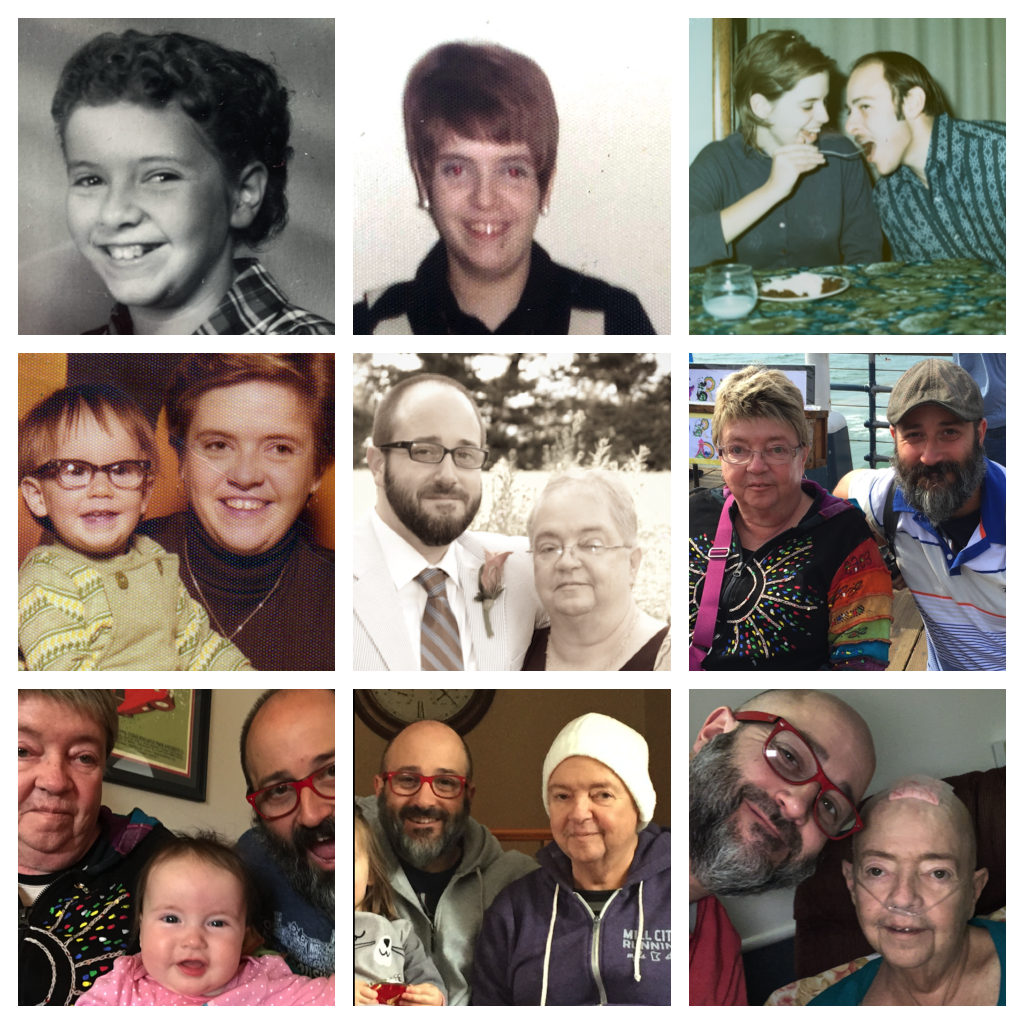
The many faces of my mom
I didn't know it at the time, but mom wrote a lot when we were kids. I found one diary a few years back that somehow survived the house fire that took my dad's life. She started it when she was pregnant with me. In her perfect mom handwriting, she wrote down her hopes and dreams and fears. She commented on the changes she saw in dad and his adjustments to what was taking place. She marked the day when they settled on the name Christopher Lawrence for a boy. A couple of times a year, I pick it up and read through it. Each time I find some new detail that brings me some comfort. Most recently, I fixated on something she wrote on the first page. They aren't her words, but those of Kahlil Gibran from his poem, "On Children":
"You are the bows from which your children, as living arrows, are sent forth."
*
I know I'll make it back
One of these days and turn on your TV
To watch a man with a face like mine
Being chased down a busy street
When he gets caught I won't get up
And I won't go to sleep
I'm coming home, I'm coming home
Via Chicago
Wilco's Jeff Tweedy didn't expect to live past 2004's "A Ghost is Born," which, save for a few key musicians, was the first album of the band's current—and longest running—lineup.
In New York City, in the throes of an addiction to the painkillers he used to combat the migraines that had afflicted him since elementary school, Tweedy said he was consumed with a "looming sense of imminent demise."
"[I]t felt like a big flood was coming, something no one could survive. So I was saving anything I could, piling it all onto this ark as a way to salvage whatever I could of myself," Tweedy writes in his 2018 book "Let's Go (So We Can Get Back). "...A Ghost Is Born would be a gift to my kids, who could turn to it when they were older and put together pieces of me a little bit more than I'd been able to put myself together for them in real life."
What he was doing, then, was removing anything that would dull the mirror he wanted his children to return to one day and see something of themselves in.
Tweedy grew up in Belleville, Illinois, a town of around 40,000 people that sits some 15 miles from the Missouri state line. Parents JoAnn Tweedy worked as an interior designer while Bob Tweedy worked at all hours for the local railroad company.
"Most nights I'd stay close to my mother…as she watched TV and smoked cigarettes on the couch. It was the best she could do," Tweedy writes in his 2018 book. "She'd been a mother for so much of her life that by the time I came around, she'd kind of given up on parenting."
Belleville and its residents are obvious characters in the music created by Tweedy's second-most well-known band that he formed in high school with classmate Jay Farrar. Uncle Tupelo helped create the alternative country/No Depression movement (named after the song on its 1990 album of the same name). A well-documented falling out with Farrar a few years later led to Wilco.
"Via Chicago" appears on Wilco's third album, 1999's "Summerteeth," which Pitchfork gave a score of 9.4 in its review, calling it "a loose song cycle considering the intermingling of perception, communication, and reality, and its [effect] on our relationships." The initial recording sessions took place about two years prior in Texas in Willie Nelson's studio, according to the 2004 book "Learning How to Die" by Chicago music critic Greg Kot.
"Tweedy was particularly emotional during the sessions because he was upset that he was unable to spend time with his wife and son because of the constant touring schedule," Kot wrote.
Inspired by Henry Miller and written in the style of a murder ballad—think "Long Black Veil"—the near co-dependent nature of Tweedy's relationship with another Jay, Jay Bennett, no doubt also influenced "Via Chicago." In his book, Kot relays this from then-Wilco drummer Ken Coomer:
"It was Jeff and Jay feeding off each other, not just musically, but other vices. There was a bonding going on, and it didn't just involve music. Jeff didn't go into rehab [for an addiction to painkillers], but he should've, [sic] in my opinion. Jay was taking painkillers, antidepressants, and wasn't in much better shape."
Bennett, who passed in 2009, lays a thick dirge over "Via Chicago" that seems to mask and rob the studio track of the immediacy and stakes of the modern-day live version. While both ask for your attention, the studio version feels lilting and morose. The live version feels necessary and haunting. Reducing a song to one moment feels foolish, but for me, it's the fourth time we hear the arpeggiated D major riff that serves as a kind of chorus. It's not the climax, but the first time we hear current guitarist Nels Cline make his instrument cry in a way that shows us what pain sounds like when it's left alone long enough to finally earn its release.
Maybe the song can reach these heights because the people now around Tweedy have helped him to see something in himself that past bandmates couldn't or wouldn’t. Especially the Jays, who chose competition instead of a complementary role. Perhaps it was the other way around. You never know until you run the equation.
But perhaps we're given a hint in Kot's book and his description of what took place after the last Uncle Tupelo show.
“Tweedy drove to his parents' house on 40th St. in Belleville, sat down on the footstool in his living room, and sobbed."
*
Where the cups are cracked and hooked
Above the sink, they make me think
Crumbling ladder tears don't fall
They shine down your shoulders
Crawling is screw faster lash, I blow it with kisses
Rest my head on a pillowy star
And a cracked door moon
Says I haven't gone too far
It would be easy to dismiss the lyrics to “Via Chicago” as nothing more than an ode to coming home. Tweedy has said he doesn't put too much into the meaning of songs—his or others. As for me, the song’s power lies in the implied changes that take place while traveling a path.
The song isn’t so much about arrival as it is about metamorphosis and what happens when someone passes through different places, among different people, long enough to be changed. What once felt fixed becomes malleable, negotiable even. The experience not only alters who you are, but also your very definition of identity. It isn't a destination, but a continuum that stretches over time.
On one end, you have the stories about yourself that you inherited from others. The routines and expectations you didn't have a say in, but took part in nonetheless. On the other end, you find comfort. A place to rest as yourself, if only for a little while. Somewhere in between, you find "Chicago." Filled with potential energy, it's a place of beginning and becoming, where the roles you were assigned loosen just enough so you can imagine something else entirely.
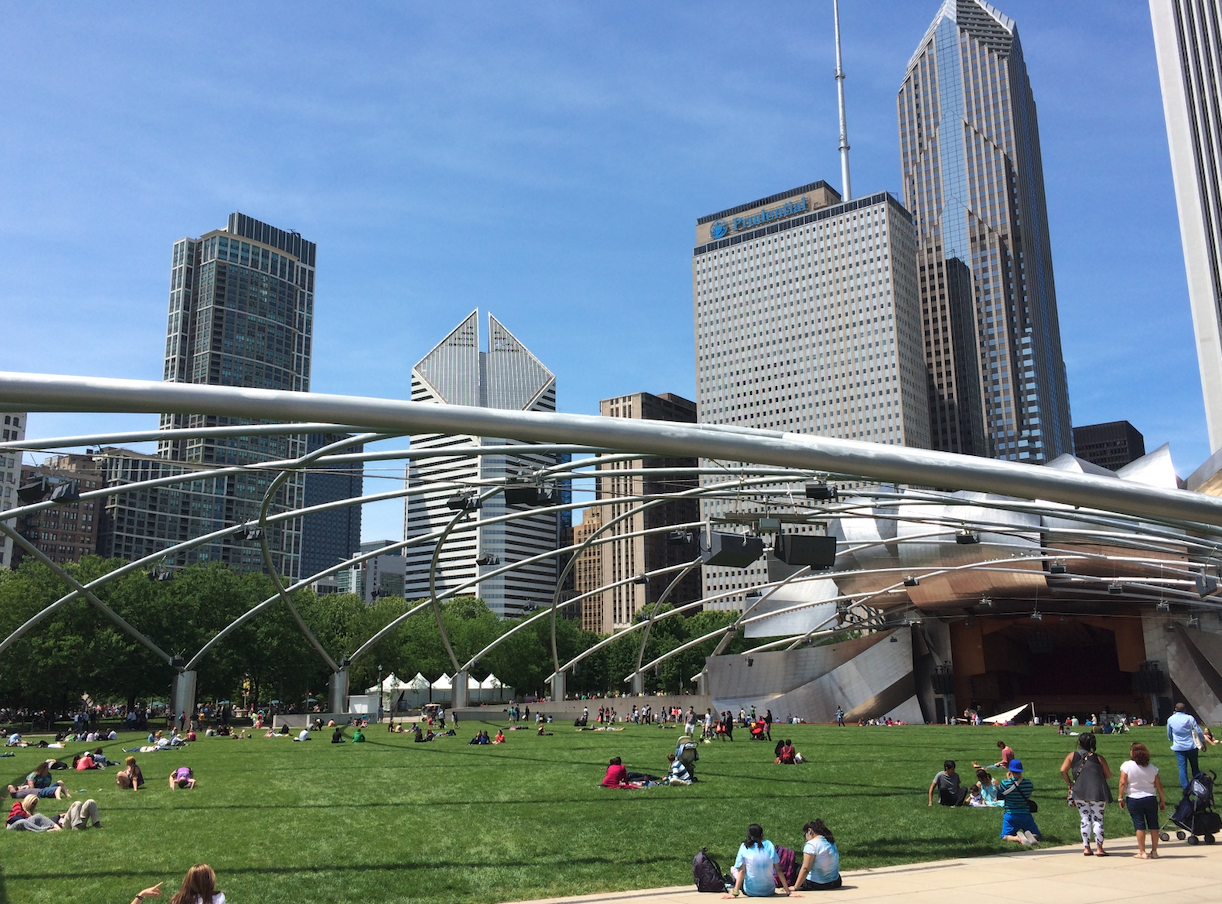
Millennium Park, Chicago
In some ways, Chicago is home. In others, it’s a mess. Because when the door slams shut on the version of yourself, and you have to face what comes next, home is where you go to cry. It's where you go to face who you've become and begin to calculate the equation anew.
*
I'm coming home
I'm coming home
I'm coming home
Via Chicago
I'm coming home
I'm coming home
I'm coming home
The last time I heard my mom's voice, I found myself in a familiar spot, wrapped up in blankets in my childhood bedroom, alone and crying. A week earlier, I had traveled a thousand miles to check in on her and my dad. Both were in an assisted living facility. Dad had suffered a stroke. Mom had aspirated a morphine tablet she was taking for pain. Doctors said we should consider hospice.
The uncertainty of that week could have lasted ten lifetimes. The day before, my sister and I told our parents they couldn’t stay in the house alone anymore. That conversation went poorly. Later, as we tried to eat together as a family, I had nothing to offer. My tank was empty. My outlook was poor. Mom looked my way and tried to coax a smile. Instead, I think she saw the fear.
Afterward, in an attempt to stop time for just a moment, I retreated to the house they hadn’t lived in for weeks. There, among the clutter and chaos, I carved out a small space so I could rest before going to see mom. Instead, I wallowed. I called and told her I’d be by in the morning.
I had traveled clear across the country, and all I had to do was get up, drive four minutes up the street, and sit with her for a while. Instead, I stayed there under the blankets in the first bedroom I remember and wept. I thought I was safe at home. I wasn't.
I never heard mom's voice again. She never spent another night in the home she helped make. Some time after we spoke on the phone, she fell trying to leave her bed. The fall seemed like the last thing her body and mind could take. When I arrived on Monday morning, doctors had sedated her. All that was left to do was wait for her to decide it was time to be done.
On the day of the funeral, I spent some time lurking around the basement of the Catholic church, remembering the weekly after—school Catechism we'd attend there. Of how attending Catholic Mass was a regular part of my childhood. As I made my way upstairs to await the beginning of the service, I saw a longtime village resident who had volunteered as a Girl Scout leader with my mom decades ago. This is someone who knew my mom. Someone who had learned from her. I flashed a smile and said hello, and she offered condolences. But in that Midwestern way of just not being able to help themselves, she gave me a leftover sentiment to take with me.
"It sure is nice that they opened the church up for someone who hasn't attended Mass in so long."
More than seven years later, those words still bounce around my head from time to time. Thankfully, they're quickly drowned out by this second chance I still chase. All my life, I knew that at some point I would be there next to mom at the end, to be the one to comfort her. To offer her something familiar. To remind her not of who she had become, but of who she had been. A waitress. A mom. A retail clerk. A preschool teacher. A 50-year-old college graduate. A tutor for inmates. But when faced with that moment that had dominated my thoughts since I was a child, I didn't know what to do. I had no one to mimic. My role model couldn't talk to me, and without that mirror to offer me a reflection, I became the person I'd always been: a frightened child who wanted his mom.
Turns out, after balancing the equation, responsibility remains.
*
I'm searching for a home
Searching for a home
Searching for a home
Via Chicago
I'm coming home
I'm coming home
Since my mom passed away, I’ve returned to my hometown a handful of times, usually for funerals or to clean up my messes. My most recent trip, in September, was for my cousin’s funeral—someone who became a touchpoint for my dad after mom’s death, and a kind of surrogate father to me after dad passed away.
The visit carried the trappings of home. My sister was there. We ran into cousins. When we stopped at the property where the house we grew up in once stood, our old high school guidance counselor happened to be walking by, and we talked for nearly an hour. People I ran into remarked on how much I’d grown up. They asked about the stories I'd worked on for The Associated Press and told me how much I reminded them of my dad…of how much they missed my dad.
And then it was done. I managed to resist the urge to linger as the version of myself I’d been for those few days. I had a flight to Chicago to catch. My sister dropped me off at the Dane County Regional Airport. On my way to the security checkpoint, I passed the spot where the restaurant used to be—the one where my parents met so many years ago. As we began our descent into Chicago, I thought about all the versions of myself that have passed from this world. I’ve started over so many times I’ve lost count, but I have a clear sense that the time in front of me is shorter than what I've left behind me; starting over now would be a waste.
Later, after scrambling through O'Hare to reach my connecting flight, my mind turned toward who I was returning to and where I would land. It’s the place where my kids go to school and dream big dreams. Where I’ve shared years of school rituals and milestones with other parents. Where I play basketball four times a week, play guitar and drums (like this cover of Via Chicago), record tiny songs, and spend time with people who push me to be a better version of myself. And it’s where the love of my life—a girl who once took me along on her own adventure to Chicago—waited for me.
If you asked her how I’ve changed, she might say I haven’t, not at my core. But I hope she’d also say I no longer mistake motion for progress. That I’m willing to account for my actions, the successes and the failures, even if she needs to remind me what those are.
Still, something feels unfinished. In a group text message recently, a friend said he needed to start sharing wisdom with his kids so that after he’s gone, they'll have something to remember him for. I knew exactly what he meant. Like my mom, I used to write solely for myself. There's a box under my desk filled with notebooks containing observations, poetry, short stories, and essays. It's been my intention to return to them and attempt to remember who I had hoped to be by now. Maybe even jumpstart the muse. But, to me, the solitude required to explore one's mind and create what it sees feels too much like isolation.
My children deserve more than my bylines and stories I've told about the news. They deserve to read stories about me and about their mom and all the people in our lives who shaped us. They should know about the places they used to know as home, and the stories of their past selves from times that they will never remember.
They deserve a mirror held in place not by a guide, but by the court jester.
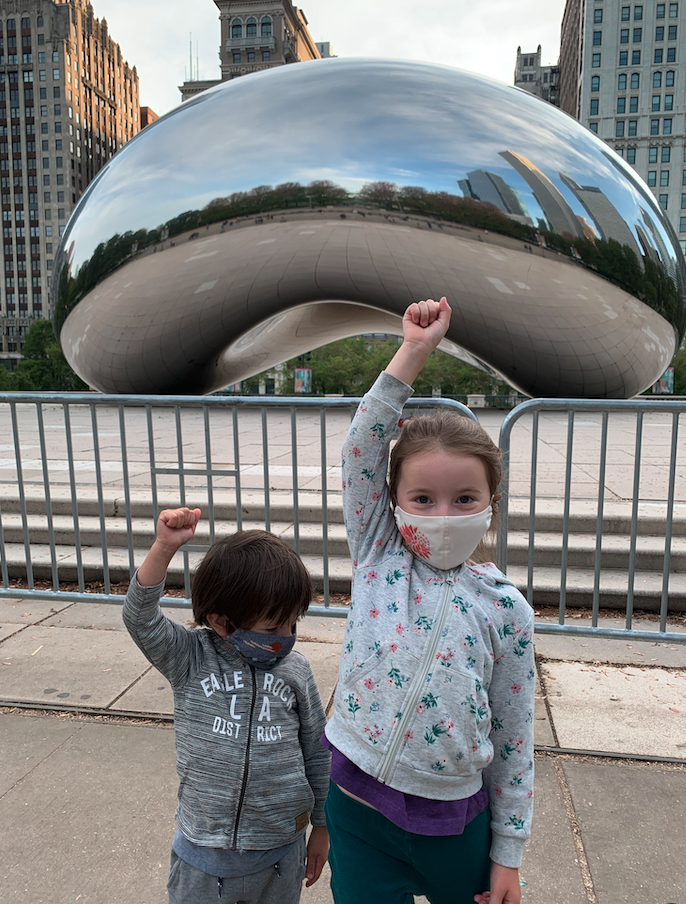
Cloud Gate, aka "The Bean," in Downtown Chicago
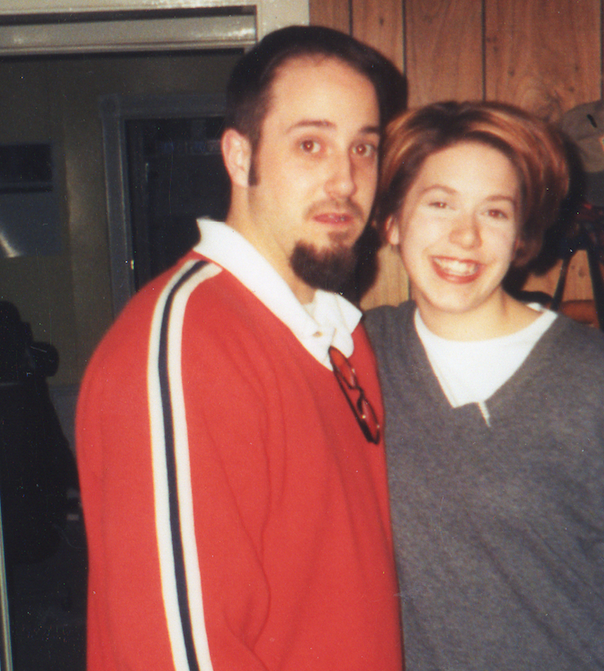
The author and his sister, 1998
Christopher L. Keller is on track to join his mom as a college graduate at the age of 50. He's planning to receive his bachelor's degree in Liberal Studies in May from the University of New Mexico. He is also an award-winning journalist with The Associated Press based in the Southwest. He believes that telling stories helps people understand the world around them and their place in it. Most importantly, it helps him understand his place in it.