
Singing Old Songs and Light Up the Tree: Martin Seay on “Family Life” by the Blue Nile
The best Christmas songs are sad. I mean, sure, I’ll rock out to “Sleigh Ride” as much as the next dude, but when I’m really after those deep and true holiday vibes, I reach for “In the Bleak Midwinter,” “I’ll Be Home for Christmas,” “Have Yourself a Merry Little Christmas,” “Christmas Time Is Here”—y’all see where I’m headed. Melancholy jams like these capture the season in rich and nuanced ways that, say, “All I Want for Christmas Is You” can’t quite achieve, banger though it may be.
There are obvious reasons for this. In most of the northern hemisphere, Christmas is dark and cold. (Though admittedly not as cold as it used to be, which prompts its own kind of sadness.) It kicks off the last seven days of the calendar year, a time when we must accept that things we hoped to accomplish will not be accomplished, things we hoped would happen are not going to happen. Even if you’re not a Christian, or not an observant one—as I, to be clear, am not—the religious narrative suffuses the holiday, ostensibly joyous (Christ is born) but shadowed from the outset with violence and guilt (to die for our sins).
For many Americans, probably for most, the winter holidays are those most associated with the household, with the family. If your relationship with your family is close, then it’s a time for celebrating with them, or regretting that you can’t. If it’s not, then it’s a time for being constantly confronted by that distance, that lack. And even the happiest holidays contain echoes of happiness now gone, along with portents of losses to come. The best Christmas songs are sad because families are the saddest thing.
I’m not talking about my family. My family is awesome. They’re, y’know, people. They have challenges and disappointments. They have a capacity to imagine who they want to be and how they want to live in the world, and they have a capacity to achieve those things that falls well short of the aforementioned imaginative capacity. That’s what sadness is. They’re sad. Everybody’s sad.
Leo Tolstoy kicks off Anna Karenina with the famous assertion that happy families are all the same but every unhappy family is unhappy in its own way, and this is the underlying premise and organizing principle of much memoiristic writing: By placing narrative emphasis on the particular, we illuminate the gap between our fraught circumstances and the definitional loving safety and stability of the properly constituted happy family. And this approach has been fruitful. It totally works.
But what if we tried something else? What if we set aside our customary emphasis on the particular to show the ways in which unhappy families are the same, or to show that all families are unhappy in some of the same ways, their tensions and conflicts not the result of individual failings and miscommunications, but of the structure of the family as such? How ’bout that?
Here’s an obvious point with twisty implications: Parents experience family life differently than children do. Parenthood is anchored in time—photos sequentially filling albums, heights measured and marked on doorframes—but kids can’t hold onto episodic memories from the earliest years of their lives, the years when selfhood takes shape most dramatically, which means that on top of all the other power imbalances inherent to the family, parents always have an expert authority over their children’s identities that the children themselves can’t really challenge. Parents have known their kids longer than the kids have known themselves.
Plus young children are egocentric, not due to any innate or acquired deficiency of character, but because they can’t be otherwise: They don’t yet have a theory of mind, an ability to understand that others perceive, know, and want different things than they do. Long before they learn to appreciate their parents as people (if they ever do) they experience them as elemental forces. When a parent gets upset by an event in one of the many extrafamilial spheres through which they move—a fender-bender, a fight with a friend, a disaster at work—the child has no way of contextualizing these stresses, and instead encounters them as akin to cosmic horror, an irruption from an outside world of limitless possibility.
Cognitive scientists classify episodic memories—i.e. memories of specific events, the kind that young kids can’t retain—as a type of explicit memory, by contrast to implicit memory, which is stuff we know but don’t remember learning, stuff we may not even know we know. Implicit memory forms the hard floor of our orientation toward the world: how it works, where we fit into it.
Later, as we grow up, we receive a bunch of explicit messaging from the culture, some of which reinforces our core understanding, and some of which contradicts it in ways that make us feel defective and insane.
Final complication: All parents were once children. Given that their most basic knowledge is subconscious, and therefore unmoored in time, maybe it’s fair to say that at some level all parents—all adults—are children.
🎄 🎄 🎄
While there’s no plausible argument that “Family Life” by Glaswegian trio the Blue Nile is the best Christmas song of all time, it may very well be the saddest.
A cursory review of online comments suggests that many people find it intolerably miserable and/or maudlin. Some can’t listen to it at all; they bail out within the first bar, upon exposure to the halting electric piano and Paul Buchanan’s plaintive voice. I get it. It’s a lot.
The Blue Nile is probably my favorite band. I have an ongoing argument with myself about whether their 1984 debut A Walk across the Rooftops or their 1989 sophomore LP Hats is the best album released in that decade; I’m pretty sure it’s one or the other, and yes, I am familiar with the work of Prince, Kate Bush, Bruce Springsteen, Whitney Houston, Talking Heads, Sade, Guns ‘N Roses, Jacksons Michael and Janet, et al.
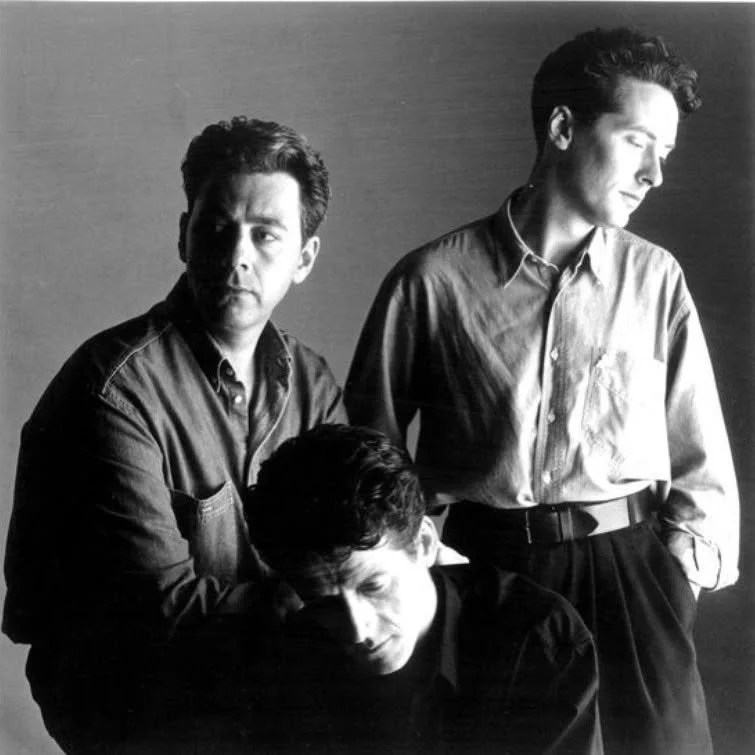
When I mention the Blue Nile to people who aren’t familiar with them, I often call them the Velvet Underground of adult contemporary: innovative and massively influential, but obscured, or maybe hidden in plain sight, by the fact that their most notable acolytes were not scrappy up-and-comers but aging 1970s stars wrongfooted by the rise of punk. Genesis alums Phil Collins and Peter Gabriel were avowed fans; Robbie Robertson and Michael McDonald collaborated with them; Rod Stewart covered them. (So did Isaac Hayes.)
The appeal of the Blue Nile to this cohort was clear enough. After a decade of dominance, rock music, whether in its bluesy or progressive manifestations, had hit diminishing returns. There was broad agreement on ingredients that might revitalize it—Stax and Motown classics, electronic music, sounds from the Global South—but no clear consensus on how to combine them in ways that felt fresh and genuine. The Blue Nile came up with an approach that drew on all three while adding an unexpected fourth: pop standards from the early and mid-twentieth century.
Buchanan, the Blue Nile’s principal songwriter, has attributed his decision to pursue a life in music to hearing two masterpieces around the time he graduated from university: the first was the Adagietto from Gustav Mahler’s Fifth Symphony, and the second was Marvin Gaye’s What’s Going On. Buchanan is a droll character, so there’s probably a self-effacing joke in there about youthful pretensions and unlikely inputs, but the bigger punchline is that it’s actually a pretty good summary of what the Blue Nile sounds like: precise, sophisticated, emotionally direct music that stretches long-lined melodies over a shimmering rhythmic moiré.
Buchanan’s voice is fantastic, instantly recognizable. He is often—very often—called “the Scottish Sinatra,” which is lazy if not quite wrong; while the singers share fine-grained, burnished timbres, a compelling melancholy, and an aptitude for going from quiet to loud, Sinatra’s sadness tends to be that of a frustrated narcissist: often downhearted but rarely in doubt. Buchanan, by contrast, exudes an underdog fragility even in his most ecstatic, swing-for-the-bleachers moments; he also occasionally slips into a keyed-up David-Byrnean jitteriness that links him more closely to postpunk than to the MOR fare of his prominent emulators.
Something else qualifies the Blue Nile as a postpunk band: the fact that they could barely play, at least in the beginning. In the classic manner of the era, this helped them steer clear of idiom and cliché. Along with Buchanan’s voice and his high, hushed, jazzy guitar, the major elements of the Blue Nile’s sound are Robert Bell’s bass—frequently slapped, an unorthodox move given the overall unfunkiness of the proceedings—and the synthesizer work of PJ Moore. Actually, the band’s albums list all three members as playing synthesizers, while Moore is additionally credited with “keyboards,” and this distinction matters. The band’s dense, distinctive electronic textures often give the sense of being painstakingly built up from sinewaves, and Moore is their chief architect. (Though they weren’t members of the band, the Blue Nile had two other core collaborators throughout their career, engineer Calum Malcolm and drummer Nigel Thomas, the latter of whom, significantly, is also a distinguished orchestral percussionist.)
The elaborate soundscapes might just come off as idiosyncratic or fussy but for Buchanan’s lyrics, a concise blend of evocative images, intriguing ellipses, and candid emotional entreaties. For me, no other band more effectively captures the charged romantic potential of a city at night. For comparables you’d have to look to other artforms: surrealist novels, Brassaï photographs, Wong Kar-wai films. This preoccupation, which recurs throughout their work, is announced clearly on “Tinseltown in the Rain” from their first album—
One day this love will all blow over,
time for leaving the parade.
Is there a place in this city,
a place to always feel this way?
—but it reaches its apotheosis on “The Downtown Lights” from Hats. In its woozy layered pulses, in the glassy burbles and swirls of the synths, and in Buchanan’s slow build from an opening croon to the peevish litany of the coda, this is the band’s most complete achievement. If you know only one Blue Nile song this is probably it; if you only listen to one Blue Nile song it should probably be this one:
Apart from picking unexpected, very specific targets and hitting them almost every time, there’s no standard playbook for becoming a cult-favorite band, but this was the script the Blue Nile followed: First, come from a discrete subculture in an out-of-the-way city, in their case practicing Roman Catholics in mostly Protestant and irreligious Glasgow. Second, sign with a brand-new boutique record label, in their case Linn Records (a subsidiary of the Scottish audio equipment company Linn Products, not the American drum machine company Linn Electronics; don’t make the same mistake I did). Third, have low-grade personality conflicts and creative differences right out of the gate. Fourth, play live infrequently and do very little press. Fifth, work slowly and maintain a commitment to quality control that verges on self-sabotage, releasing only four albums during your 23-year run. Sixth, communicate so poorly that even your own members aren’t quite sure when or whether you broke up.
And that’s how the Blue Nile came to occupy their current spot in pop culture: a national treasure in Scotland, an if-you-know-you-know passion among listeners, and, maybe most notably, a secret handshake among musicians, a password declaring adherence to a set of aesthetic values and aims. Almost from the start, the band functioned as a scenic byway that cut across genres, linking (for instance) Rickie Lee Jones, Annie Lennox, Julian Lennon, Matraca Berg, Chris Botti, Curtis Stigers, and Bono. As the Blue Nile quietly petered out—stopped collaborating, stopped speaking—their albums have exerted a separate agency, as good albums will do, and their music keeps popping up in unexpected places, praised or cited or covered by Melanie C, Devendra Banhart, the xx, Chvrches, Black Midi, Sabrina Carpenter. Emerging avant-pop prodigy and guitar hero Mk.gee is on the record as a big fan. Alex G recently enlisted Buchanan for the soundtrack to Teenage Sex and Death at Camp Miasma. After Jessie Ware hipped him to Hats, Matty Healy, frontman of the 1975, became obsessed with the Blue Nile, borrowing overtly from their oeuvre. He shared “The Downtown Lights” with Taylor Swift during their brief fling, something she mentions on The Tortured Poets Department, with predicable and immediate effects on vinyl inventories. A new Blue Nile enthusiast is born every minute.
🎄 🎄 🎄
“Family Life” is the seventh track and the emotional basement of Peace at Last, the Blue Nile’s generally upbeat third album, released in 1996. Peace may be their least-beloved LP, for some valid reasons. For starters, it sounds more conventional than their prior work, with Moore’s sui generis synthesizers ceding territory to Buchanan’s guitar—or rather guitars, including quite a bit of warm, folky acoustic. Not incidentally, the songs seem more open about citing their references, which tend toward comfort listening: 1960s pop and R&B. And while Buchanan has never been reluctant to refer to his faith in his lyrics, it’s prominent on Peace, to the extent that a couple of songs are written explicitly as prayers. Like, addressed to Jesus. By name. Which is not everyone’s jam, obviously.
Peace at Last is also loaded with willfully sentimental evocations of the joys of marriage and parenthood, so much so that the casual listener is all but certain to assume that Buchanan had recently gotten married, had a kid. The album hits different when you learn that he’d done neither.
Many fans of Rooftops and Hats seem annoyed that Peace is so happy—way off-brand, not what they go to the Blue Nile for—but I think this is a bad rap. Sure, most of the songs sound pretty damn jaunty on a first or second listen, but then one starts to notice how hard their narrators are working to keep woe and worry at bay. The more forcefully these troubles get pushed out, the bigger and more dire they seem in their very invisibility. On “Body and Soul”—which otherwise sounds like one of Curly’s numbers from Oklahoma!—Buchanan sings “Please believe me / the past is nothing”; the more we hear him say it, the clearer it is that the past is not nothing, that underneath its sunny surface the past is probably what the song is really about.
The strongest argument that Peace at Last is darker than it seems is the fact that “Family Life” is on it at all.
As it happens, the song is the Blue Nile’s second slow ballad about a Christian religious holiday featuring a piano that doubles the vocal, after “Easter Parade” from A Walk across the Rooftops. “Easter Parade” is an important song for the band—an oblique mission statement and ars poetica, it contains the word “hats” that titles their second album—and fans are meant to notice the resemblance, maybe to hear it as a sequel.
Certain compound words—rooftop, birthday, headlight, railway, typewriter—seem to carry a quasi-magical significance for Buchanan, gathering weight as they recur across albums, and he begins “Family Life” with one of these:
Starlight, do you know me?
Please don’t look at me now, I’m falling apart.
Silver on the window,
like the bike I once had at home in the yard.
This is good narrative writing. The important elements are already in place: the high emotional stakes (“I’m falling apart”), the concern with being known or being recognized as oneself, and the gravitational pull of childhood reminiscence, what at this point we may take as nostalgia for a silver bicycle.
Buchanan’s voice drops out—the piano plays a descending melodic phrase from which lyrics seem to be missing—and then the narrator returns, setting aside the starlight metaphor to clarify who’s really being spoken to:
Jesus, love let me down,
and I know where you are.
It might lead somewhere.
The singer’s little pause before “somewhere” diffuses the word; it fades like smoke, and we’re back at the head of the melody:
Gather me in snowfall,
and the cars going by, the north and the south.
Flowers on the table,
and the coffee gets cold like the milk in my mouth.
Our picture of the narrator is filling in: blanketed and muted by the winter weather, static as the rest of the world moves, adrift in time. The memory of the childhood bike is seeming less sentimental; there’s a sense of wrongness, of temporal dislocation. The flowers on the table are out of season. The coffee in the narrator’s grown-up cup is supplanted rather than augmented by the milk of infancy, milk that—like everything else in the scene—has long since gone cold.
Then the descending melody again, this time with lyrics that might have come from a discarded Lorenz Hart notebook: “Sailing on, no honeymoon / just separate chairs in separate rooms.” The prayer continues: “Jesus, please make us happy sometimes. / No more shout. No more fight. / Family life.”
We know enough now to hazard some guesses. The narrator and his absent partner are at odds, to the extent that their future together is in serious doubt; they’ve settled into wounded mutual resentment. The flowers on the table are probably an attempt to make amends, and the fact that the narrator is sitting alone with them suggests that the gesture has been rejected.
And the narrator is not blameless. In the shouting and fighting, he said things he shouldn’t have said and cannot take back. He has revealed a cruelness that his partner didn’t know he possessed, and that he probably never knew he was capable of, or thought he had overcome—hence his opening question to the starlight. He has ceased to recognize himself.
But he recognizes the cruelness. Skipping ahead to the end of the next verse, the narrator prays for Jesus to “wipe the tears from her face” and to do… something unspecified about “the sound of his voice”; we might at first take “her” to be the narrator’s partner—and that may be partly correct—but whose voice is this?
We’ve slipped back in time again. The voice belongs to the narrator’s father, whose cruelty he suffered in childhood. The tears are probably his mother’s. That silver bike, we now see, is not a memory of home, but rather a memory of the narrator’s earliest means of escape from home, an escape he believed himself to have achieved for good a long time ago. Turns out he didn’t get free of the cruelness; it just lives in him now.
The great sadness of “Family Life”—and maybe of family life—isn’t the father’s shitty temper and its lingering harms. It’s the fact that the narrator can’t get outside it, can’t get enough distance to see it, handle it, set it aside. For him, the cruelness has always been there, part of his life since before that life was fully his own. It predates and underlies all his mechanisms of selfhood. No inner resource will fix him or put right his wrongs, and this incapacity will doom his relationship—or, maybe worse, it won’t: They’ll patch things up, have the kids they dream of having, and generally pursue the life they want to live together, except that the narrator will keep fucking it up, doing damage to everyone he loves the most, damage that will lurk at toxic inaccessible depths in them, just as it lurks in him.
And yet there’s hope. Tomorrow’s Christmas!
🎄 🎄 🎄
We should be careful not to understate the lifelong consequences of our built-in developmental discontinuities—particularly with respect to trauma endured early in life, before we’re able to hold onto specific events, before it’s even totally clear what we do and don’t experience as trauma. But we shouldn’t overstate them, either.
As many smart people have observed, most of the limitations and structures that are presented as intrinsic to family life, as natural, are in fact constructed in particular social, cultural, political, and economic conditions. They’re for damn sure not easy to change—especially because the family is deliberately defined in ways that make it resistant to outside influence: first as a productive unit wherein authority resides with the father and all roles are strongly gendered, second as the basic building block of society from which all other structures proceed—but neither are they fixed.
Different doctors write different prescriptions. Some theorists illuminate options for unshackling familial roles from gender; others contest the treatment of the household as a company, and of children as property; still others suggest that communities rather than families might be understood as the primary guarantors of children’s welfare. None of these are bad ideas.
And none of these are where Buchanan is coming from. Not exactly.
There’s a tendency—I am susceptible to it myself—to conflate Christianity with the patriarchy, to assume that one implies the other. To be sure, this tendency usually wins bets, particularly in the post-Moral-Majority USA. But for someone as deeply engaged with his faith as Buchanan, this easy equivalency will not do. At the heart of “Family Life” is a gentle suggestion that those who conceive of Christianity through the lens of the traditional family are looking through the wrong end of the scope: they should be doing exactly the opposite. (“If anyone comes to me,” declares Jesus in the Gospel of Luke, “and does not hate his own father and mother and wife and children and brothers and sisters, yes, and even his own life, he cannot be my disciple.”)
I will not list the many ways in which the biblical Holy Family departs from the standard American conception of the nuclear family as a small sovereign fiefdom, but in the current context, here’s the big one: Mary and Joseph’s kid is God’s kid first. And that, I think Buchanan would say, is no less true of any child, very much including the children whom the narrator of this song hopes to raise with his partner. This is the message of Christmas, the message the narrator of “Family Life” ultimately receives.
In the midst of the despondency that moves him to prayer, the narrator realizes that the resources he needs to overcome the anger and fear that have poisoned him against his household cannot be found within him, or within the household at all. If he tries to man up, embrace his patriarchal role, and commit to keeping his shit together in the future, he will fail, and he realizes this. He will fail because the threat to his family is tangled up with his conception of the family.
What he does instead is surrender, admit and accept his weakness, put himself at God’s mercy. What can preserve his family is a power that transcends the individual personalities that constitute it, that transcends the idea of family itself. “Jesus, please,” we heard the narrator sing, “make us happy sometimes”—not let us be happy sometimes, like Jesus operates a booth on the happiness tollway or whatever. Make us happy sometimes. Happiness isn’t ever ours; it belongs to God, and is always a gift from God.
Not by accident is “Family Life” shot through with silences: the vocal dropping out in the first verse, the third verse shortened by what sounds like Buchanan choking up. The song seems to edge against what can’t be spoken, either because it eludes us (like buried anger) or because it transcends us (like God). When the narrator finally states the song’s thesis, he does it as succinctly as possible: a single word—“mystery”—murmured amid the crescendo in the bridge. It’s nearly drowned out by trumpets, announcing the arrival of divine power and divine mercy, just as they’ve done for thousands of years.
Do you believe it? I’m pretty sure I don’t, though I can sure as hell admire it.
Unless my ears deceive me, Buchanan has provided a consolation prize in “Family Life” for those like me who can’t quite go along. It’s in a peculiar lyric from the first verse: “It might lead somewhere.”
Specifically it’s in that word somewhere—another compound word, and a word we’ve heard before, though not necessarily in the Blue Nile catalogue. It’s the “somewhere” that Stephen Sondheim put on Leonard Bernstein’s melody, which looks back in turn on the “somewhere” that Yip Harburg gave to Harold Arlen. If we can’t turn to God to free us from ourselves and our circumstances, maybe we can turn to acts of creation, perfect words set to perfect tunes.
For Buchanan, these may amount to pretty much the same thing.
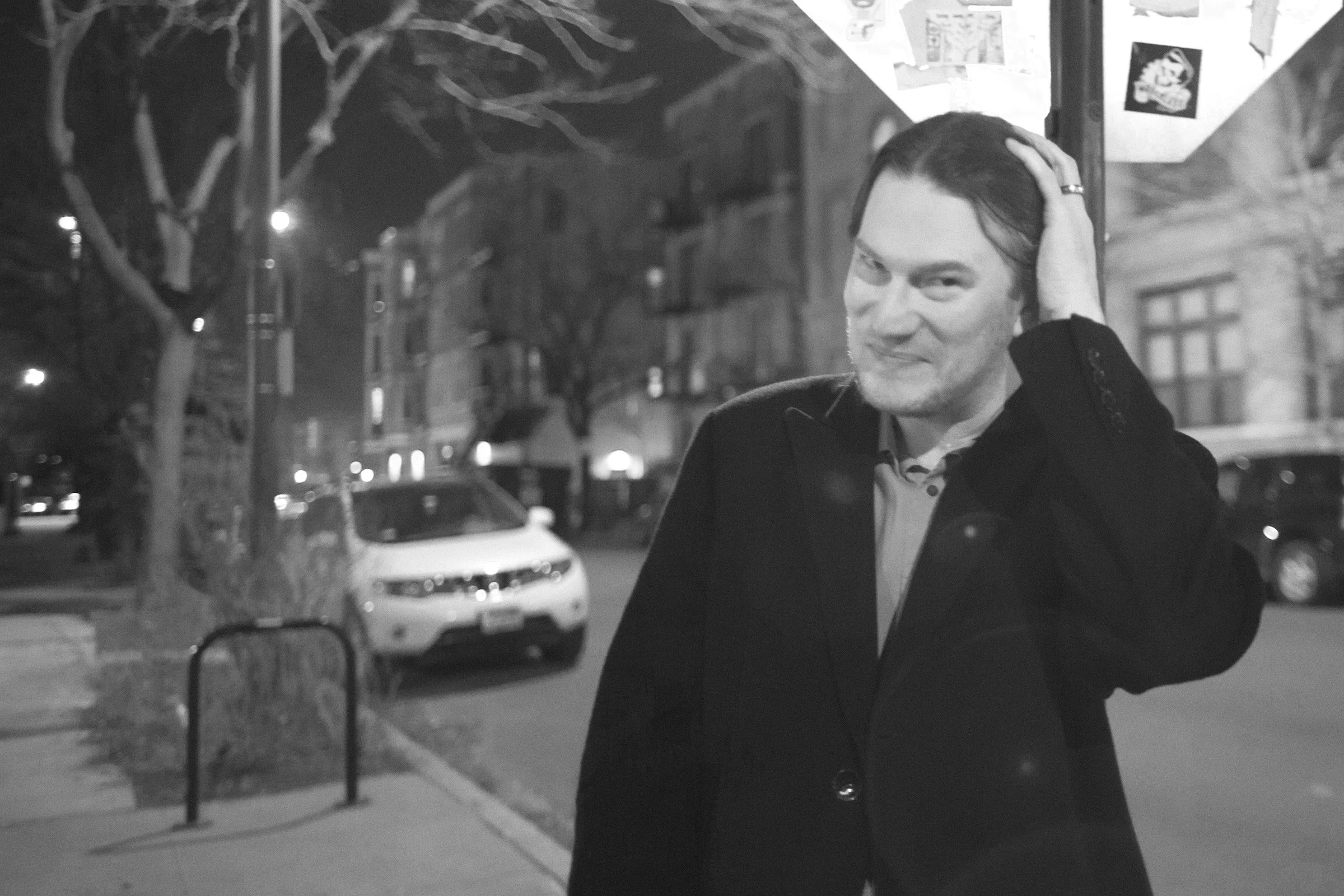
Martin Seay is the author of the novel The Mirror Thief. Originally from Texas, he lives in Chicago with his spouse, the writer Kathleen Rooney.