
second round game
(10) Wilco, “Via Chicago”
stopped
(2) Soul Asylum, “Runaway Train”
116-95
for a spot in the sweet 16
Read the essays, listen to the songs, and vote. Winner is the song/essay with the most votes at the end of the game. If there is a tie, we will play a one-hour overtime (and repeat until we have a winner). Polls close @ 9am Arizona time on 3/17/26.
emily costa on Soul Asylum’s “Runaway Train”
On October 6th, 1992, Soul Asylum released their sixth album, Grave Dancers Union. They’d been a band for over ten years at that point, but hadn’t seen any large-scale success. Columbia Records snagged them in the post-Nirvana alternative-rock signing blitz, and the resulting album spawned five charting singles. The third, “Runaway Train,” became massive, due in part to Tony Kaye’s innovative and inescapable music video.
On October 8th, 1992, I turned five years old. I don’t remember the party much, but there is a Polaroid of my grandfather on that day. It’s likely the last photo taken of him, something I wish I didn’t have, but can never get rid of. It’s tucked into a row of pictures in a shoebox, somewhere in the mix, a landmine. He is scary thin. He had lung cancer, its progression so terrible and quick that he had to move in with us. He sat for this stretch of time, mostly immobile, in our TV room. Almost exactly a year prior to his death, my grandmother died of breast cancer at 52.
When he died, it was barely a month after that Polaroid birthday. It was also the day before my sister was born. I remember when paramedics wheeled him out of our house, the way he yelled, the way he did not want to go. And I remember the weight after, when he did not come back, the lack of him like a black hole.
In the same shoebox of pictures, I have my KidCare ID, a booklet made to resemble a passport. These types of IDs existed so that parents had a way to show authorities their child’s image and statistics should the child go missing. Inside the booklet there is a Polaroid of me, boyish and barely smiling, hands in the pockets of my patterned shorts. None of my vital statistics are filled out. It must have been summer, mid-90s. The picture was taken at Marshalls. The back reads, “We at Marshalls created the Safety Smart Program to extend our commitment as a resource center for our customers, to make a difference on issues of concern to the families who shop our 460 stores nationwide.” This is vague fucking language. This is not the language that was used by my mother, or the language I saw on the news, or the language I saw in the music video for Soul Asylum’s 1993 hit “Runaway Train.” What they really mean is, your kids are in grave danger of going missing, of being kidnapped or murdered simply because they exist. To be fair, there is more pointed language elsewhere in the booklet, most notably the “7 Rules for Safety” shared toward the end (“I check first for permission from my parents before getting into a car or leaving with anyone, even someone I know. I check first before changing plans or accepting money, gifts, or drugs without my parent’s knowledge…”). There is also the bold, blue print on the first page, larger than all the other words, which says 1-800-THE-LOST. Underneath, it reads The National Center for Missing and Exploited Children.
This is the same organization, founded in 1984 by John and Revé Walsh, the parents of murdered six-year-old Adam Walsh, that Tony Kaye and Soul Asylum worked with for the music video for “Runaway Train.” The video was released on May 16, 1993. In February 1993, we had another one, my mother’s father. He was living in Florida at the time. They shipped him back up to Connecticut to bury him. I have another picture somewhere, me and my sisters in front of his gravestone, me caught mid-blink, although it’s entirely possible I just had my eyes closed.
It’s like this that I enter the summer of 1993. My deep fear of death, and the ensuing loneliness from keeping that fear inside, had begun their congealing into excessive worry and obsessive-compulsive disorder. Does sadness, if not given room, if its origins are not explained and accepted, turn into this sort of fear? Or had the fear existed all along? Any feelings I had about the frightening things I saw during this time—the waxy look of an embalmed body, how my father was suddenly so angry and violent, how death could come so suddenly—I kept to myself. No one was talking. No one but the TV.
There, a constant hum of terror. Early reality shows, soaked in injury and violence, blurred with the news. COPS or Rescue 911 or Unsolved Mysteries or John Walsh’s America’s Most Wanted. So many ways for so many things to go wrong. A few years later, I’d read and watch news coverage of a child murder involving one of my father’s teenage employees. But before that, other stories overlapped and replayed—the murder of James Bulger, Rudy Linares and his father, Baby Jessica, Polly Klaas [1], John Wayne Bobbit, Amy Fisher, the Waco tragedy, the World Trade Center bombings. And then the music video:
In an oral history of the song, Soul Asylum founder Dave Pirner says “Runaway Train” is about depression. “The thing that got it rolling was that I was in a very dark place, and I had somebody that I could call up in the middle of the night. [Laughs] That was it! It’s almost embarrassing when I think about how personal it is.” The first verse introduces this, the speaker, a “firefly without a light,” connected to someone who is “there like a blowtorch burning.” There’s a flicker of hope for the depressed speaker. Someone can pull him out, keep him tethered to something larger. He can avoid the inward turn. But in the prechorus, there’s a swing back into the clutches of depression, and it feels impossible: “It seems no one can help me now/I'm in too deep/There's no way out.”
There is a conflation of what the song is about (depression) and what the music video is about (runaways), so much so, maybe, that the song seems to be retroactively viewed as being about runaways. (And the song’s title certainly adds to this confusion.) While Pirner’s subject, this deep sadness, is at the core of the music video, it is wrapped in a package of fear. This fear exists in multiple forms; there is the parent’s fear of losing a child, the fear the children experience in the narratives throughout the video, and then the fear pumped into the children and teens watching the music video—whatever messages are received through the screen.
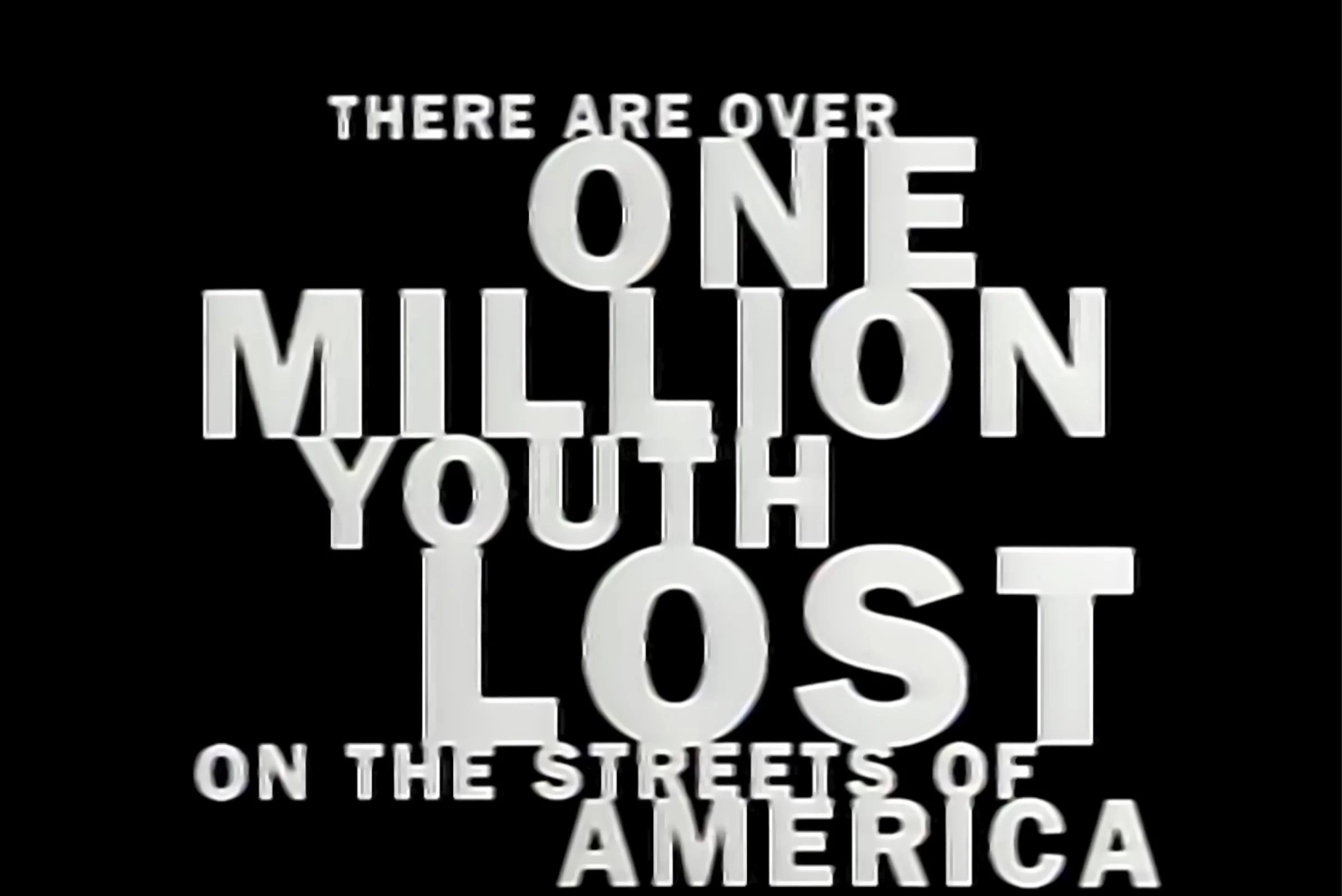
The opening shows those stats for lost youth, underscored by a whoosh of traffic and police sirens. The songs starts, the band playing in a yellowy glow, but almost immediately there are flashes of other people. Mostly everything is in close-up at first, which is disorienting but mood-building. We see tears on a cheek, a door slammed, Dave Pirner looking directly at us. Soon, multiple narratives unfold, each centering a child experiencing abuse or crisis.
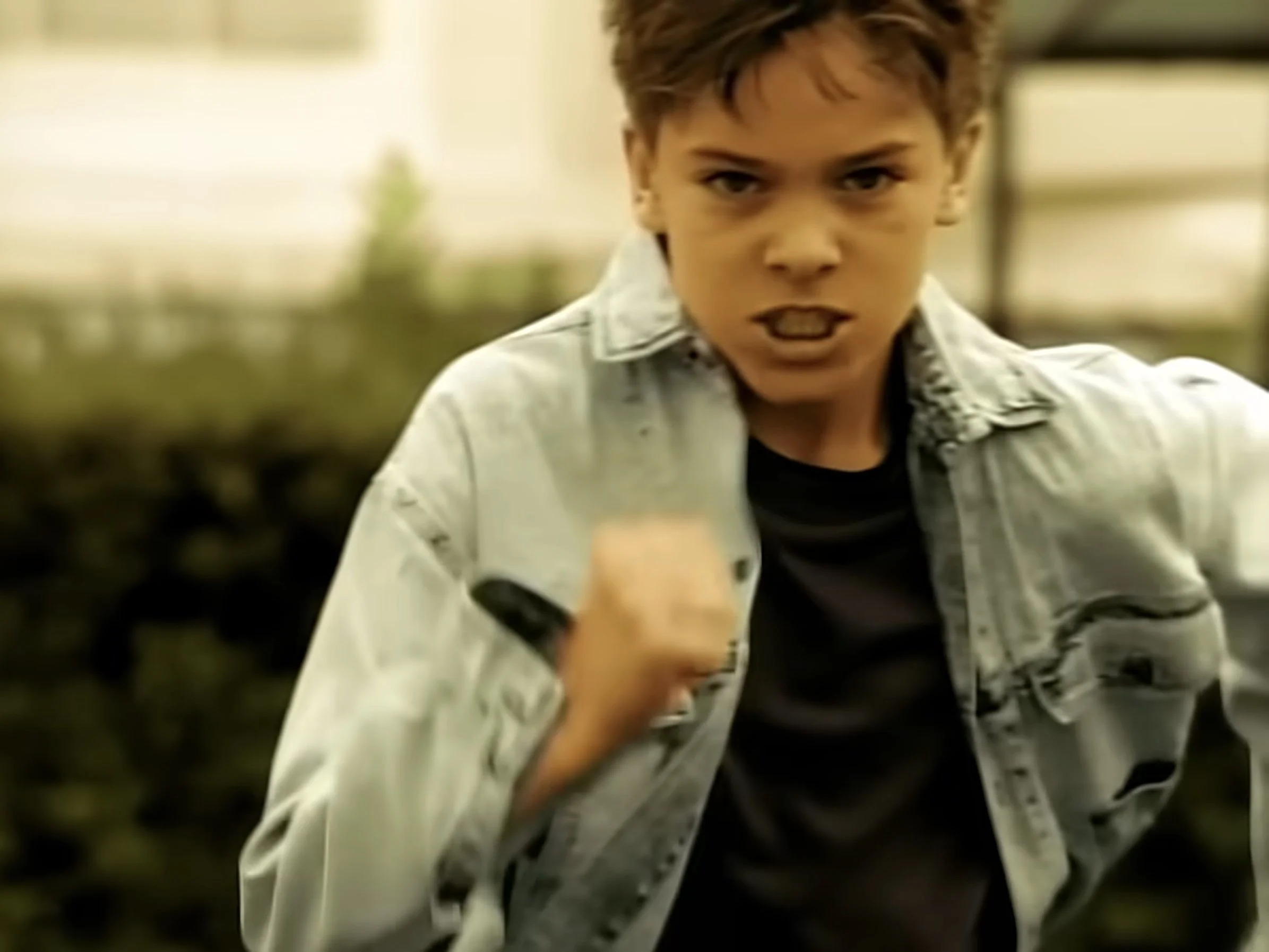
First, an older man beats his wife to death, and a young boy, likely the grandson, witnesses and tries to hide. The boy escapes, running in slow motion, fear in his eyes. The video uses hallucinatory and jumbled visuals which converge and overlap in quick cuts and collage, but then we have moments of clarity like this, this terrified boy running toward us. A quick cut to a child taking candy from a white-haired man, then the chorus kicks in, and the video’s agenda is clear. Photographs of real “lost youth” appear, each followed by a black screen showing their names and “missing since” dates displayed in white text. It’s jarring, even though I’ve seen it so many times, this sudden movement from blurry, active violence and escape to a smiling photo of a real teenager who might be dead.
The band moves into the next verse. A little girl in makeup shivers on the street with a group of sex workers. Pirner sings “Can you help me remember how to smile?” and there’s a cut to a smiling infant in golden light. Then back to the girl, where an old man—the same grandfather—is pulling up. He has big glasses and big teeth, a cartoonish exaggeration in line with a child’s nightmare. The frequent cuts mimic memory. We see the smiling baby with its mother, Soul Asylum playing in a dilapidated house. Another cartoon-like villain, a frightening older woman with sharp eyebrows and thin lips, drives and smokes and watches. The little girl is forced into a van. Soul Asylum plays, and something appears over the scene, an impressionistic image superimposed, the face of a child. Is this a ghost child? Has one of these scenes gone too far? Or, is it representative of a child’s face reflected in a TV, like my own child’s face must’ve been, watching the video?
The men in the van take off their shirts. A flash of red, an ambulance, the girl on a stretcher with a bloody lip, the band in that yellowy light again, the house’s peeling paint, the dirty kitchen. Flashes of children’s drawings in black ink. It’s unclear if they’re witness sketches, or simply products of a child’s imagination.
The solo starts and the collages become more complicated and disorienting, but the children are gathering, these injured and abused children, and they’re heading somewhere green. More children run in slow motion, a girl’s grimace so full of pain, a kid with a black eye, a flash of the bleeding grandmother. And then all the kids are together, trying to hide under a white blanket or tarp, which is actually a blown-up image of one of the missing photos. But maybe they are safe now in this makeshift fort, this childhood symbol reminding us of the childhood they’ve been denied. This scene is miniscule, gone in the blink of an eye.
While the mother and the smiling baby stroll down a busy street, the thin-lipped woman smokes and hunts. The mother looks in a shop mirror, and the woman, her severe shoulderpads enhancing her predatory look, snatches the baby. Now the mother is the one running in slow motion, and the last image is the biggest gut-punch of them all: a photo of a real-life toddler, then the words “THOMAS GIBSON, missing since 1991.”
Director Tony Kaye was inspired by a kid on a milk carton to create a video with “social relevance,” but he says, referring to the strength of the song, that he “could have filmed a brown paper bag for three minutes and it still would have been a hit.” He mentions in this same interview that 21 out of the 36 children featured in the video have been found. “I’d argue that it was the single most important thing that happened in the history of MTV,” he says, “because it saved young people’s lives.”
But it’s complicated, because there are other factors at play. Kaye concedes some of this, albeit vaguely, noting how “it wasn’t always plain sailing for the families afterwards—kids don’t run away from happy homes—but maybe things had changed when they went back or they were older and able to cope better.” Guitarist Dan Murphy goes into more detail in a 2006 interview with Pasadena Weekly:
Some weren’t the best scenarios. I met a fireman on the East Coast whose daughter was in the end of the video, and he’d been in a bitter custody battle with his wife over her. It turned out the girl hadn’t run away, but was killed and buried in her backyard by her mother. Then on tour, another girl told us laughingly ‘You ruined my life’ because she saw herself on the video at her boyfriend’s house and it led her being forced back into a bad home situation.
There were other kids [2] who met equally horrific fates, some of whose cases have only been “resolved” more recently. Aundria Bowman’s adoptive father admitted [3] only a few years ago that he murdered her and buried her remains in his backyard. But in the 90s, before she went missing? Aundria had told adults at her high school she was afraid to go home, eventually telling police her adoptive father was molesting her. He denied it, blamed her adoption for causing her “rebelliousness,” and moved the family. Another boy, Curtis Huntzinger, was murdered by a family friend, his remains found in 2008. Thomas Gibson, the toddler shown at the very end, is still reported as missing. His father, Larry Gibson, a former deputy sheriff, spent some time in prison after being convicted of second degree manslaughter. It was alleged he shot at a stray cat in his yard and accidentally killed Thomas, but it’s also said his four-year-old witnessed an unidentified couple come into the yard and abduct Thomas. And that story was later changed, with the four-year-old witnessing Larry beating Thomas to death. Every detail of every version is horrific. No body has been found. Larry Gibson was eventually released and maintains his innocence. According to The National Center for Missing and Exploited Children, who have provided an age-progressed picture of him, Thomas “was last seen in the front yard of his home at approximately 11:30 a.m. He was wearing a purple sweatshirt, grey pants, and black and white checkered tennis shoes. He has a gap between his teeth.”
This is the information that comes to the forefront when researching these children, these heinous true crime accounts, some pieced together by highly focused amateur sleuths, or the age-progression photos for those still missing, vigils held by families but largely presented by NCMEC. But holy hell, I’ve got to intervene here. I have to tell you that seeing and reading about Thomas Gibson so often has fucked me up royally. I have to tell you that I’ve been working on this essay for months, hoping to write maybe a bit more about, oh I don’t know, Dave Pirner’s hair, or the SpaghettiO’s shirt he wore at the 1993 VMAs, instead of missing and murdered children. But of course that is tangential clouding bullshit that can only go so far, because the kids are really the thing about the song, the reason for its cultural and personal impact, but also the reason it is so, so sad.
I’d only really started hitting my stride in the small pockets of time during Christmas break, which meant I had to keep mentally switching back to parent mode at a moment’s notice. I have to tell you that Thomas Gibson looks a lot like my son when he was two years old, gap in his teeth and all, and that every day, every fucking day, I have been reading about Adam Walsh getting decapitated after being abducted at a mall, and that in the chaos of trying to read and write and switch and write and switch, I had forgotten I’d promised to see the new Spongebob movie with my son, which was at the mall movie theater, and I had forgotten, too, that I’d be doing it alone, because my husband had an appointment, which is why I’d chosen that time to take my son in the first place, to give us something fun to do, and I’d forgotten, too, that it gets dark really fucking early in January, and can I tell you how much I’ve cried these past few weeks?
Well, here’s something good, finally, maybe the only little bit that I’ve got. Here is Elizabeth Wiles, the most publicized case of “found” youth.
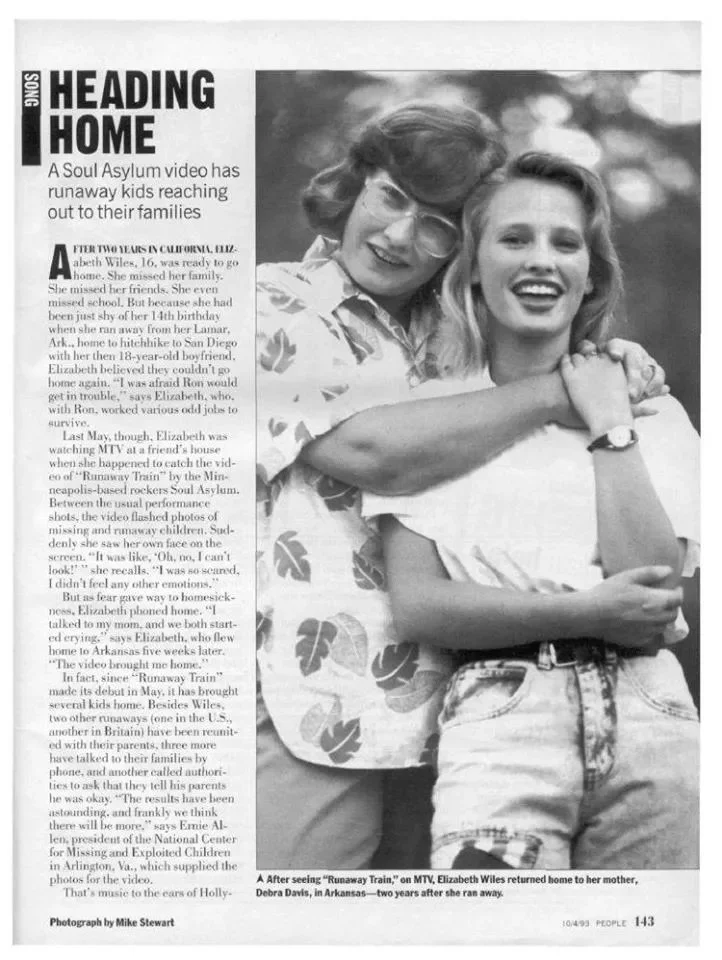
People documents how it went down:
Elizabeth was watching MTV at a friend’s house when she happened to catch the video of “Runaway Train” by the Minneapolis-based rockers Soul Asylum. Between the usual performance shots, the video flashed photos of missing and runaway children. Suddenly she saw her own face on the screen. “It was like, ‘Oh, no, I can’t look!’” she recalls. “I was so scared, I didn’t feel any other emotions.” But as fear gave way to homesickness, Elizabeth phoned home. “I talked to my mom, and we both started crying,” says Elizabeth, who flew home to Arkansas five weeks later. “The video brought me home.”
Elizabeth’s story is a lovely reprieve from the pain. And as much as I’d like to stay there, it’s impossible. Because what of the other 21?
Nick Keppler wrote a fantastic article for Slate in 2023 that clarifies a lot of what actually happened to these kids, these 21 that were “found” and the role the video played in their lives. He talks to some of them, noting how “all were determined runaways and none of them said they were ‘saved’ by the video.”
Through Keppler’s interviews, we now have documents that show a point of view we haven’t really gotten: the “found” kids from the video who didn’t have an Elizabeth Wiles type of homecoming. Through these interviews, he’s able to drive home a crucial point. “The actual lives of ‘Runaway Train’ kids were more complicated,” he writes in summation, after detailing how many of the children featured did something closer to escaping. “They ran from sexual molestation, cycles of abuse, and school days that filled them with dread. Some, impressively, found stability. It wasn’t always by coming home.”
But if these kids who ran away were escaping, shouldn’t we want them free? We should want them to run like the kids do in the video, away from the danger. Isn’t that what adults had taught them? And if that’s so, what are we to make of Thomas Gibson, of his inclusion in the video?
The kidnapping throughline is what scared me most as a child. Keppler mentions “the moral panic over abducted children,” linking to a Jezebel article called “Half-True Crime: Why the Stranger-Danger Panic of the '80s Took Hold and Refuses to Let Go” by Rich Juzwiak. Between research, Juzwiak weaves in his own experiences growing up in the early 1980s, and they closely resemble the world I grew up in a decade later, this panic bleeding well into the ’90s, even echoing and influencing today’s parenting. While reading, I vacillated between the dumbfounded epiphany that, besides the more personal and familial aspects, I wasn’t alone in my childhood terror, and surges of anger and frustration that the mechanisms behind my fear were actually far-reaching national efforts to cause the fear. I spoke to my sister about these childhood feelings a few days ago and she said, “The thing about the ’90s though is that you always thought you were gonna die.”
Juzwiak focuses on the ways the moral panic of missing children and “stranger danger” in the early 1980s infiltrated our society, how a few brutal “nightmare scenarios” (most notably the Adam Walsh case) changed legislation and paralyzed children with fear, a fear that, he posits, was caused by NCMEC’s grossly inflated numbers. He cites a Pulitzer-Prize winning article by Diana Griego and Louis Kilzer that says, for example, “The FBI reports that it had 67 cases of children kidnapped by strangers in 1984. The National Center for Missing and Exploited Children says that it has firm records on 142 cases.” Juzwiak explains that the number became inflated because “runaways were often lumped into statistics about missing children—as many as 95 percent of children reported missing were runaways, and most of that group returned home within three days.” And this was 1984, a decade before the Soul Asylum video. In that video, those two separate issues are absolutely conflated, echoing the same type of meaning-merging the song and video experienced.
Juzwiak speaks to Joel Best, author of Threatened Children, who explains why this phenomenon took place, and perhaps why it continues:
We take our anxieties about the future and we translate them into efforts to protect children [...] We have this sense that the future is uncertain. Children are the walking, talking future. There is a sense of powerlessness and a sense of fear. We seize on protecting children as a way of, ‘We can do this.’
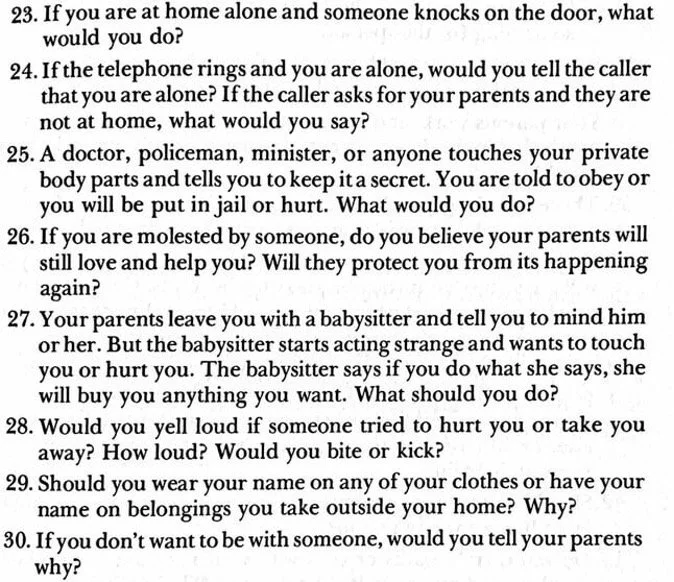
This overcorrection and overprotection has its root cause in fear, but that only begets more fear. “In 1986, the classroom-distributed periodical for kids Weekly Reader found in a poll that Stranger Danger and the threat of nuclear war were among the biggest concerns of kids in Grades 2 through 6,” Juzwiak notes. He cites Weekly Reader’s editorial director Dr. Lynell Johnson as saying “I think we have scared kids too much.” He underlines this point by including an image of the 50-question Protect Your Child survey by Laura M. Huchton, a much more intense version of what appears in my KidCare ID:
The cycle continues. The fear still infects us, as the near-inescapable bombardment of news, of online content, reminds us of danger. Putting aside all the other gigantic threats going on simultaneously in our world, there are the child-centric, whether real or imagined, or “half-true,” as Juzwiak mentions in his article’s title—the spectre of the Epstein files, the QAnon conspiracies, Chris Hansen’s popularity, rumors of Pinterest child pornography, school shootings, radicalization on Fortnite, child predators on Roblox, AI chatbots pushing children to suicide. We keep them home, but we allow them on devices that threaten. There is always a threat, so our fear is seemingly always warranted. In an article for The Atlantic, Kaitlyn Tiffany describes the perfect storm that created the fear and propelled the movement in the ‘80s:
‘Family values’ political rhetoric drove paranoia about the drug trade, pornography, and crime. Second-wave feminism had encouraged more women to enter the workforce, though not without societal pressure to feel guilt and anxiety about leaving their children at home alone, or in the care of strangers.
So much of this sounds like a version of what’s happening now in our tech-dominated world, which is part of Tiffany’s point, as she goes on to explore the ways child sex trafficking conspiracies spread easily, with usually-reasonable people falling for misinformation because who wouldn’t want to help a child? She writes about the internet’s role as both a problem and a tool that “gives each of us the power to take on work as champions of morality and marketers of fear.”
There’s even reflection back in our media again. I watch with my son as the evil entity Vecna on the 1980’s-set cultural juggernaut Stranger Things explains how he preys on children because they are weak, how he picks out the especially weak ones. It’s no accident that he’s styled in so many ways after Freddy Krueger, the spectral embodiment of a literal child molester who was burned to death by overprotective parents. And, spoiler, it’s Winona Ryder—who lived in the same community as Polly Klaas, who offered $200,000 for her return, and who was once, interestingly enough, Dave Pirner’s girlfriend—as Joyce Byers, the mother of the abducted “lost” kid[4] in the series, who gets to decapitate Vecna at the end.
I have to tell you something else, too. I’m writing this from inside a depressive jag, which is also part of why I’ve been crying so much. This research is definitely contributing, but more likely, it’s this time of year.
My father died five years ago, and that Christmas was spent watching him in hospice, much like I’d watched his father when I was five. The disintegration of a person, of a body. I spent the time wanting something different to happen. The fear consumed me, anticipatory grief a heavy rock on my chest. When it became abundantly clear something different was not going to happen, when I understood all they could do was give more morphine, when I understood he’d no longer wake up, the fear dissipated almost immediately. Maybe this is because I’m an adult now, and can sort through these emotions more deftly. I can’t say any of those emotions felt good, but it felt good not to be afraid anymore. The sadness, which I’d only come to understand during the ensuing year, wasn’t as bad as I had assumed it would be. It was the fear that was worse. And I started to see how the fear is always worse, how fear has paralyzed me throughout my life, how it kept me from understanding reality.
I hate the holidays, too, because someone I love very much, someone I’m too scared to name here—fear still exists in me more fully than I’d like it to, but I’m seeing this paragraph as a step forward—physically assaulted me before Thanksgiving when I was fifteen. My mom was too scared to call the police, so we waited until a teacher noticed my black eye. The teacher called the Department of Children and Families, but by the time they showed, my bruises were fading. When we got the pictures we’d taken back from the lab, we saw how the injuries and marks on my arms had been washed out by the flash. By January, I’d tried to kill myself. And even so far away from all of that now, early winter still reminds me of the days I spent in the hospital trying to imagine a home I could return to, one infinitely better and safer than the one I left.
I think when I watch the boy running out of the house in the “Runaway Train” video now, it makes me cry because I wish I’d run, too.
When the fear comes, because it always does, I try to make it useful. But it’s hard. Sometimes I turn on PlutoTV’s 90s music video channel before I leave the house as background noise for my dogs. The other day, when I was getting ready to take my son to school, “Runaway Train” came on. “Oh!” I told him. “This is the music video I’m writing about.” In my excitement, I wasn’t thinking beyond that.
“What is it about?" he asked as we stood inches from the screen. “What happens in it?”
I paused. I tried to explain, how it’s a story. It’s not real, those frightening people aren’t real, but the pictures are, how they made the video to help the kids. “But I was so scared of it when I was your age,” I said. And then of course he asked so many more questions.
How was I supposed to explain it without scaring him? This was one of those parenting moments where time seems to freeze and you have the opportunity to do something different than what was done for, or to, you. “You know stranger danger, right?”
He laughed, said, “yeah, guys in vans.”
Why was it funny? Do they teach stranger danger in Health class? Had I already told him this? We’d gone over bodily autonomy, consent and privacy, how sperm meets egg—so many conversations I powered through in hopes to normalize and inform, to reset generational harm. Or, fuck, tried to. And now I have these statistics, this knowledge.
The fear creeps in, so I try to decide how to use it. But the impulse is there—to pass it along. I want to scare him.
What would you do if a man asked you to help find his puppy? I want to ask. If someone grabbed you, would you scream? Would you kick and bite? Would you run, and run, and keep running, and not look back?
[1] There are reports Klaas was featured in a version of the music video, but it’s difficult to confirm.
[2] The UK video had different pictures, and at least two of the lost kids, Vicky Hamilton and Dinah McNicol, were the victims of serial killer Peter Tobin. In Australia, a number of the pictures shown ended up belonging to victims of serial killer Ivan Milat.
[3] While in custody for charges related to the 1980 homicide of 25-year-old Kathleen Doyle.
[4] The first episode is called “The Vanishing of Will Byers,” and brings to mind so much of the cultural fears of this era (and the following ones).
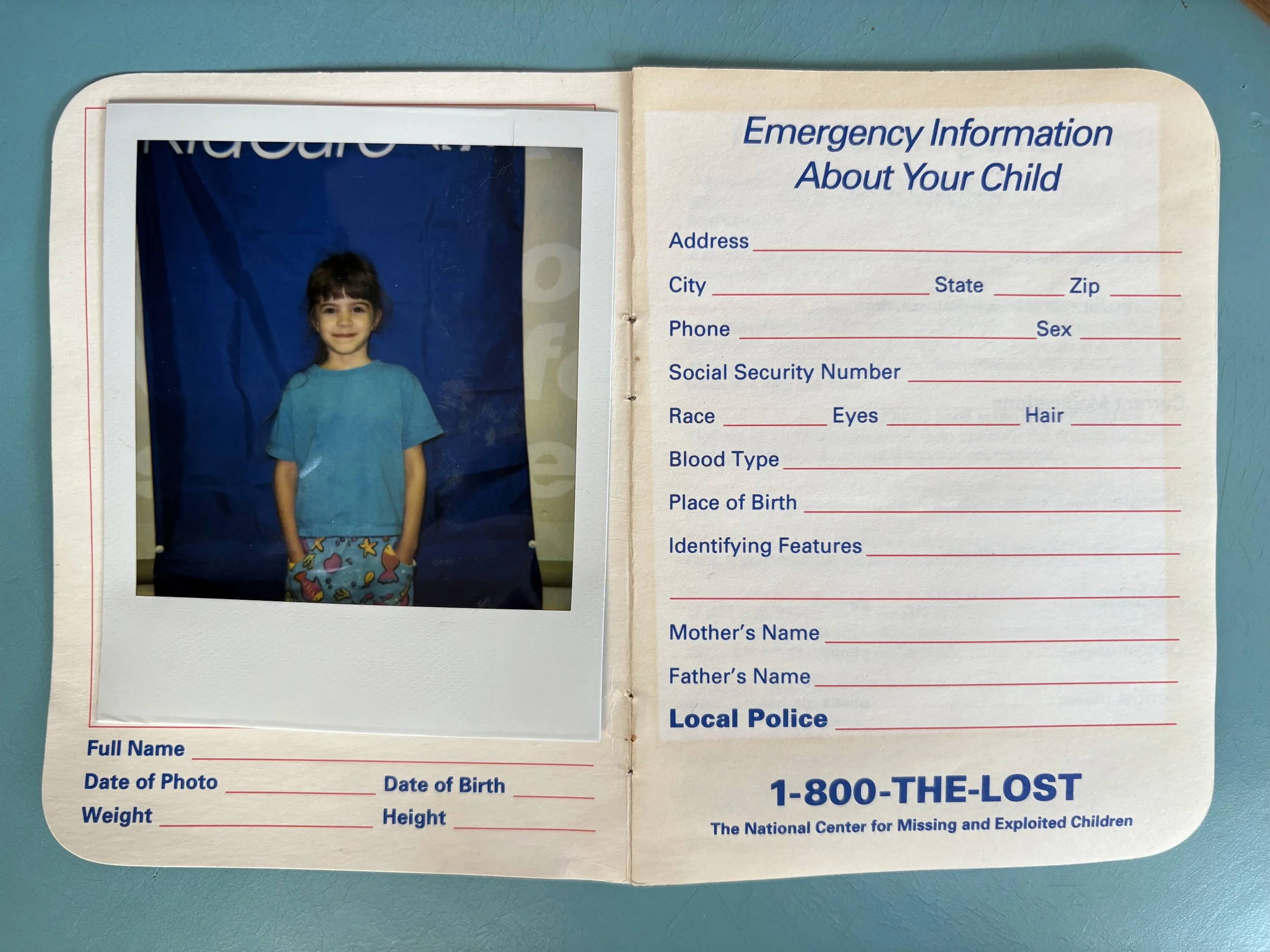
Emily Costa is the author of Girl on Girl (Rejection Letters) and Until It Feels Right (Autofocus). Emily writes semi-regularly as half of LISTLESS on Substack.
After everything falls away, what's left? christopher l. keller on On Wilco's "Via Chicago" and the responsibilities of mirrors
“Today, for instance, I am particularly oppressed by one memory of a distant past. It came back vividly to my mind a few days ago, and has remained haunting me like an annoying tune that one cannot get rid of. And yet I must get rid of it somehow. I have hundreds of such reminiscences; but at times some one stands out from the hundred and oppresses me. For some reason I believe that if I write it down I should get rid of it. Why not try?” —Notes from the Underground, Fyodor Dostoyevsky
*
I dreamed about killing you again last night
And it felt alright to me
Dying on the banks of Embarcadero skies
I sat and watched you bleed
As a young man, my father found his future home in a slice of pie and a cup of coffee at an airport diner in Madison. I do not doubt that even then, he had searched far and wide for reliable food and reliable service in every diner and restaurant he visited. I saw it all the time growing up. I heard his comments about the quality of the coffee and the warmth of the food. In this case, it surely didn't hurt that the cute waitress appeared to remember him, but didn't know his backstory or about the small-town roots that threatened to entangle and keep him on the farm. Dressed up in a uniform for a now-defunct airline that operated out of O'Hare International Airport in Chicago, he'd tell her a joke and leave a nickel or two as a tip. It's how small-town boys get women in the city to remember them.
It's how you stand out.
The cute waitress, my mom, saw that airport diner as just another stop in another town she had moved to after her father died. There would be more waitressing jobs, more cat calls, and more stingy tips. A college dropout, she made a living from tips in the big city, or at least cities only slightly larger than the small central Wisconsin towns she shifted between. As a middle child, she became used to a certain level of anonymity. That changed when she started to wait tables. People noticed her.
That's the origin story my sister and I heard growing up in the same small town that our dad came from. But there's so much more we're left to guess at. There are gaps we won't be able to fill in because we never asked, and now, our parents are gone, along with that restaurant. A gift shop currently occupies the space, and I bought a couple of shirts there a couple of years ago as I was flying back to where I had arrived from.
One said, "Nah, I'm Good." The other had a screen-printed image of the state of Wisconsin.
Above it read "This is Home."
*
Buried you alive in a fireworks display
Raining down on me
Your cold, hot blood ran away from me
To the sea
An unmistakable feeling of sadness often accompanies memories of my childhood in small-town Wisconsin. It's a sadness I kept bottled up and hid behind a forced smile and a serious demeanor. It felt less like something was missing and more like something had been taken. What remained was a space that never quite filled in. In a town of 3,000 people, where everyone not only knows each other, but most everyone is related somehow, other people offer a reflection of who you are. They provide the adjectives that serve as a kind of shorthand for your identity. You're the "Athletic" one or the "Pretty" one. Or the "Smart" one. The one who causes "Trouble."
Maybe you don't have a descriptor. Or you don't like the one you have. What then? You're left at a persistent fork in the road. Down one path, you just play it safe, all day, every day. Conformity might as well be a defense mechanism handed down at birth. "Keep your head and limbs inside the moving vehicle at all times!" If nothing sticks out—if you don't stick out—nothing can hurt you. Many people travel down that path and settle in. It's an easy crutch.

Montrose Beach in Chicago, July 4, 2010
But that other path, well, that's a rich and imaginative inner world that can unfurl whenever the noise from the outside becomes quiet enough to allow for dreams. It's filled with futures as rock-and-roll stars and secret admirers and authors and comedians. These possible identities feel as though they are just one bold step away from becoming reality. But even there, untethered from reality, a very real fear lingers. Fail, and the folks back home begin to whisper. They talk among themselves and agree on the adjectives they can apply to your endeavors. They seem to believe that you can either stay at home or you can find your true self; you can't do both. When you're dead and gone, when you've eventually found peace and a place to rest, they'll think back to how you carried their load a thousand times on your back. In that remembrance, they'll shout about how they knew you.
They'll never know how you subtracted them from your sense of self years ago.
*
I printed my name on the back of a leaf
And I watched it float away
The hope I had in a notebook full of white dry pages
Was all I tried to save
But the wind blew me back via Chicago
In the middle of the night
And all without a fight
At the crush of veils and starlight
Growing up, I didn’t lack for friends. In the small subdivision where we lived, by sheer proximity, kids were everywhere—up and down the street, around the corner. You knocked on a door to invite someone outside, or you rode your bike or shot baskets in the driveway, and sooner or later someone joined you.
There was one summer, though, when they didn't.
I can't remember how old I was or how long it lasted. I just remember that the other kids stopped knocking on my door. They stopped coming over when I was outside. Suddenly, they were outside playing together, and I watched it all from our front picture window. I didn't feel invited. I didn't feel included. I felt separated and lonely, and an intense sadness. Here's where I need to be upfront. That's how I remember that summer. That's the memory I have. Is it entirely possible that I woke up one day and wondered if they'd even notice if I didn't come around anymore? Maybe I didn't like who I had to be when I was with them, so I just chose to remove myself from the group? Absolutely.
For all the time I spent in my head, I didn't have the tools to describe how I felt to others, let alone other kids. I grew up in a time and a place where boys were expected to mirror their fathers, who were really just boys themselves. They never learned how to express their feelings, only their fears, which took the form of a hands-off approach to parenting unless discipline was required.
One kid in particular exemplifies this. He is in some of my earliest memories, rocking back and forth and banging his head against the couch cushions, shouting "I. WANT. IT. NOW." when he didn't get his way. Alone, he could be kind. But in a group, with others to show off for, he'd turn into a bully. Like the time when we were playing "pro wrestling." I thought we were pretending. This kid took every opportunity to remind me of how "weak" I was.
Anyway, sometime in between that moment we were first introduced and that summer of loneliness, that kid found a way to describe me. I might have been about my son's age now, an age where everything is real, because why would people want to hurt their friends, physically or emotionally? I'm sure he doesn't remember today, but I can recall how there in a fort we had made in my backyard, he reduced me to tears in an instant.
"You're a mama's boy," he said. "You have to have your mom fight your battles for you."
He wasn't wrong. I absolutely gravitated toward my mother more than my father. One-hundred percent. Dad was insular and reserved. He'd show me how he'd do things, but never let me try on my own; his directions were the right way to reach the end. Mom, on the other hand, made it OK to try something and move on if it doesn't work out. We all make mistakes, so why linger on them? She had a big personality and knew that humor and a little bit of silliness helped to put others at ease. Given all of the health issues she'd encountered since her teenage years, I suspect she had developed this defense mechanism. Doesn't matter. I liked the reflection of myself that she provided.
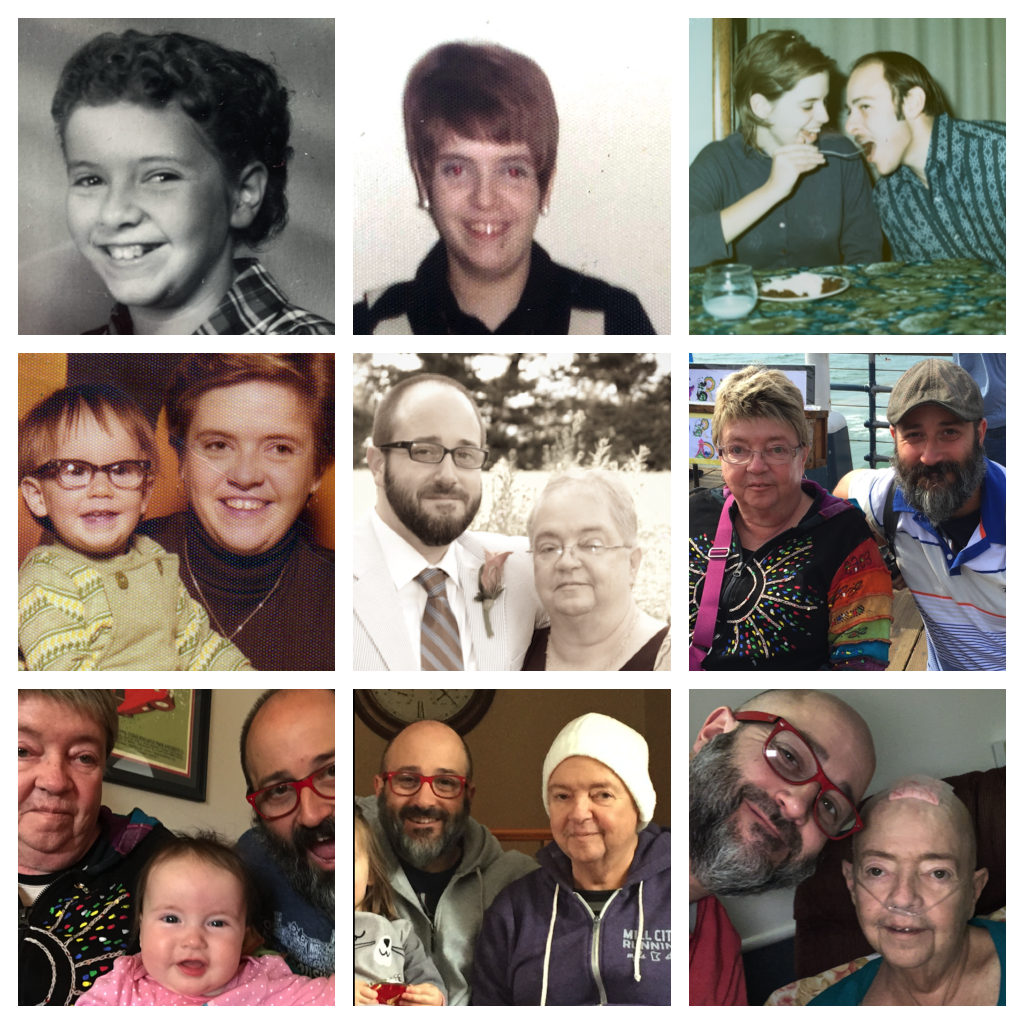
The many faces of my mom
I didn't know it at the time, but mom wrote a lot when we were kids. I found one diary a few years back that somehow survived the house fire that took my dad's life. She started it when she was pregnant with me. In her perfect mom handwriting, she wrote down her hopes and dreams and fears. She commented on the changes she saw in dad and his adjustments to what was taking place. She marked the day when they settled on the name Christopher Lawrence for a boy. A couple of times a year, I pick it up and read through it. Each time I find some new detail that brings me some comfort. Most recently, I fixated on something she wrote on the first page. They aren't her words, but those of Kahlil Gibran from his poem, "On Children":
"You are the bows from which your children, as living arrows, are sent forth."
*
I know I'll make it back
One of these days and turn on your TV
To watch a man with a face like mine
Being chased down a busy street
When he gets caught I won't get up
And I won't go to sleep
I'm coming home, I'm coming home
Via Chicago
Wilco's Jeff Tweedy didn't expect to live past 2004's "A Ghost is Born," which, save for a few key musicians, was the first album of the band's current—and longest running—lineup.
In New York City, in the throes of an addiction to the painkillers he used to combat the migraines that had afflicted him since elementary school, Tweedy said he was consumed with a "looming sense of imminent demise."
"[I]t felt like a big flood was coming, something no one could survive. So I was saving anything I could, piling it all onto this ark as a way to salvage whatever I could of myself," Tweedy writes in his 2018 book "Let's Go (So We Can Get Back). "...A Ghost Is Born would be a gift to my kids, who could turn to it when they were older and put together pieces of me a little bit more than I'd been able to put myself together for them in real life."
What he was doing, then, was removing anything that would dull the mirror he wanted his children to return to one day and see something of themselves in.
Tweedy grew up in Belleville, Illinois, a town of around 40,000 people that sits some 15 miles from the Missouri state line. Parents JoAnn Tweedy worked as an interior designer while Bob Tweedy worked at all hours for the local railroad company.
"Most nights I'd stay close to my mother…as she watched TV and smoked cigarettes on the couch. It was the best she could do," Tweedy writes in his 2018 book. "She'd been a mother for so much of her life that by the time I came around, she'd kind of given up on parenting."
Belleville and its residents are obvious characters in the music created by Tweedy's second-most well-known band that he formed in high school with classmate Jay Farrar. Uncle Tupelo helped create the alternative country/No Depression movement (named after the song on its 1990 album of the same name). A well-documented falling out with Farrar a few years later led to Wilco.
"Via Chicago" appears on Wilco's third album, 1999's "Summerteeth," which Pitchfork gave a score of 9.4 in its review, calling it "a loose song cycle considering the intermingling of perception, communication, and reality, and its [effect] on our relationships." The initial recording sessions took place about two years prior in Texas in Willie Nelson's studio, according to the 2004 book "Learning How to Die" by Chicago music critic Greg Kot.
"Tweedy was particularly emotional during the sessions because he was upset that he was unable to spend time with his wife and son because of the constant touring schedule," Kot wrote.
Inspired by Henry Miller and written in the style of a murder ballad—think "Long Black Veil"—the near co-dependent nature of Tweedy's relationship with another Jay, Jay Bennett, no doubt also influenced "Via Chicago." In his book, Kot relays this from then-Wilco drummer Ken Coomer:
"It was Jeff and Jay feeding off each other, not just musically, but other vices. There was a bonding going on, and it didn't just involve music. Jeff didn't go into rehab [for an addiction to painkillers], but he should've, [sic] in my opinion. Jay was taking painkillers, antidepressants, and wasn't in much better shape."
Bennett, who passed in 2009, lays a thick dirge over "Via Chicago" that seems to mask and rob the studio track of the immediacy and stakes of the modern-day live version. While both ask for your attention, the studio version feels lilting and morose. The live version feels necessary and haunting. Reducing a song to one moment feels foolish, but for me, it's the fourth time we hear the arpeggiated D major riff that serves as a kind of chorus. It's not the climax, but the first time we hear current guitarist Nels Cline make his instrument cry in a way that shows us what pain sounds like when it's left alone long enough to finally earn its release.
Maybe the song can reach these heights because the people now around Tweedy have helped him to see something in himself that past bandmates couldn't or wouldn’t. Especially the Jays, who chose competition instead of a complementary role. Perhaps it was the other way around. You never know until you run the equation.
But perhaps we're given a hint in Kot's book and his description of what took place after the last Uncle Tupelo show.
“Tweedy drove to his parents' house on 40th St. in Belleville, sat down on the footstool in his living room, and sobbed."
*
Where the cups are cracked and hooked
Above the sink, they make me think
Crumbling ladder tears don't fall
They shine down your shoulders
Crawling is screw faster lash, I blow it with kisses
Rest my head on a pillowy star
And a cracked door moon
Says I haven't gone too far
It would be easy to dismiss the lyrics to “Via Chicago” as nothing more than an ode to coming home. Tweedy has said he doesn't put too much into the meaning of songs—his or others. As for me, the song’s power lies in the implied changes that take place while traveling a path.
The song isn’t so much about arrival as it is about metamorphosis and what happens when someone passes through different places, among different people, long enough to be changed. What once felt fixed becomes malleable, negotiable even. The experience not only alters who you are, but also your very definition of identity. It isn't a destination, but a continuum that stretches over time.
On one end, you have the stories about yourself that you inherited from others. The routines and expectations you didn't have a say in, but took part in nonetheless. On the other end, you find comfort. A place to rest as yourself, if only for a little while. Somewhere in between, you find "Chicago." Filled with potential energy, it's a place of beginning and becoming, where the roles you were assigned loosen just enough so you can imagine something else entirely.

Millennium Park, Chicago
In some ways, Chicago is home. In others, it’s a mess. Because when the door slams shut on the version of yourself, and you have to face what comes next, home is where you go to cry. It's where you go to face who you've become and begin to calculate the equation anew.
*
I'm coming home
I'm coming home
I'm coming home
Via Chicago
I'm coming home
I'm coming home
I'm coming home
The last time I heard my mom's voice, I found myself in a familiar spot, wrapped up in blankets in my childhood bedroom, alone and crying. A week earlier, I had traveled a thousand miles to check in on her and my dad. Both were in an assisted living facility. Dad had suffered a stroke. Mom had aspirated a morphine tablet she was taking for pain. Doctors said we should consider hospice.
The uncertainty of that week could have lasted ten lifetimes. The day before, my sister and I told our parents they couldn’t stay in the house alone anymore. That conversation went poorly. Later, as we tried to eat together as a family, I had nothing to offer. My tank was empty. My outlook was poor. Mom looked my way and tried to coax a smile. Instead, I think she saw the fear.
Afterward, in an attempt to stop time for just a moment, I retreated to the house they hadn’t lived in for weeks. There, among the clutter and chaos, I carved out a small space so I could rest before going to see mom. Instead, I wallowed. I called and told her I’d be by in the morning.
I had traveled clear across the country, and all I had to do was get up, drive four minutes up the street, and sit with her for a while. Instead, I stayed there under the blankets in the first bedroom I remember and wept. I thought I was safe at home. I wasn't.
I never heard mom's voice again. She never spent another night in the home she helped make. Some time after we spoke on the phone, she fell trying to leave her bed. The fall seemed like the last thing her body and mind could take. When I arrived on Monday morning, doctors had sedated her. All that was left to do was wait for her to decide it was time to be done.
On the day of the funeral, I spent some time lurking around the basement of the Catholic church, remembering the weekly after—school Catechism we'd attend there. Of how attending Catholic Mass was a regular part of my childhood. As I made my way upstairs to await the beginning of the service, I saw a longtime village resident who had volunteered as a Girl Scout leader with my mom decades ago. This is someone who knew my mom. Someone who had learned from her. I flashed a smile and said hello, and she offered condolences. But in that Midwestern way of just not being able to help themselves, she gave me a leftover sentiment to take with me.
"It sure is nice that they opened the church up for someone who hasn't attended Mass in so long."
More than seven years later, those words still bounce around my head from time to time. Thankfully, they're quickly drowned out by this second chance I still chase. All my life, I knew that at some point I would be there next to mom at the end, to be the one to comfort her. To offer her something familiar. To remind her not of who she had become, but of who she had been. A waitress. A mom. A retail clerk. A preschool teacher. A 50-year-old college graduate. A tutor for inmates. But when faced with that moment that had dominated my thoughts since I was a child, I didn't know what to do. I had no one to mimic. My role model couldn't talk to me, and without that mirror to offer me a reflection, I became the person I'd always been: a frightened child who wanted his mom.
Turns out, after balancing the equation, responsibility remains.
*
I'm searching for a home
Searching for a home
Searching for a home
Via Chicago
I'm coming home
I'm coming home
Since my mom passed away, I’ve returned to my hometown a handful of times, usually for funerals or to clean up my messes. My most recent trip, in September, was for my cousin’s funeral—someone who became a touchpoint for my dad after mom’s death, and a kind of surrogate father to me after dad passed away.
The visit carried the trappings of home. My sister was there. We ran into cousins. When we stopped at the property where the house we grew up in once stood, our old high school guidance counselor happened to be walking by, and we talked for nearly an hour. People I ran into remarked on how much I’d grown up. They asked about the stories I'd worked on for The Associated Press and told me how much I reminded them of my dad…of how much they missed my dad.
And then it was done. I managed to resist the urge to linger as the version of myself I’d been for those few days. I had a flight to Chicago to catch. My sister dropped me off at the Dane County Regional Airport. On my way to the security checkpoint, I passed the spot where the restaurant used to be—the one where my parents met so many years ago. As we began our descent into Chicago, I thought about all the versions of myself that have passed from this world. I’ve started over so many times I’ve lost count, but I have a clear sense that the time in front of me is shorter than what I've left behind me; starting over now would be a waste.
Later, after scrambling through O'Hare to reach my connecting flight, my mind turned toward who I was returning to and where I would land. It’s the place where my kids go to school and dream big dreams. Where I’ve shared years of school rituals and milestones with other parents. Where I play basketball four times a week, play guitar and drums (like this cover of Via Chicago), record tiny songs, and spend time with people who push me to be a better version of myself. And it’s where the love of my life—a girl who once took me along on her own adventure to Chicago—waited for me.
If you asked her how I’ve changed, she might say I haven’t, not at my core. But I hope she’d also say I no longer mistake motion for progress. That I’m willing to account for my actions, the successes and the failures, even if she needs to remind me what those are.
Still, something feels unfinished. In a group text message recently, a friend said he needed to start sharing wisdom with his kids so that after he’s gone, they'll have something to remember him for. I knew exactly what he meant. Like my mom, I used to write solely for myself. There's a box under my desk filled with notebooks containing observations, poetry, short stories, and essays. It's been my intention to return to them and attempt to remember who I had hoped to be by now. Maybe even jumpstart the muse. But, to me, the solitude required to explore one's mind and create what it sees feels too much like isolation.
My children deserve more than my bylines and stories I've told about the news. They deserve to read stories about me and about their mom and all the people in our lives who shaped us. They should know about the places they used to know as home, and the stories of their past selves from times that they will never remember.
They deserve a mirror held in place not by a guide, but by the court jester.
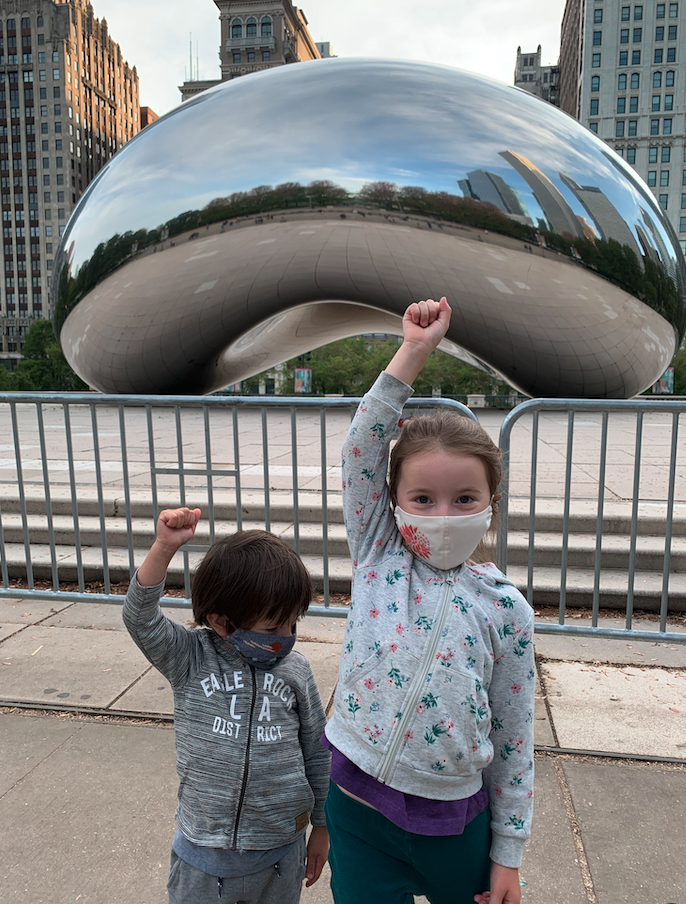
Cloud Gate, aka "The Bean," in Downtown Chicago
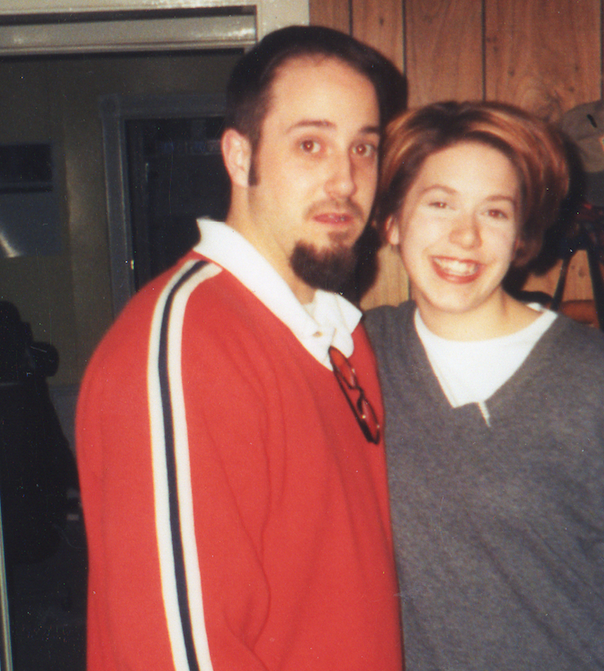
The author and his sister, 1998
Christopher L. Keller is on track to join his mom as a college graduate at the age of 50. He's planning to receive his bachelor's degree in Liberal Studies in May from the University of New Mexico. He is also an award-winning journalist with The Associated Press based in the Southwest. He believes that telling stories helps people understand the world around them and their place in it. Most importantly, it helps him understand his place in it.