
second round game
(7) Alanis Morissette, “uninvited”
snubbed
(2) Bonnie Raitt, “i can’t make you love me”
89-82
and will play in the sweet 16
Read the essays, listen to the songs, and vote. Winner is the song/essay with the most votes at the end of the game. If there is a tie, we will play a one-hour overtime (and repeat until we have a winner). Polls close @ 9am Arizona time on 3/13/26.
casey powaga on bonnie raitt’s “i can’t make you love me”
Anyone who sings a lot of karaoke like I do has their list of go-tos. I tend towards 1980s male vocals, singers like Tom Petty, David Byrne, and Peter Gabriel. Avid karaoke singers also keep a secret list of their all-time bombs, performances that were so poor the singer shrinks at the memory of them. Even years later, these performances inspire cringes in the shower or behind the wheel or wherever else past embarrassments seem to creep up.
Sometimes, it’s the singer that’s the issue. They’re too drunk or they don’t actually know the words to the song or otherwise can’t keep up with its tempo. Some songs, however, have no business being sung at karaoke by novice singers. For songs like these, you almost can’t blame the singer for their hubris in thinking that they have the pipes to bolt out a given hit, a song so powerful in its presence and resonance that of course someone would want to belt it at the top of their ill-prepared lungs to a room of strangers.
I have a handful of karaoke bombs in my quiver. The most awful bomb must be “I Can’t Make You Love Me” by Bonnie Raitt, sung in the early evening to a near empty Tucson gay bar called, “It’s About Time” or IBT’s for short. This was in late-summer of 2010 and I was at IBT’s with my then-girlfriend Sara who had helped me move from Portland to Tucson for grad school. I sat at the bar while I sang, a small consolation to my embarrassment, a way to hide my shame and I struggled through the song. My voice shook as I strained to hit any of the notes. The slow melody seemed to drag out longer than the song’s 5:33, which is already too long for a karaoke tune.
The song had snaked me, jumped up from the grass and bit me on the calf. I’d heard it a million times before and had thought that surely, the slow and steady tune with the plaintive lyrics would be in my wheelhouse. It would be doable. The song’s seeming simplicity had tricked me. The chorus is so direct and human, so relatable: “I can’t make you love me if you don’t.”. Who among us hasn’t felt that degree of unrequited love? It’s more than that though. Somewhere in the song’s deeply simple lyrics and melody lies the plainness of love, its binary nature. You either love someone or you don’t. Someone either loves you or they don’t.
The instrumentals and tone of the song are as stark as its message. Mike Reid and Allen Shamblin, the writers of the song, reflect in an interview about these instrumentals. Bruce Hornsby plays piano on the recording. “Bruce really took the intro and he articulated what I wrote,” Reid said. “He did it through the Hornsby filter, which really kicked it up to another level.” Shamblin added, “I thought [Bruce’s part] was transcendent. It was spiritual.”
After the song’s initial recording, co-producer Don Was set to adding overdubs and embellishments. The producers soon realized that they needed to strip away everything that they added. “It took me a minute to figure out to get rid of all that stuff,” said Ed Cherney, the song’s engineer. “It didn’t have that emotion anymore. I started hearing the work we were doing instead of the moment of somebody bearing that soul. All that other extemporaneous stuff got in the way of it. I was trying to get back to that feeling, that total feeling of empathy for her and that deep sadness, that deep feeling of that loss.” The track’s spare nature is a part of its appeal. Less is more.
While I struggled through my karaoke rendition of “I Can’t Make You Love Me,” unrequited love was the furthest thing from my mind. I was deeply in love with Sara. And she was deeply in love with me. We were enamored with one another. Our happiness betrayed the mess of the start of our relationship. Our romance had started in scandal up in Portland. Sara and I had known each other for years before we started dating. She’d been the on-again-off-again partner of my best friend, Alex. A few weeks after Alex and Sara broke up for what would the last time, Sara and I met for drinks. The rendezvous was at first completely innocent. We wanted to remain friends after the breakup. We wanted to catch up. What happened instead was we fell madly in love, first that night over drinks when we admitted to one another creeping mutual crushes.
Alex and I had been friends since high school back in Minnesota. She had transferred to my big, public suburban high school at the start of Sophomore year after getting kicked out of her Christian high school for giving flowers to another girl. We met for the first time in Frau Ortenzio’s German class, where we stumbled over the language’s inscrutable grammar but mostly just goofed around in the back of the room. Alex and I shared a sense of humor at the absurdity of high school, our teachers, and the overall mores with which we were both raised, Alex, evangelical Christian, and me, Catholic.
We also shared the trappings of turn-of-the-millennium teenage queerness: interest in women singer songwriters, crushes on female teachers, and an abiding interest in the show Xena: Warrior Princess. Despite all the evidence of our gayness, we were both still closeted to ourselves and others and wouldn’t come out to one another until college when we had both finally got away from our homes and explored life and romance out on our own. After college, I would visit Alex in Minneapolis and we’d go out to gay bars and tear shit up. A few years later, Alex moved to Portland, Oregon, where I’d eventually follow her from the East Coast after a bad breakup with my first girlfriend.
In Portland, Alex and I became young adult friends, meaning we’d meet each other after work for happy hours and complained about our jobs and our love lives. We took to calling the “happy hours” simply “hours” because each of us were deeply unhappy with our entry level jobs, our farcical romances, and strained relationships with our Christian parents. Alex and I were devoted to one another. We spent weekends together hiking and exploring Oregon. We engaged deeply in the process of growing up, together.
The fact that Alex was the Great Platonic Love of my twenties made my revelation to her that I was in love with her recent ex excruciating. Alex and I had plans on a Tuesday to go to a concert at the Doug Fir in southeast Portland. The concert had fallen less than a week after my happy hour with Sara that had evolved into confessions and the weekend that had devolved into lots of sex. The night of the concert, Alex pulled the car up to my home and before getting out, I told her that I wanted to date her ex, Sara. Alex was shocked. She angered, told me to get out of her car. We wouldn’t speak again for years.
“I Can’t Make You Love Me” is a devastating song, slow and mornful, not typical top forty fodder. From the get, you hear the singer’s abject longing, her swallowed pride at the confession that yes, she’s in love with the you of the song even though there’s no chance that they’ll be together after this final night. It’s the last straw for the singer, one last attempt to hold and touch and look at the beloved with the hope that they’ll love her back. They do not love her back. They never will. The singer knows this, despite herself.
Somehow, Bonnie Raitt recorded this perfect song in one take. According to Raitt, the song was so sad she couldn’t recapture the emotion of the tune in additional recordings. Artists know: When you have it, you have it. “I Can’t Make You Love Me” became one of Raitt’s biggest hits.
Towards the middle of the song, Raitt falls into a painful double negative. She sings: “I close my eyes, then I won’t see the love you don’t feel when you’re holding me.”
A lot is made of the blindness of love, how one doesn’t see the flaws in a romantic partner or other possible constraints to the partnership. But there’s also a looking away required of people in unrequited love, a willful ignorance around the affections of another person. Bonnie Raitt captures this sad knowledge, the recognition that what’s felt in one’s mind and body doesn’t necessary match real world circumstances.
The inspiration for the song had come to Reid and Shamblin from an anecdote in The Tennessean about a man who, having succumbed to alcoholism, lived under a bridge in Nashville. One day, the man’s wife came to pick him up to bring him to the courthouse to get a divorce. “We hugged, and we cried, and then we went through with the divorce,” the man said. “You know, you just can’t make a woman love you.”
It's telling that the man did not blame himself or his alcoholism for the divorce but rather the absence of love. His fortunes had been decided by a woman’s whims rather than his own problems. Instead, his divorce was on account of a lack of love, a coinflip of the heart which landed on “loves me not”. Most situations are tinged by the subjectiveness of those involved. A drunk always holds an unreliable point of view.
Now, with the clarity of half a decade of sobriety, I reflect on my drinking days with Alex as a sort of cudgel against the loneliness of one’s twenties. Back in the day, Alex and I would throw back the drinks at our “hours”. Beer after beer. Gin after gin. If it was the weekend, we were drunk. Our jobs and love lives were difficult, so we drowned our sorrows. For a time, Alex had Sara, though, despite the ups and downs of their relationship. My love life was especially desolate. Upon moving to Portland, I’d thought that I’d have dates lined up out the door. The city was a queer utopia, I’d imagined, a place of endless romantic opportunity. Instead, and over the course of two years, I’d had several one-night stands and women who, despite my pursuit, weren’t really interested in me.
My many failures made my eventual revelations towards Sara even more irresistible. Me and Sara were in love with each other. We were over the moon. I was accustomed to rejection at this point, so the mutual love felt special. Our love was requited. It was good.
Sara and I dated throughout the spring. I lost my best friend, but also a few others in our friend group who sided with Alex in the conflict. Of course, you don’t date your best friend’s ex. Even in queer circles, where the dating pool is considerably shrunken from that of the straight world, this behavior is taboo. I’d spent hours and hours with Alex drinking and imagining my life improved by the presence of a girlfriend. And then, when I finally got a girlfriend, I became a pariah to my friends. Portland was cursed, it seemed. I was either single with friends all around or partnered with no friends, loneliness served two ways.
When I was accepted to the MFA program at the University of Arizona in Tucson, hundreds of miles from Portland, my future with Sara came into question. She’d just received a promotion from work and didn’t want to leave. I was going to Tucson, no matter what. We decided that we’d make long distance work.
In the song, Raitt asks for nothing other than the truth:
Lay down with me, tell me no lies
Just hold me close, don't patronize
Don't patronize me.
This plea acknowledges something exceedingly painful about unrequited love, the propensity of people to try and let others down easy when really, the truth sets a person free. The only thing worse than someone not loving you back is that same person putting on false kindness with a tinge of superiority. The object of affection is, after all, in the position of absolute power. They have nothing to lose except for an admirer and most times, no admirer at all is better than one on such an uneven playing field.
My relationship with Sara only lasted until Thanksgiving. I visited her in Portland for the holiday and knew immediately that something was off. There was no longer a sweetness between us, no longer the urge to incessantly touch and be touched. We were done, as simple as that. Now fifteen years later, I still think of Sara as one of the great loves of my life. I also think about Alex as one of the great losses of my life.
I saw Alex two years after Sara and I broke up at the wedding of “The Moms”, my former roommates from Portland, a lesbian couple who were in their thirties and thus advanced in age compared to us twenty-somethings. Alex ignored me in the buffet line, her new girlfriend giving me the stink eye the entire event. I, too, was there with my new girlfriend, Sarah. It was all very dramatic and very lesbian. It was also not lost on my that my new girlfriend had the same name as my prior one, but what can I say? A lot of dykes born in the eighties are named Sara/h.
Alex’s snubbing of me at the wedding hurt me a lot. We’d grown up together, yet she couldn’t set aside my transgression. At the time, I didn’t think that I needed to be forgiven. I had operated out of love, selfish love but love, nonetheless.
Now in retrospect, I regret betraying my friend. I had put romantic love over platonic love and in doing so, had ruined a decade-long friendship for what ended up being an eight-month relationship. Alex could have been more understanding. Sara and I were in love. Love! It’s the greatest thing around and we should move mountains to feel it. I could have been more understanding. Of course, Alex would feel a way about me dating Sara. They’d been in love for two years, even if their relationship had not proven durable.
In the world of “I Can’t Make You Love Me”, you love someone or you don’t, love is a zero-sum game. In the Sara-Alex-me love triangle, the three of us loved each other and hated one another all at once, in a thick cloud of emotion. Sometimes, love is nebulous, there but not, elusive. And just because a relationship ends, doesn’t mean that the love between to the two people is gone.
“I Can’t Make You Love Me” is now a standard and has been covered by countless artists, including Prince and Bon Iver. Carrie Underwood sang the song on American Idol. Prince’s version is weirdly horny, while Bon Iver is characteristically spooky and soulful. The song’s beauty proceeds it so that whoever sings it, they tend to nail the emotional complexity (save for me at karaoke, of course).
In the Stereogum interview, Rait mentions, “The number of people that have written me letters saying that they’ve never seen their husband in tears until they watch him watch me sing that song in concert … it just makes me feel very, very proud and very grateful.” The tune makes grown men cry, an achievement for any mainstream pop song.
Perhaps the most relatable moment comes at the song’s crescendo where Raitt vows:
Mornin' will come, and I'll do what's right
Just give me till then to give up this fight
And I will give up this fight
There’s a time that comes for everyone to simply stop fighting. I eventually apologized to Alex for everything. Years later, we’d make up and be in each other’s lives again in a limited fashion. Today, we’re nowhere near as close as we were in our twenties. A person can get over something without truly rectifying it, it turns out.
I still think about Sara and Alex every time I hear “I Can’t Make You Love Me”. First, I think of bombing at karaoke, Sara at my side in the Tucson gay bar. Next, I remember Alex and the devastation of losing a best friend to love. I think about how you can’t make a person feel one way or another. I think about loss and how everyone knows it. I think about what it means to act for love and how destructive that can be. I think about the totality of love, how it means everything to everyone.

Casey Powaga is a trans non-binary writer whose work has been previously published in Roxane Gay’s The Audacity Emerging Writers Series and Notre Dame Magazine. They have an MFA in Creative Writing in Fiction from the University of Arizona and are working on a novel about brain trauma, alcoholism, and queer spirituality.
Mother Rage: Lela Scott MacNeil on Alanis Morissette’s “Uninvited”
It’s 1998. I’m fourteen and poorly contained, spilling out everywhere, hoping no one notices. I’m waiting for Mom to pick me up from school. She’s late, which she is a lot, but I understand, because she has a lot of important things to do. While I wait, I listen to Alanis Morissette on my Discman. I don’t understand most of her lyrics but when I listen to her voice, to the feelings it holds, I feel held. Leaning against the brick schoolyard wall, I sink down into the protection of a woman who can say what she wants and feel what she feels. I’m full of her spirit, eyes closed, headbanging a little. I open my eyes. My breath catches as I see Mom pulling up.
I get in the car and say, “Hi Mom!” with a big smile.
“You’re so lucky,” says Mom. “My mother would never have picked me up from school like this.” I nod. Mom likes to tell me how lucky I am to have a mother like her. Not like my grandmother, sitting in the dark living room consuming only vodka and cigarettes after my grandfather divorced her. I know I’m lucky. I’m fiercely loyal to Mom. I take her side in every argument. People never understand her like I do, how hard a life she’s had, what it takes to make her happy.
“Grandma’s a bitch,” I say. Mom beams. I love making her smile. When she smiles, a light turns on inside her that fills me up too. Her happiness is the main thing I worry about. I ask how her day was. She likes when I ask her questions. She tells me this morning my dad was an asshole for absolutely no reason and then the woman checking her out at the grocery store gave her a nasty look. I ask a lot of questions, but even so, as she pulls into the garage, there’s a shift in her weather: pressure drops, clouds turn a sick green gray.
“You know, it’s your job to make me happy,” she says in a tight, wavering voice. “And I have to say, I’m not feeling very happy right now.” My muscles tighten. My mouth is dry.
“And what pisses me off most is you can’t fathom how much I gave up to be your mother.”
“I know.” I say. I hope she believes me. I know I’m a bad daughter and I know I’m lucky to have a mother like her and I’m willing to do anything to show her that I love her, that I’m grateful, that I understand her pain. “I know,” I say again.
“What do you know?” she hisses. Her face is red. My pulse is loud in my ears. “You have no fucking idea what it’s like to be me.” She’s right. I’m a piece of shit. A wave of gray green shame breaks over me.
Inside, she tells me Dad has called to say he’s working late and to have dinner without him.
“Isn’t that just like him,” she says. “And on a day when I’m feeling so lonely.”
“We could go out to eat,” I say hopefully. This often cheers her up.
“Ooo good idea! Where should we go?” She’s smiling. Good. I relax a little.
“Let’s get Indian food!” I say, because I know it’s her favorite. As the words leave me I see on her face it was the wrong answer. She rushes me, pins me to the floor.
“HOW CAN YOU SAY YOU WANT INDIAN FOOD WHEN YOU KNOW I’M TRYING TO LOSE WEIGHT??" she screams. My ears ring. I close my eyes. I can feel droplets of her spit hitting my face but I don’t hear the rest of her words. I’ve retreated inside myself.
In my mind, I’m in England, where I go each summer with my best friend Zoe to visit her Granny. Zoe’s Granny lives in Bovey Tracey, a picture postcard village on the edge of Dartmoor. In my mind, Zoe and I are standing on the bed in her Granny’s guest room, shouting along to Alanis. We’re about to get in trouble, for standing on the bed and for shouting about going down on someone in a theatre, but that’s not the part I remember.
I love every minute I spend in England. Zoe’s Granny is strict and proper. We practice our table manners for weeks before each trip so we don’t disappoint her: absolutely no elbows on the table, bring the soup to your mouth, not your mouth to the soup. Her rules make me feel safe, cared for. We spend our days exploring Tolkienesque landscapes with names like Hound Tor, Gara Rock, Fairyland. At night we eat baked beans on toast, courgettes and runner beans from the garden. Then Zoe’s mother reads to us from The BFG or Danny the Champion of the World and we fall asleep.
I come back to my body, to the room. Mom is in the corner, curled around herself, sobbing. I take her in my arms. Her tears soak my shirt but I don’t care. I love feeling so close to her. Too soon she pulls away, says she’s tired, crawls up the stairs to her bedroom.
I retreat to my room and get my Discman out of my backpack. Flipping through my 12 disc CD case, past Ace of Base, The Bridge and The Sign, I take out the City of Angels soundtrack. I liked the movie okay but mostly I bought the soundtrack because it has the new Alanis song on it, “Uninvited,” the first song she’s released in three long years since Jagged Little Pill. I press play and skip past track one (some dumb U2 song). The piano starts soft and sad. I feel a hard tug in my chest. Alanis’s voice comes in, telling us she’s flattered by our fascination with her. I turn the volume up loud enough to drown out the sound of Mom’s sobs. I let Alanis fill the space between my skull and the world. Her voice swells; she’s a hot blooded woman who wants things; she can uninvite you if she changes her mind. Here in the safety of my headphones Alanis sings everything I’m feeling, no judgement, no conditions. She doesn’t ask me to be smaller or quieter. Some long clenched thing inside me loosens a little. The tears I’ve been holding back spill out. I bite my tongue to keep myself quiet. If Mom hears me crying she’ll come yell at me again, call me sensitive, inconsiderate, a baby. Deep below my crust a molten core of rage begins a slow push towards the surface. I turn on one track repeat, dig my nails into my palms, let myself dissolve. Eventually I don’t exist outside of this song, this tender cave of feeling.
There’s a loud knock at my door. I jump, pull off my headphones. The door opens.
“Lela?” Mom’s voice is soft, childlike. I try to wipe away my tears before she notices. Her face is swollen but her eyes are clear. The storm has passed, for now. “Want to go to the Hard Rock Cafe?” she asks.
There’s only one right answer but I hesitate. I know she’s trying to make it up to me. Part of me wants so badly for things to be good between us. Part of me wants to escape and doesn’t know how. I pull on a smile.
“I love the Hard Rock Cafe,” I say. “We deserve it.” I don’t really love the Hard Rock Cafe but I’m good at pretending. At the restaurant we sit in a big round vinyl booth beneath photos of Metallica and order pulled pork sandwiches, onion rings, vanilla malts, all of Mom’s favorites.
“You know sweetie,” says Mom between bites of onion ring, “I think it’s important you understand something about me. I’m what’s called a highly sensitive empath, one of only two percent of the population.”
“What’s a highly sensitive empath?” I ask. I’m good at asking questions.
“It means I feel things more deeply than other people do. And I don’t just feel my own emotions, I actually absorb everyone else’s emotions around me. It’s a gift.” I nod. It’s true her feelings are bigger than everyone else’s. “And I don’t have the same filters other people have. I feel everything at once and sometimes it’s all just...too much.” She takes a loud slurp of her malt. I take a loud slurp of mine to show her how much fun I’m having. I eat until I feel sick.
As we’re finishing our food, she says, “Well, this is delicious. But after today, we have to pull ourselves together and stop eating like this.”
“We do?” I ask. Her eyes flash gray. Shit. That was the wrong question. I brace myself.
“Lela, now that you’re becoming a young woman you have to be careful about what you let inside your body. One day you’re going to fall in love with a man and want to get married. And that man isn’t going to want to marry you if you’re overweight.” She sucks up the rest of her malt. I take a sip of mine but the flavor is gone, it’s liquid cardboard.
“You know, I was barely eating anything when your Dad fell in love with me.” I do know, because she loves to tell this story. She wasn’t eating because of the stress of her divorce from her first husband. She divorced him because he told her she’d make a terrible mother.
“All I could force myself to eat each day was a smoothie,” she says now. “I made sure to eat that one smoothie every day. It’s important to take care of yourself.” I nod. “And that’s why your father saw me and fell for me. He said I was so skinny, he just wanted to feed me.” In all the times she’s told the story it’s never had such a clear equation: skinny = love. Walking out of the restaurant, I’m dizzy with fear and sugar and shame. Soon, with Mom’s strong encouragement, I start to starve myself.
In 1998, Alanis Morissette was twenty-four and still reeling from the treatment of a man who managed her teen pop star career back in Canada. He started sexually abusing her when she was fourteen, telling her things like If you weren’t so wise beyond your years I would have been able to control myself and I might want to marry you someday if you watch that weight and you keep your firm body. He controlled everything she sang, wore, ate. During music video shoots she’d get so hungry she’d sneak out to the fridge in the middle of the night and eat cold Velveeta slices. The next morning, he’d count the slices and she’d be in trouble. Of course she developed an eating disorder, of course.
I wish I’d known we had this in common back in 1998, as my anorexia bloomed and enveloped my life, as my mother’s vines of self loathing wrapped so tightly around my throat it was hard to breathe. I’m grateful I had Alanis’s music, at least, an emotional room of requirement where I could feel things I needed but wasn’t allowed to feel. Rage, at my mother, at my mother’s mother, at a world that filled us all with pain. Grief at not getting the mother I needed. Joy, because I was alive, and there were times when being alive was wondrous, like standing on Zoe’s Granny’s bed shouting out Alanis, like eating courgettes and runner beans fresh from the garden, like getting so lost in a book or a song I forgot I hated myself.
It’s 2025. It’s my birthday. I’m forty-one. I’m in Las Vegas, at the Colosseum, watching Alanis perform. I’ve never seen her live before. I’ve read she calls her concerts “a space where if you want to cry through the whole thing, punch the air through the whole thing—whatever you need to do, I’m doing it with you.” Being so close to her voice fills my blood with a feverish thrill. I want to rush the stage and give her a hug. Therapists have told me my fourteen year old self still lives inside me and it’s important to listen to her, to give her what she needs. She needed this concert.
Alanis’s hair is long and wild. Her vibe is maternal. Her voice is exactly as I remember it. I feel my fourteen year old self behind me, a ghost tickling my shoulder, breath hot on my neck. I take a video for Zoe. I take a hundred blurry photos. I put my phone away. I want to be here for this.
“You like snow but only if it’s warm,” sings Alanis. “You like rain but only if it’s dry.” I sit next to hundreds of women my age and shout the words we learned as children. Time wobbles. The past presses down on me like a weighted blanket. What gives her voice this power to dissolve time? My inner fourteen year old jumps up and down to the beat, sings YOU YOU YOU OUGHTA KNOW.
This music opens up to me the way it used to, like a magic door in a fairy tale, but this time I can feel my fingertips, my guts. Her voice is supernatural. It creeps inside me, explodes from my chest, pin balls around the room, then pulls back into her throat, connecting her to us. To me. I needed this. The fourteen year old, yes, but also the forty-one year old. For so long I told myself I needed nothing, but it wasn’t true, and I’m grateful I don’t listen to that voice anymore.
Alanis tells us rage is her favorite feeling. We cheer. She tells us she’s a highly sensitive empath, one of only two percent of the population. My stomach drops. She says highly sensitive empaths and narcissists can look the same from the outside. I think about my mother and the Hard Rock Cafe. In the years since, I’ve looked up the term highly sensitive empath and learned it’s not an official diagnosis. It’s a pseudo-scientific self-applied label my mother used to make her inability to regulate her emotions sound like a superpower. I want to ask Alanis how she knows she’s a real highly sensitive empath and not just a narcissist who believes she’s a highly sensitive empath. Sitting in the dark I feel betrayed, beyond all logic and proportion.
It feels like a betrayal to realize the real fifty-one year old Alanis is not the same Alanis who imprinted on me at fourteen. Even so, her same voice twists, dives, carries all her (and my) many parts: sick/pretty, high/grounded, lost/hopeful. Sometimes she has to unhinge her jaw to let the full sound out. Her hair undulates like a fifth limb. As she told the Guardian, “my hair is a band mate. It’s a way of expressing and flailing and raging. It’s like a typewriter, it speaks on my behalf.”
She plays “Uninvited” as the first encore. I squeal at the familiar melancholy opening. I’ve been waiting all night. The song is deliberate, almost menacing. It knows what I don’t want to admit. Alanis calls it her fear of love song. The piano builds, builds until it’s shaking my teeth, the notes hanging thick and heavy as smoke. It’s almost too much, too much feeling, but I love it, I love her, I love her voice folding in on itself, half concealing lyrics that form a cave or a womb or a bottle of wine or a body. Her longing becomes my longing, our longing for the thing we fear most. Is she the shepherd or the uncharted territory? Am I?
Later, telling a friend about the concert, I say Alanis’s betrayal feels much easier to forgive than my mother’s.
“Of course,” says my friend. “Alanis owes you nothing.”
My mother used to love to brag that one time, at Esalen, Alanis kissed her on the mouth. It always made me angry in a way I didn’t understand until I started writing this essay. I needed the Alanis who raised me to exist apart from my mother. After I got over the betrayal at the Colosseum, I realized Alanis did me a favor by showing her true self; I saw that the Alanis who raised me was my own creation, an imaginary mother pieced together from glue and lyrics and chords and need. I feel less broken knowing even back then, some part of me was dressing up in Alanis’s voice to tell myself: hold on, there’s a whole life out there waiting for you.
I keep being confronted by a choice: learn to re-parent myself or let my pain hurt everyone around me, like my mother and her mother before her. I haven’t spoken to my mother in seven years. They’ve been full of rage and grief and joy, each new uninvited feeling more terrifying than the last. But I no longer feel shame when I eat, or when I’m sad, or happy. I still flinch at loud noises and I still have the daily stomach ache that started when I was fourteen. The body takes longer to re-parent than the mind I guess. These days I’m letting my body feel it all: hot/cold, loud/quiet, heavy/light, dark/bright. Sometimes my body feels so full of loss and love for the world I find myself crying on the street in downtown Los Angeles, fat ravens circling overhead, quoting poetry, asking me what I’m going to do with my one wild and precious life. I put on my headphones and press play on “Uninvited” one more time. The opening notes crawl through my ears. I shiver in the sun.
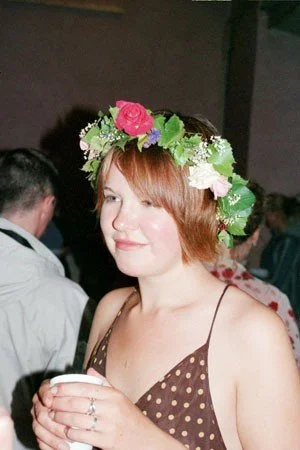
Lela Scott MacNeil was born in Los Alamos, like the atomic bomb. Her writing has appeared in Gertrude, Essay Daily, and Trouble in the Heartland: Crime Fiction Inspired by the Songs of Bruce Springsteen. Her March Vladness extracurricular essay is included in Hit Repeat Until I Hate Music: The March Xness Anthology. She lives in Downtown Los Angeles.