
second round game
(6) Collective Soul, “the world i know”
rejected
(14) Des’ree, “I’m Kissing You”
168-142
and will play in the sweet 16
Read the essays, listen to the songs, and vote. Winner is the song/essay with the most votes at the end of the game. If there is a tie, we will play a one-hour overtime (and repeat until we have a winner). Polls close @ 9am Arizona time on 3/13/26.
DON’T KNOW WHAT GOOD FEELS LIKE UNTIL YOU FEEL BAD: JAMES CHARLESWORTH ON “THE WORLD I KNOW”
[EXT. JERSEY CITY – EARLY MORNING]The Colgate Clock in the pre-dawn gloom. A mournful dirge on acoustic guitar. A harried BUSINESS MAN in suit and tie checks his watch as he trudges along a chain-link fence backdropped by the Hudson and the skyline of lower Manhattan. Through his eyes we rise from a subway station into the steel canyons of the city, its windblown sidewalks and sewer grates. At a bodega, he procures a plain bagel and a steaming coffee.From his place on the periphery, where he’s been eying the Business Man with a pensive sort of curiosity, ED ROLAND, lead singer and songwriter of Collective Soul, gazes earnestly into the camera and, his long hair lifting in a slight breeze, begins to sing.ED ROLAND (singing)Has our conscience shown?Has the sweet breeze blown?*
In the fall of 1994, on an afternoon his newly famous band had been flown by private jet to New York City at the behest of NBC to perform as live musical guests on Late Night with Conan O’Brien, preacher’s son Ed Roland stepped outside a midtown hotel room and went for a long walk up and down Broadway. As usual, he had the beginnings of a song in his head.
“It was a different New York City then,” he would remember later. “There was still some grit and dirt… especially around Times Square and Union Square. There were homeless people living in cardboard boxes. Then somebody pulled up in a limousine with a fur coat on and walked right by.”
It’s easy to picture him, tall and traversing the city in the trench coat he dons for the video, long hair ablow across his drawn equine face, a handsomeness that will one day make him pop up on Playgirl’s annual list of the sexiest rock stars. But in the video he looks less like a sex symbol and more like some prophet or professor or wiseman, this son of a Baptist minister and Elton John devotee who has always insisted on “the separation of Church and rock ‘n’ roll,” but whose songwriting style is undeniably laced with the spiritual, woven with references to heaven and littered with allusions to guiding lights and paced with the rhythms of a church choir. When Ed Roland was fifteen, he was in a car accident that killed his best friend; when he was twenty-three, he lost his other best friend to a heroin overdose; for a full decade he struggled to find his place in the music industry before finding massive success almost accidentally at the age of thirty. If nothing else, the man who strode those streets and avenues of Midtown that day was one attuned to the highs and lows of the world, the struggles and redemptions that contour our lives and give them depth and meaning.
“I took a two-hour walk,”—he would say later of the day he wrote the song that would become his band’s second biggest hit—“and just absorbed and observed from the highs and lows of what society was offering the greatest city in the world. I was looking at what the good was [and] what the bad was. But also, you don’t know what bad feels like until you feel good. You don’t know what good feels like until you feel bad.”
*
[EXT. MANHATTAN – MORNING]The Business Man waits in line to board a bus. Preoccupied with his copy of the Times proclaiming headlines of despair (“War Victims; Camp Children Starve”), he fails to notice a woman next to him begging for change.ED ROLAND (singing V.O.)Has all kindness gone?Hope still lingers on...From his seat on the bus, the Business Man observes as the woman turns and trudges off. He winces, and his face shifts toward the camera, eyes meeting ours as if imploring us to absolve him of his guilt.ED ROLAND (singing V.O.)I drink myself of new-found pity...*
I was drunk the first time I saw the video for “The World I Know.” Not the festive carefree drunk you see glamorous actors pantomiming in movies; not the vividly and artistically rendered fever dream drunk you read in certain books. Rural central Pennsylvania: October 1995. At the height of Collective Soul’s fame, I was an eighteen-year-old part-time pizza delivery boy living at my parents’ house, unenthusiastically enrolled in my first semester at the local branch campus of the state university, and on the day in question I had skipped my Friday afternoon classes with a couple friends to drink a case of Stoney’s at one of the friends’ father’s house while he was at work. The Stoney’s was a rare splurge. Typically in those days we subsisted on forties of Silver Thunder malt liquor that could be procured for $1.25 and tasted like gasoline with a pound of sugar poured in, or glass flasks of fortified wines like Cisco or Mad Dog 20/20. I don’t remember what the impetus was for the Stoney’s: one of us must have aced a test, or more likely failed it (my major was D.U.S., i.e. Division of Undergraduate Studies, i.e. I’m mostly here for the parties). What I remember about that afternoon, as I sat on the couch watching the opening frames of the video, was thinking “ugghh jeezus, fucking Collective Soul…”
I was not a Collective Soul fan. It wasn’t necessarily that I hated their music: they had some pretty cool guitar riffs, and at least one of my friends was the owner of their self-titled second album, which had come out earlier that year. It was more that something about their music struck me as—how do I put it?—too mainstream for my taste. Maybe a little too uplifting? In the aftermath of the dissolution of grunge I had returned to my metal roots and was passing through the doorways of Green Day and Rancid into more obscure hardcore melodic punk rock. All I knew about Collective Soul was that they were a Christian band (they’re not) and that their song “December” from earlier that year was hotly rumored to be “about a blow job” (it’s not).
Probably my dislike for Collective Soul was rooted in something else entirely: a manifestation of internal anxiety that had something to do with low self-esteem, something to do with the insecurities of adolescence: an unwillingness to look unguarded emotion in the eyes combined with a mistrust of anyone who purported to have found something that made them feel less lonely and uncertain. It was this same anxiety that had made me turn to alcohol. I’d started drinking in my mid-teens, somewhere around the time I began to realize that the thing that was holding me back was this nervous stress that shuddered through my body like an electric current anytime I found myself in social situations. Best I could tell, the kids I saw with bottles of Icehouse or Red Dog or Zima or Mickey’s wide mouths in their hands seemed not to suffer from this affliction. I crossed the threshold with reluctance and fear—I’d heard stories all my life of family members who’d struggled with alcohol, stories told in the guise of humor but always underneath I could sense the warning—and then from the first sip these admonitions were forgotten and my life with alcohol became a long straight road with a series of green lights turning yellow that I had to accelerate through, the pedal floored so I could make it before those red lights of my reservations and my guilt arrived.
That was my situation on that day I sat on the couch at my friend’s dad’s house watching the video for “The World I Know,” three years into an entertainment that had become a habit that had become a dependency. Picture me there: dingy flannel shirt and loose jeans, feet up on the coffee table and watching obliviously as the morose Business Man in the music video navigated the day-to-day drudgery of his morning commute. Years later, after I’d left home and embraced a new identity as a grad student studying creative writing at a liberal arts school in Boston, I would have been quick to identify these opening scenes with the world-weary Business Man as an easy example of what we liked to call a Last Chance to Change Story: a moody tale of a protagonist mired in a mournful state of mind, clearly on his way to some reckoning or epiphany or catharsis that would confront him with the opportunity to face down his ennui and his angst and his malaise and either find a way to overcome it or succumb to it.
But on that day in October ’95—half-drunk, my GPA hovering around a 2.0—I lacked the perspective to identify such narratives, let alone recognize them in myself. Picture me: clad in my backwards baseball cap and clutching a brown Stoney’s bottle. The world I knew was so small then, not much larger than the ten-mile radius stretching from my parents’ house to the local branch campus of the state university. What did I understand, back then, about last chances to change?
*
[EXT. MANHATTAN – MORNING]ED ROLAND (singing)All the words that I’ve been reading /Now have started the act of bleeding into one...The newsprint blurs as the Business Man’s eyes fill with tears. In broad daylight on a city street, he weeps. A metal fire escape scales a yellow brick brownstone, and it is at its base that he tosses aside the newspaper. Halfway up the ladder of the fire escape, he discards his briefcase, its contents spilling out upon the concrete sidewalk. He pulls off his suitcoat and sends it parachuting down...[EXT. ROOFTOP – MORNING]Alone, surrounded by the city’s anonymous rooflines and water towers, the Business Man spins in a rotating spiral of grief, raises his palms to his face while his tears roll down.*
In the summer of 1993, the band that would become known as Collective Soul, which was not really a band at all at that point, released its debut album, which was not so much an album as a collection of demos conceived and recorded largely by one man in the basement of his home in Stockbridge, Georgia. At thirty years old, Ed Roland had by this point mostly given up on his dreams of rock stardom. After fronting a series of bands in the Atlanta underground scene to middling success, he had settled on this last-ditch effort of throwing together a demo tape and putting it out on a local label in the hopes of selling the publishing rights.
The story likely would’ve ended there, were it not for a DJ at a college radio station at Georgia State University in Atlanta who took a shine to the opening track—which happened to be called “Shine”—and put it into regular rotation. The song itself was a bit of a curiosity: with its droning drop-D guitar riffs and shifting dynamics and healthy dose of Eddie Vedder-style yarling in the choruses and the double-time outro (“Shine on meeheeheeya! Meeheeheeya!”), it was nothing extraordinarily new per se, but there was a certain novelty in the delivery, a freshness in the combination of influences. Within days, it became the station’s most requested and most played song, and when station management contacted Ed Roland to see if his band could play some local shows, he accepted—despite the fact that he did not have a band—and then cobbled one together consisting of his little brother and a couple other musicians who’d contributed to the demo and a friend or two he knew from cub scouts and little league baseball. Other radio stations around the south picked up the song and experienced similar overwhelmingly positive reactions, and as the calendar turned to 1994, “Shine” rose up the Billboard charts so fast even Atlantic Records could not ignore it. They signed Collective Soul, rereleased Ed Roland’s basement demo without even bothering to remaster it or update the chintzy cover art, and sent the band on a year-long cross-country tour opening for Aerosmith. They secured them a prime-time slot on the main stage at Woodstock ’94 in front of 300,000 people, and then, just a month later, with “Shine” peaking at number 11 on the Billboard charts—less than two years after Ed Roland had recorded it by himself in his basement studio as a last ditch effort to salvage a fleeting dream—the spot on Late Night with Conan O’Brien.
“The World I Know” is Ed Roland’s tribute to that journey, an ode to that afternoon in New York City when he had the opportunity, for the first time, to look back on how far he had come. It may have been written on a piece of hotel stationery when he got back from his two-hour walk spent observing the highs and lows of society—jotted down before he took the elevator to the lobby to catch a limo to Rockefeller Center—but it was formed in the grief of his adolescent loss, forged in the decade of struggle he’d overcome before the light of opportunity shined down on him. Ed Roland had no way of knowing, of course, that his band’s moment of massive fame was already on the downswing, that although they have released a total of thirteen albums over their undeniably successful thirty-year career, they would never again achieve the success they’d stumbled upon with “Shine.” And yet from its mournful opening dirge to the soaring major chords of its powerful chorus, “The World I Know” succeeds in achieving something more lasting and memorable and heartfelt than any of the heavy riffs and yarling of their first and biggest hit.
That afternoon at my friend’s father’s house, I knew nothing about Ed Roland or his journey (I thought he was in a Christian band who’d recorded a song about a blow job). I had not yet arrived at any such crossroads or catharsis or epiphany as the Business Man. I didn’t know anything about last chances to change or looking down from tall ledges. Perhaps it was just that I was half-drunk, or perhaps I really had bombed a test and was already feeling—somewhere in the hard to access regions of my teenage-boy brain where accountability and ambition lived—a sense of dejection and failure. Maybe it was adolescent hormones or some other circumstance weighing on me that I can’t recall now. But something about that particular song and that particular video on that particular day—when I watched the Business Man’s story and then saw how it ended—spoke to me through the soundproof walls of my ignorance, made me acknowledge something deep in my heart that forced me to turn away from my friends and twist my backwards baseball cap around to hide my eyes so they couldn’t see the emotion I was fighting, an intimation I did not yet have the serenity or the courage or the wisdom to understand or act upon, a fleeting comprehension that, while I could not yet see the light at the far end, I could at least recognize, maybe for the first time ever, the presence of a tunnel.
*
[EXT. ROOFTOP – MORNING]At the edge of the building, the Business Man removes his shoes and sits cross-legged at the ledge, looking down from this dizzying height.CLOSE UP ON BUSINESS MAN’S FACE: He nods, accepting his decision and his fate.The Business Man climbs a guardrail and lifts himself to stand upon the cornice of the brownstone. His arms stretch out and the camera angle rises behind him to show us the endless uncaring city as he leans forward into death......and a pigeon lands on his arm.*
On a raw and rainy night in September of last year, my fiancée and I drove an hour north from our home outside Boston to see Collective Soul. This was no Woodstock ’94 with a crowd of 300,000, no live performance on Late Night with Conan O’Brien for an audience of millions. Nope, this was a show for two thousand damp souls in a hangar-like venue in an off-season beach town a block from the Gulf of Maine. Yet it was a room full of Collective Soul fans—a group of which I suppose it is now fair to call me a member—a venue packed with people mostly our age and capable of looking back on those years in the mid-90s when Collective Soul had their heyday, each perhaps with their own stories of how this band’s strangely uplifting music touched them. Folks ready and willing to sing along, early in the show, when the band dialed up the drop-D riffs of “Shine,” the song that had flung them all those years ago into stardom. And folks who seemed to understand intuitively what was coming when, near the end of the evening, after the band had worked its way through their more recent catalog, Ed Roland inconspicuously exited stage right and ducked down a short staircase, accepted from a roadie an acoustic guitar that he slung over his shoulder, then trotted back up the stairs to take center stage beneath the floodlights. A field of held-aloft smart phones rose up before our eyes and Ed Roland—sixty-two years old now, gray hair tied back in a ponytail beneath a white cattleman’s hat, eyes shielded by sunglasses—strummed his guitar and, after a few measures, began to sing…
Last year I celebrated a quarter century of sobriety. That’s not true—I didn’t celebrate it. It just happened, without fanfare or deep reflection. I’ve been sober so long now that most of my closest friends can’t comprehend at all the person I was when I first saw the video for “The World I Know.” My wife, who was still my fiancée on that day she stood singing along with me in the crowd at the Collective Soul show, can barely fathom the teenage version of her husband whose indiscretions I infrequently describe for her. Redemption seldom resembles anything so obvious as a pigeon alighting on a shoulder; for me in my drinking days there were countless harbingers and omens, innumerable instances of the world trying to tell me what I was doing was stupid, reckless, reprehensible. In the end it wasn’t an avian intervention but flashing police cruiser lights, handcuffs, twenty-eight days at a treatment facility in the Pennsylvania woods.
Watching the story of the Business Man on that long ago day in my freshman year of college did not make me stop drinking, but still every time I hear “The World I Know,” a part of me is brought back to that day—and for a moment I can see that teenage version of myself, his ignorance and his confusion and his potential. Every time I hear that moment when the final chorus finishes up and the opening theme returns—altered this time from minor to major, the substitution of just one note in the chord progression turning that mournful dirge of the intro into a redemptive and joyful conclusion—I am able to access some small piece of that now unrecognizable person I once was. I am able to look the unguarded emotion in the eyes. I am able to acknowledge the bad and, in doing so, I get to embrace the good.
*
[INT. HAMPTON BEACH CASINO BALLROOM]When the second chorus arrives, the music stops. Ed Roland ceases his strumming and raises both arms as if in a summoning. The band stands silent around him, not even clapping to keep the beat. The only sound that fills the echoing space of the ballroom is a chant almost religious:2,000 VOICES (singing in unison)So I walk up on high / and I step to the edgeTo see my world below...Have to laugh at myself / while the tears roll downCuz it’s the world I know / well it’s the world I know...*
Why does “The World I Know” deserve your vote in this tournament of sadness? Because the best sad songs are not the ones that leave us mired in mournful hues and tones, but those that dip us down deep into our sorrows and our griefs, immerse us in them and make us feel them so fully that they threaten to drown us, only to lift us up, still dripping, into the light. And because in life—real life—there are no last chances to change. There is always still time to make a difference, to alter a course, to carve a new path.
No matter how dark this world we know might become, it is never too late to persist. Never too late to do everything we can to make the world we know a place we’re happy to call home.
Has all kindness gone?
Hope still lingers on…
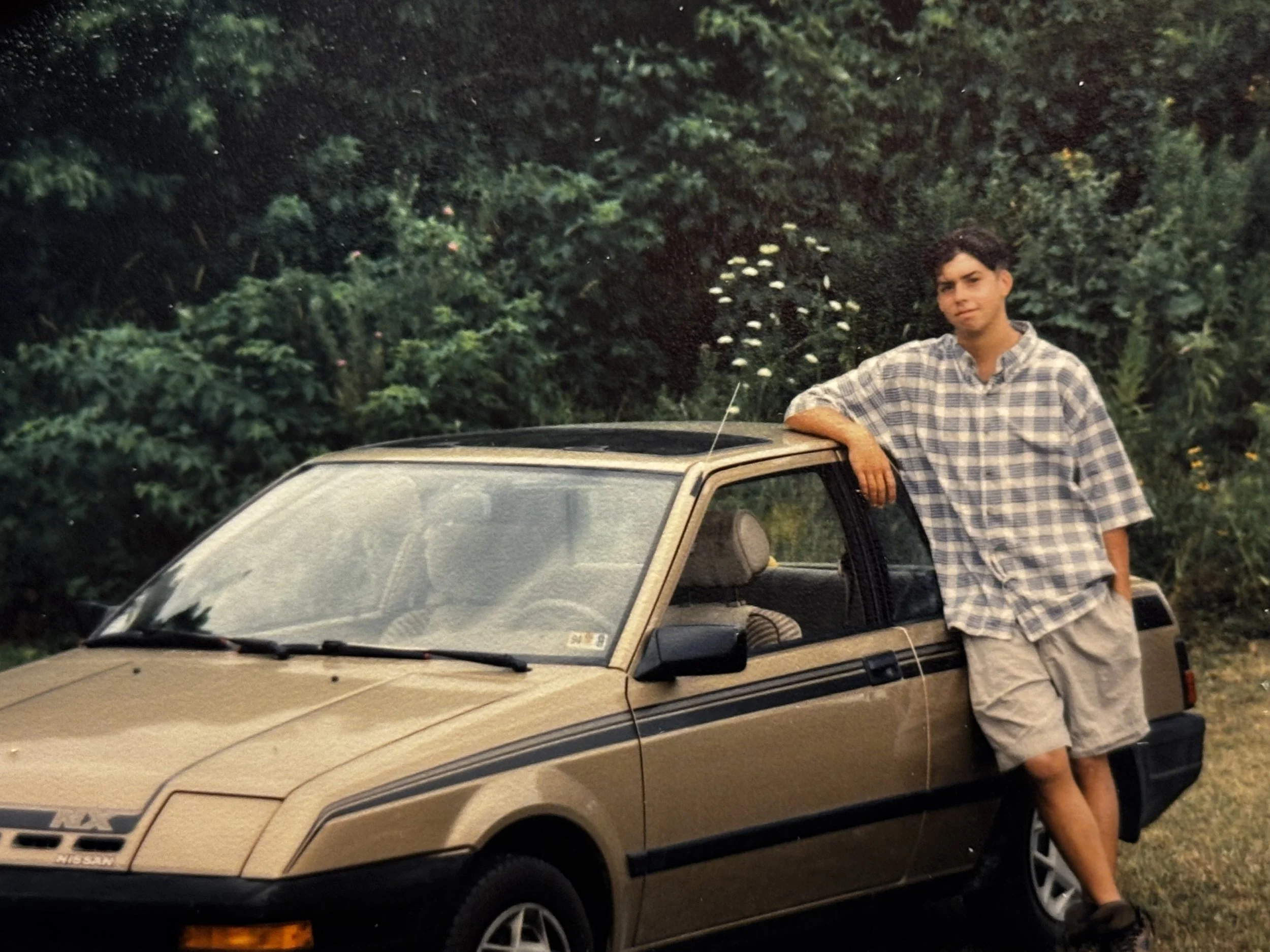
James Charlesworth (pictured here with his 1983 Nissan Pulsar that he bought for $500, c.1994) grew up eighty miles east of Pittsburgh and lives in Boston. He is the author of a novel, The Patricide of George Benjamin Hill, and four previous essays for March Xness.
EMILY PODWOISKI ON DES’REE’S “I’M KISSING YOU”
I walked down the aisle to this song
Wow 😯. I’d cry by the end of the isle
I’m daydreaming about wedding songs again. I am not ‘engaged,’ though my boyfriend of nearly four years insists that we are a betrothed couple. That’s because during a recent road trip to Seaside—also known as “the Jersey Shore of Oregon”—I told him I’d marry whoever finds me a sand dollar on the beach.
Unfazed by the rising tide that afternoon, Evan searched for a sand dollar that hadn’t already been smashed to smithereens. As I stepped over shattered shells, I worried I had given my suitor an impossible challenge. Maybe we’d leave the beach sad and empty-handed, which I’d interpret as a sign not to marry him. What can I say? I’m a superstitious girl, I’m the worst in the world.
After an hour of wandering through broken crab claws and washed up moon jellies, Evan kneeled before me, presenting a perfectly round shell, bleached by the sun and stamped in the center with its signature sea-flower.
Now we joke that the sand dollar is my dowry, which makes me laugh until I remember all the reasons why I don’t want to get married—nerves, divorce, patriarchy—and I deny that we are engaged. But then Evan says to me, “You are my sea wench,” and I think maybe I will marry him after all. Or at least, I’ll throw a party.
The wedding dress is already taken care of. It’s the most exquisite number in my closet: a 1990s Pamela Dennis floor-length gown I bought from a vintage shop. Simple and sleek, with velvety diagonal pleats that wave across the fabric like ripple marks in sandstone. The song would have to match the dress: something elegant and timeless and devastating.
my beautiful wife walked down the aisle to this masterpiece 😍 ❤
I used to play this on repeat and cry for hours when I was a teenager.
Same here
The world is a sadder place with no Des’ree in the charts! Please come back 😢
In 1995, Des’ree is terrified to write the love theme for Baz Luhrmann’s upcoming film, Romeo + Juliet. It seems like an impossible task: to create the saddest love song of the 1990s, inspired by one of the saddest plays of the 1590s. Des’ree is terrified to write something bad, terrified to let Luhrmann (and Shakespeare) down. Terror is a familiar feeling for the British singer, who suffers from a fear of flying as well as chronic stage fright. “Even though the desire [to sing] was there,” she says in an interview, “it terrified me to do it. And still, now, I’m paralyzed with nerves when I have to go on stage.”
Despite her terror, Des’ree dusts off her Shakespeare and rereads the play. She writes not one but two songs: “Sword of Love,” which pulls more imagery from the text, and “I’m Kissing You.” The director cuts “Sword of Love”—it’s too saccharine, a critique Des’ree may have feared. But “I’m Kissing You” is so hauntingly beautiful that Luhrmann asks Des’ree to perform the song in his film.
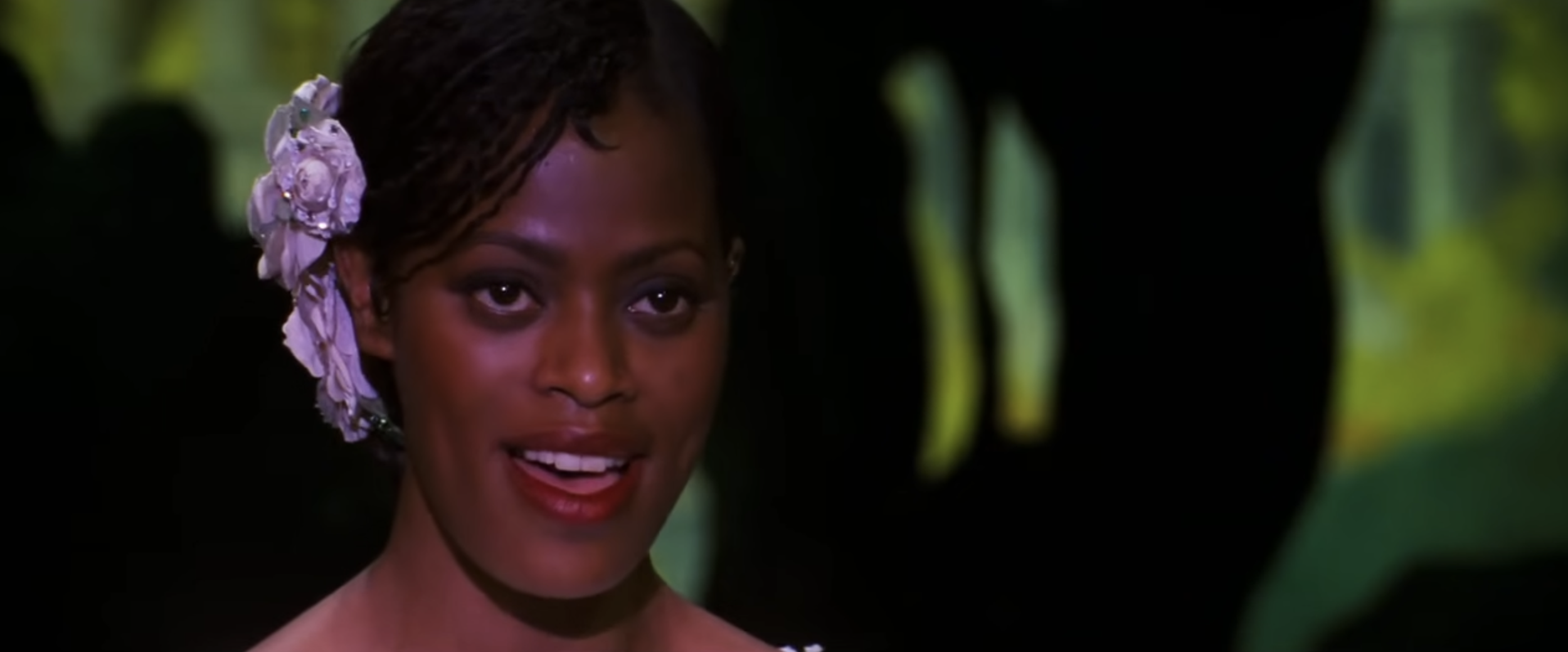
In her twelve-second cameo as “Diva,” she appears on stage wearing a sleek white crochet dress, performing at the Capulets’ masquerade party. In a close-up shot, her braids are pulled away from her face, clipped to side by lavender roses. Instead of looking directly into the crowd, she fixes her gaze on the back of the ballroom. The piano is the only instrument that accompanies her deep contralto. All the partygoers go silent, listening to a voice that clearly belongs to a virtuoso singer.
Following the release of Romeo + Juliet, an Irish Times interviewer asks Des’ree if she kissed “heart throb” Leonardo DiCaprio on set. Des’ree laughs and says, “I haven’t kissed him,” adding that no, he was not the muse behind the song.
this song MADE that movie.
used this at my wedding....
Me too. I messed that up and can barely Listen to this.
2026 anyone
The first time I heard Des’ree sing “I’m Kissing You,” I was five years old. I wasn’t supposed to be watching Baz Luhrmann’s 1996 rendition of Romeo + Juliet with its PG-13 rating, but then again, neither was my eleven-year-old sister Erica. One of the small glories of the nineties was that our parents didn’t care too much about what we watched on TV. By age four, I had already been traumatized by Starship Troopers. At least Romeo + Juliet would educate us in Shakespeare, Mom reasoned.
Erica was less interested in Shakespeare and more interested in Leonardo DiCaprio. Sometimes I’d sneak into Erica’s room to study her Scholastic magazine, “Lovin’ Leo: Your Leonardo DiCaprio Keepsake Scrapbook,” which she kept on her bedside table like a Bible. The cover was a closeup of Leo’s young face, squinting and looking beyond his overgrown blond bangs. Inside its pages were glamour shots of Leo covered in smoochy red lip prints. Leonardo, Romeo… What’s in a name? They were really one and the same.
Erica sat criss-cross applesauce before the television. She tossed the Romeo + Juliet VHS sleeve to the side and pushed the tape into the machine. The plastic door flapped like a curtain. As the movie began, I turned the sleeve over in my hands and stared at the young couple on the cover, framed by an aquatic jungle of coral and seaweed and tropical fish.
Romance, I’d soon realize, was not red-and-pink but aquarium blue.
this scene will always give me chills. it’s just so purely romantic. my god
I’ll take this song and love at first sight scene… Any day over Titanic movie
So dreamyyyy wtf...
Let me set the scene: Romeo, dressed like a medieval knight, wanders away from the masquerade party, away from the Diva’s performance, and into the bathroom, where he submerges his face in water. He’s trying to come down from a bad ecstasy trip. In the mirror, he notices a massive aquarium wall separating the girls’ powder room from the boys’ room. Romeo drifts towards the “submarine beauty,” as Luhrmann puts it in his script. Surely looking at fish will help.
From the ballroom, the Diva’s voice echoes: Pride can stand a thousand trials / the strong will never fall / but watching stars without you / my soul cried… Romeo bends down and looks through the aquarium glass. Butterflyfish float by. Then, from the other side, someone looks back.
At first, all Romeo sees of Juliet is her eye, framed between blue coral like a Victorian “lover’s eye” portrait. Juliet, dressed like an angel, leaps up. The young strangers look at one another. Romeo doesn’t break eye contact; Juliet looks away, then back. Pressing his nose against the glass, Romeo puckers his lips into a kiss, making Juliet laugh until she’s pulled away by the Nurse. The Diva cries: Oh, oh, the aching…
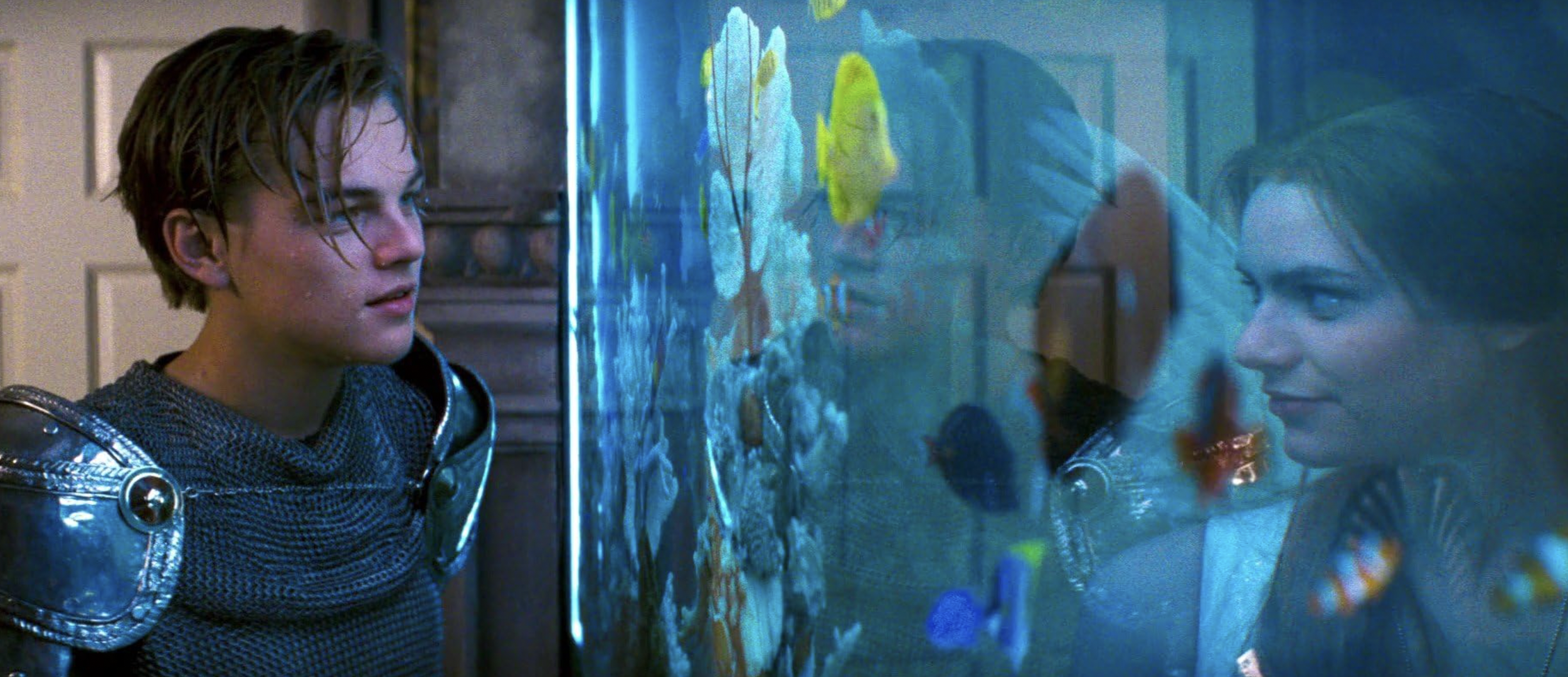
“Did my heart love till now?” says Romeo, watching Juliet from afar. “Forswear it, sight! For I never saw true beauty till this night.”
Imagine what this scene does to an eleven-year-old girl and her little sister. I’ll tell you: Erica leaned forward, mouth agape, and pressed the “rewind” button. Suddenly we were enraptured by a film that so far, was kind of boring. We didn’t pay much attention to the beginning, all gunfights and family drama. Finally, here was the romance, the poetry, the promise of that blue movie cover. Like my sister, I wanted Leo, the fish tank, the angel costume, but most of all, I wanted the song.
I want Leo to look at me how he looked at the fishes
all those fish are dead now
Those fish are alive in mind when we watch this
Throughout my teenage years, Romeo + Juliet remained my romantic blueprint, the reason why I snuck boys into our swimming pool late at night in the hope of making out underwater (which, I learned, was not as hot as it looked). Still, I’d hold my breath with the song in mind, fantasizing about love and fate.
For the first time in years, I rewatched Romeo + Juliet. Now that I’m thirty-one, I thought I’d be annoyed by Luhrmann’s frenetic pace. I thought the Hawaiian shirts paired with Shakespearean English would feel gimmicky. I thought maybe I’d judge Romeo and Juliet as stupid, horny teenagers. They get a lot of flak for being stupid, but I don’t think that’s the point of Shakespeare’s play, even though a certain type of English major loves to bludgeon this point to death. It’s NOT a romance, it’s a tragedy! they say, as if both can’t be true.
Des’ree understood the assignment; she understood that Romeo and Juliet were the products of a dumb, violent culture; she understood that Shakespeare’s play was about the cruelty of feuding families and the corruption of young love, impulsive as it may be. Des’ree knew the song had to be elegant and timeless and devastating.
By the end of the film, tears were rolling down my cheeks. Maybe it’s that damn song, or maybe it’s the way Claire Danes looks at her Romeo as he dies… it just gets me.
Erica doesn’t hesitate when I urge her to rewatch Romeo + Juliet; a day later, she texts me: “So many of my adolescent obsessions don’t hold up over time, but that movie was fucking brilliant. Leo is fucking beautiful too I get why I loved him.”
“Too bad we’re both too old for him now,” I text back.
A sweet forehead kiss
This sh*t hurts GODDAMN!!
Out of all the songs in this year’s essay tournament, “I’m Kissing You” sounds the most like crying. When Des’ree sings, “Oh, oh the aching,” she cradles that last note, lets it cry. She’s not quite sobbing, not quite wailing. Her soft, low vibrato never loses control, though it sounds like she could unravel at any moment. The song evokes the early stage of a good cry, the part when the throat tightens, when language begins to crumble and quiver.
Music critic Jim Farber describes Des’ree’s voice as “indigo”—a color that is rich like purple, but not without blueness. Evan thinks the song sounds like a dirge. An online commentator compares the song to an operatic aria, defined by The Metropolitan Opera as “a self-contained piece for solo voice, usually accompanied by orchestra. In opera, arias mostly appear during a pause in dramatic action when a character is reflecting on their emotions.” I wouldn’t be surprised if Des’ree and Luhrmann know their opera terminology (unlike me) and had hoped to capture the mood of an aria. After all, “I’m Kissing You” is the dramatic pause of Romeo + Juliet, a movie that is so fast paced for the first quarter that it’s dizzying. Love at first sight causes time to slow down; it insists upon a dramatic pause, a long exhale.
In 1997, music critic Ann Powers wrote that Des’ree “overdoes the melodrama” on the track, but I disagree. “I’m Kissing You” never struck me as melodramatic. Des’ree’s emotions don’t seem forced or over the top. There’s a rawness and authenticity in her voice, anchored in real longing. The most melodramatic part is halfway through the song when she stops singing and the string instruments swell to a crescendo. Des’ree doesn’t even need those strings to tug at your heart; her voice is a lasso all on its own.
Besides, you know who is melodramatic? Red Hot Chili Peppers. The Goo Goo Dolls. Guns N’ Roses. Plenty of male musicians who aren’t often labeled as melodramatic (Mick Jagger, anyone?). Don’t even get me started on Celine Dion’s “My Heart Will Go On.” Even Kate Winslet said that song makes her want to “throw up.”
I’m probably digging myself a grave here. I know “I’m Kissing You” is up against some big names. Hear me out: Des’ree is so underrated, so quintessentially 90s. It’s almost as if she exists only within that era, though of course that isn’t true. Her last album A Love Story was released in 2019. Otherwise, she’s been absent from the spotlight. There’s no public information available about her whereabouts or marital status or upcoming projects. All I know is that during her hiatus, Des’ree enrolled in art and pottery classes in London. I wish I could tell you more but let us honor the mystery of Des’ree.
If you’re still unconvinced, then watch her live performance of “I’m Kissing You” from 1996. Even through the static and poor video quality, Des’ree stuns. It’s her stage, her aria, and her mic is on, meaning she sure as hell isn’t lip syncing, even though her voice sounds identical to the recorded track.
And let’s make a little commotion for Des’ree’s whole look: she dons a black lace dress, and painted across her décolletage is a yellow sunburst with rays reaching out in all directions. When she steps into the spotlight, the sunburst seems to glow from within, as if her lungs are lanterns.
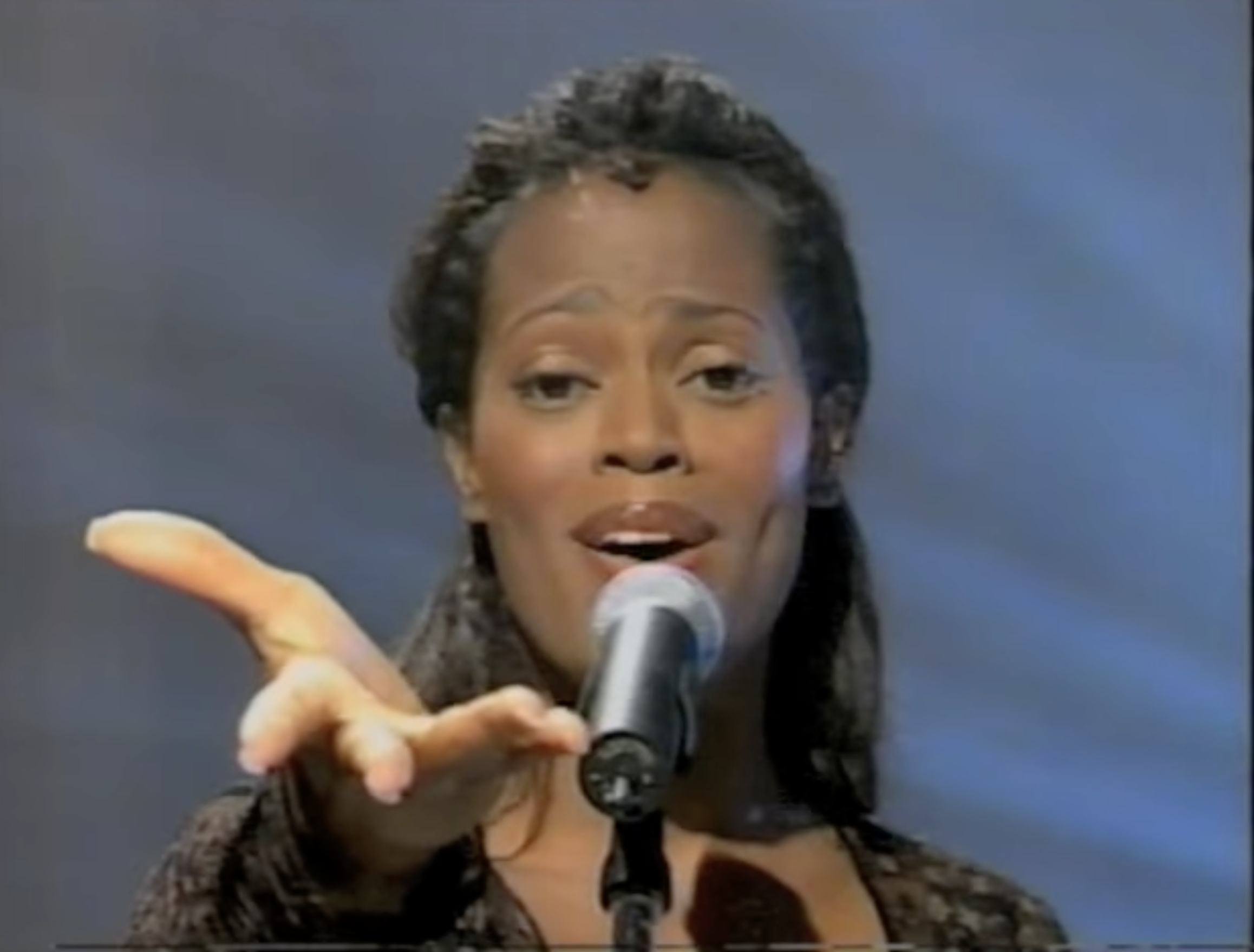
I don’t think I even blinked watching her. Wow
prince would say "my mic is ON". Desree not serving a plate, she serving the entire buffet!
Why ain’t nobody STAND to clap?! Give this woman a round of applause now please
I want her to sing this at my wedding
In 2016, Des’ree tells the Guardian, “People tell me all the time that they walked up the aisle to it.” I believe her. In the comments section of the music video, everyone is crying and getting married to “I’m Kissing You.” It’s comical how people respond as if the song is a Rorschach test. Some see marriage, some see wreckage. In one thread, a debate breaks out:
I walked down the aisle to this song. It's been over 21 years and I'm still with my husband.
This song is about lost love though.
You think so? I think it’s about enduring love.
She literally says, “Watching stars without you… My soul cries.”
Valid point. She also says, Heaving heart is full of pain and Where are you now. But there’s a glimmer of hope when the Diva sings, I’m Kissing You—I am kissing you, not was kissing you. The present tense suggests that maybe, love is not lost.
I wonder how many brides have walked down the aisle to the song. Judging by the YouTube comments, thousands! I wonder how many went with Des’ree’s version, how many went with the instrumental, how many went with Beyonce’s godforsaken cover titled “Still In Love (Kissing You).” Beyonce changes Des’ree’s lyrics, adds embellishments to the original song as though she’s playing a game of Exquisite Corpse. Maybe it’s the butchered lyrics that annoy me, or maybe it’s the music video. Sure, Beyonce looks gorgeous frolicking around the beach and smiling, but this is a sad song. Her cover erases all the aching, all the sadness, all that gorgeous blueness. The cover certainly didn’t impress Des’ree, who sued Beyonce for copyright infringement in 2007.
“I’m Kissing You” is nothing without its sadness. But is it too sad for a wedding song? Would I walk down the aisle to Oh, oh, the aching…?
On an online forum called “Bridal Walk Song” from 2021, a bride-to-be named Jasmine writes: I’ve been thinking about walking down to I’m Kissing You (Romeo & Juliet) by Des’ree […] now I’m wondering if it’s too sad.
Michelle writes, If you love the song then use it.
Naomi replies, I was thinking of that song too... do it.
I’m with Michelle and Naomi. Do it, I want to chime in, even if it’s sad. Because weddings are kind of tragic. You are vowing until death (or divorce) do you part. That line—originally “till death us depart” from the Book of Common Prayer—has got to be the saddest, heaviest part of the wedding liturgy. Some couples soften the line, promise to stay together for eternity. It’s a nice sentiment, but the realist in me objects, even likes the drama of “Till death do us part”—an acknowledgement that lifelong love comes to an earthly end.
Maybe weddings aren’t happy endings like the ones Shakespeare wrote in his comedies. If we’re lucky, weddings are joyful beginnings. I mean “joyful” in that Zadie Smith way, who described joy as “that strange admixture of terror, pain, and delight,” and what are weddings if not a strange admixture of terror, pain, and delight? Terror at the realization that your marriage could end in heartache. Pain because maybe loved ones are missing in attendance, pain because it hurts to think about losing your beloved. And delight because, well, there’s kissing, rice throwing, champagne drinking, hopefully some karaoke singing, dancing…
Months after Jasmine’s initial post, she provides an update. Did she or didn’t she walk down the aisle to the saddest ballad of the 1990s?
Yes!! I did and it was perfect. No regrets.
The chokehold this song had on millennials ❤️🔥
“had”???? I’m still not over this song
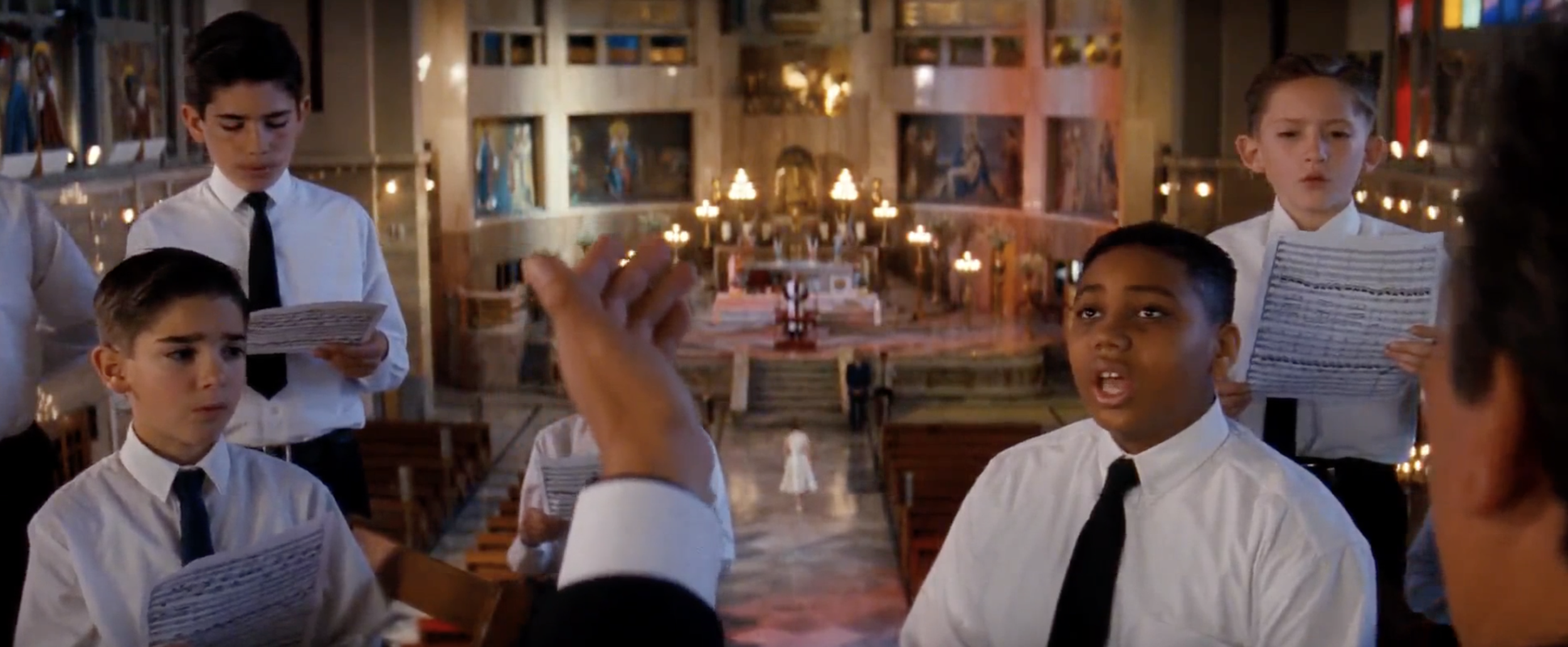
Funny enough, Juliet does not walk down the aisle to “I’m Kissing You,” even though the song plays when the star-crossed lovers first meet, when they make out underwater, and when they have sex for the first time. But as a wedding song? Too sad, even for Romeo and Juliet.
Instead, another song fills the candle-lit church where they elope: the young Quindon Tarver’s choral cover of Rozalla’s “Everybody’s Free (To Feel Good).” Tarver is another standout musician in the film. His scenes as a choir boy still raise goosebumps. Luhrmann had been searching for a “young Stevie Wonder” and found Tarver, a twelve-year-old Texan boy who “sounded much more like Aretha Franklin.” I remember stealing Erica’s Romeo + Juliet soundtrack on CD and religiously playing Tarver’s cover of “When Doves Cry” on my yellow boombox. I didn’t understand how such an otherworldly voice could emerge from such a young soul. I’d always wondered what happened to him and was incredibly sad to learn that Tarver died in a car accident in 2021. He was thirty-eight years old.
Twenty years after the release of Romeo + Juliet, Tarver gives an interview to ABC Australia for their segment on the “Young Hearts Run Free Festival,” a Romeo + Juliet celebration in Sydney, Australia. Tarver would perform there for the film’s twentieth anniversary, singing to a crowd of fans in masquerade masks.
“Has a lot changed for you?” the interviewer asks. It’s a silly question. Of course life has changed since 1996.
“Um, yeah,” Tarver says, speaking softly. “I’ve grown of course. I’m now a man. I’ve got vitiligo,” he says with a laugh, pointing at the light streak around his eye. “And I’ve matured. And my voice has matured. I’ve overcome a lot.” At the time of Romeo + Juliet, Tarver was sexually abused within the music industry, which caused him to stop singing for a long period of time. “I didn’t tell anyone until I was twenty-seven-years old. What was supposed to be my dream, what was supposed to make me feel happy actually destroyed me.”
“Finding myself again, I became able to sing again. I found my passion back,” Tarver says. “I’m free now. Everybody’s free! I’m free.”
38 is too young
Why can't we keep anything beautiful?
Before our road trip to Seaside, I’d never seen a living sand dollar. I didn’t even realize that sand dollars are living breathing animals. I’d only ever seen their white exoskeletons washed ashore, but living sand dollars are actually purplish in hue. Their bodies are covered in millions of fuzzy spines called cilia that fall off once they die. Cilia is a sign of life; never remove a sand dollar from a beach if it still has its velvety hair, which allow the creatures to move freely across the seafloor, nuzzle into the sand, and guide phytoplankton into their tiny mouths. Aristotle compared the sea urchins’ feracious, five-part jaw to the horn lantern, which also had five parts and met at a single, domelike roof. When the sand dollar is hungry or maybe feels like singing to the mermaids, its jaw unhinges, lets some light inside.
During his quest, Evan stumbled upon four living sand dollars clustered together in a small constellation. Up close, their spines swayed in all directions. I told Evan they didn’t count towards my challenge because they were still alive. Eventually, the tide rose and swept their bodies back into the ocean.
When Evan finally kneeled before me and presented the dead sand dollar, also called a “test,” I stood there, happy and stunned. This was better than an engagement ring. I took the test in my hand, felt its smooth edges, traced the flower-engraving with my finger. Evan and I kissed. We left the beach feeling good.
During the car ride home, Evan and I giggled about our ‘engagement.’ As I held the sand dollar, I noticed a rattling inside. I held the test to my ear, shook it from side to side as if it were a rain stick, trying to figure out what was stuck inside. Sand? Sea glass? Ocean debris?
Evan drove over a bump, and I lost my grip. The sand dollar slipped from my hand and fell to the car floor, where it cracked open like a piece of pottery. From its insides spilled five white teeth, shaped like doves.
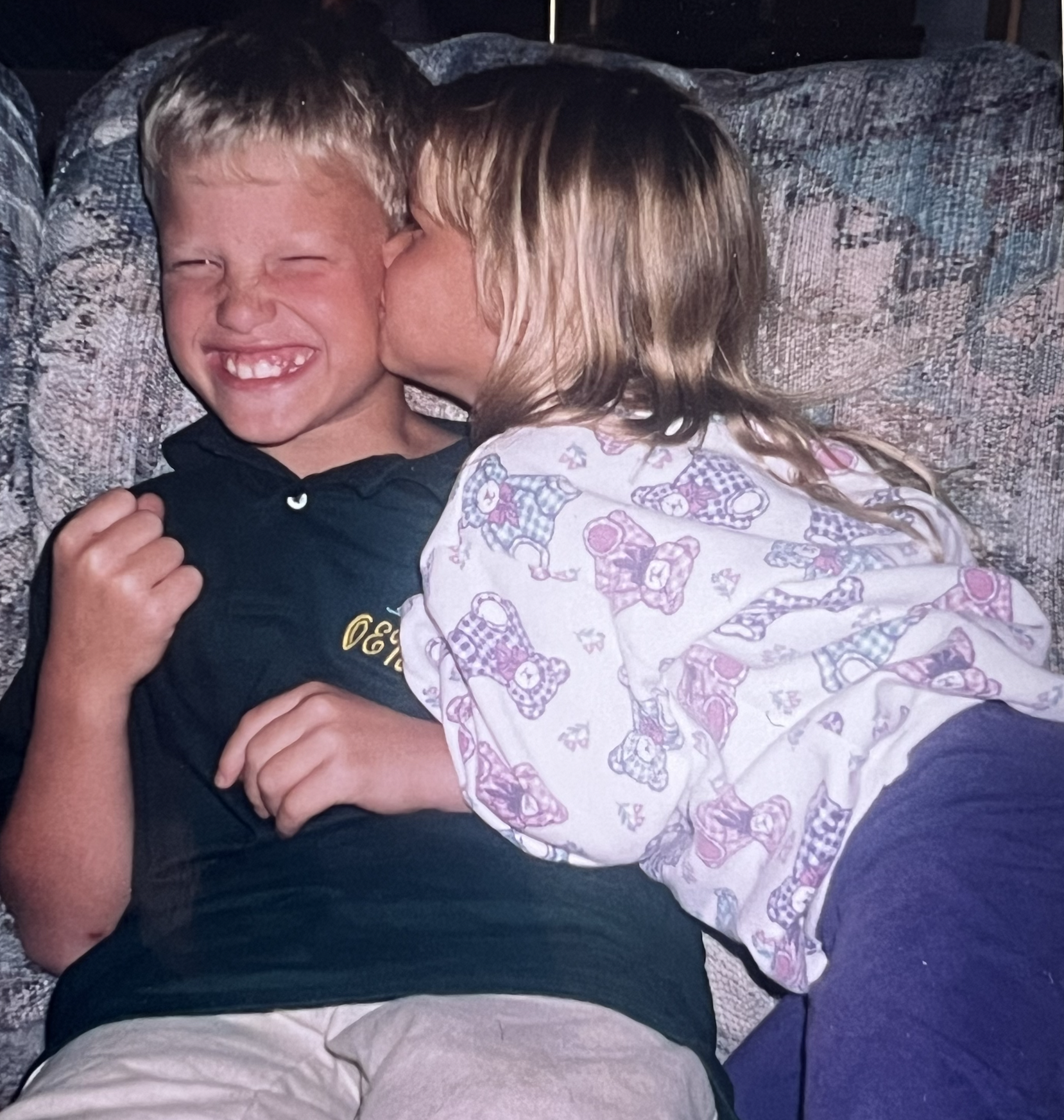
Emily Podwoiski has been K-I-S-S-I-N-G (and crying) since 1994. Read more on her Substack, Valentine Girls.