
first round game
(2) Soul Asylum, “Runaway Train”
broke up
(15) Patty Loveless, “You Don't Even Know Who I Am”
112-100
and will play on in the second round
Read the essays, listen to the songs, and vote. Winner is the song/essay with the most votes at the end of the game. If there is a tie, we will play a one-hour overtime (and repeat until we have a winner). Polls close @ 9am Arizona time on 3/11/26.
emily costa on Soul Asylum’s “Runaway Train”
On October 6th, 1992, Soul Asylum released their sixth album, Grave Dancers Union. They’d been a band for over ten years at that point, but hadn’t seen any large-scale success. Columbia Records snagged them in the post-Nirvana alternative-rock signing blitz, and the resulting album spawned five charting singles. The third, “Runaway Train,” became massive, due in part to Tony Kaye’s innovative and inescapable music video.
On October 8th, 1992, I turned five years old. I don’t remember the party much, but there is a Polaroid of my grandfather on that day. It’s likely the last photo taken of him, something I wish I didn’t have, but can never get rid of. It’s tucked into a row of pictures in a shoebox, somewhere in the mix, a landmine. He is scary thin. He had lung cancer, its progression so terrible and quick that he had to move in with us. He sat for this stretch of time, mostly immobile, in our TV room. Almost exactly a year prior to his death, my grandmother died of breast cancer at 52.
When he died, it was barely a month after that Polaroid birthday. It was also the day before my sister was born. I remember when paramedics wheeled him out of our house, the way he yelled, the way he did not want to go. And I remember the weight after, when he did not come back, the lack of him like a black hole.
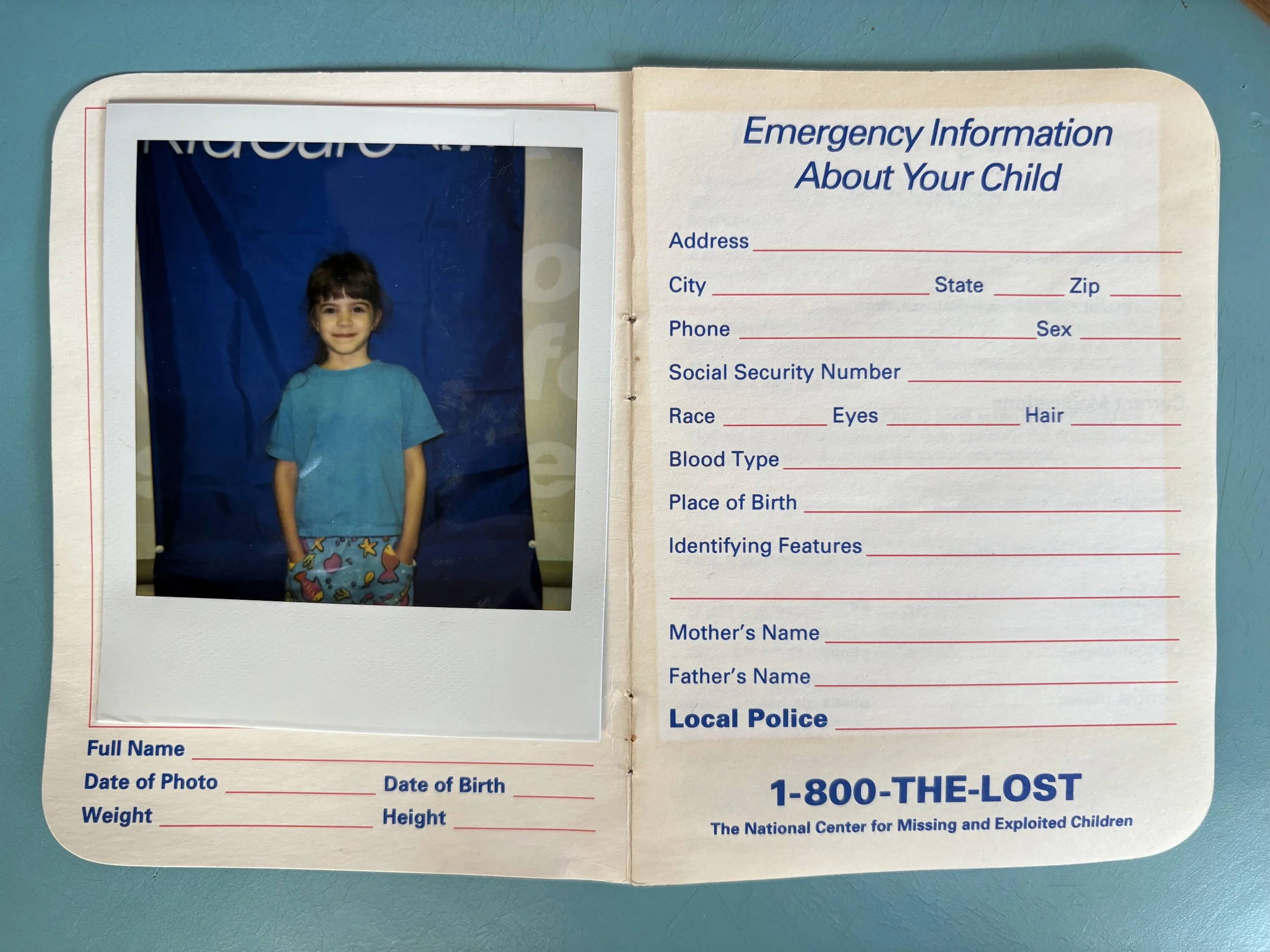
In the same shoebox of pictures, I have my KidCare ID, a booklet made to resemble a passport. These types of IDs existed so that parents had a way to show authorities their child’s image and statistics should the child go missing. Inside the booklet there is a Polaroid of me, boyish and barely smiling, hands in the pockets of my patterned shorts. None of my vital statistics are filled out. It must have been summer, mid-90s. The picture was taken at Marshalls. The back reads, “We at Marshalls created the Safety Smart Program to extend our commitment as a resource center for our customers, to make a difference on issues of concern to the families who shop our 460 stores nationwide.” This is vague fucking language. This is not the language that was used by my mother, or the language I saw on the news, or the language I saw in the music video for Soul Asylum’s 1993 hit “Runaway Train.” What they really mean is, your kids are in grave danger of going missing, of being kidnapped or murdered simply because they exist. To be fair, there is more pointed language elsewhere in the booklet, most notably the “7 Rules for Safety” shared toward the end (“I check first for permission from my parents before getting into a car or leaving with anyone, even someone I know. I check first before changing plans or accepting money, gifts, or drugs without my parent’s knowledge…”). There is also the bold, blue print on the first page, larger than all the other words, which says 1-800-THE-LOST. Underneath, it reads The National Center for Missing and Exploited Children.
This is the same organization, founded in 1984 by John and Revé Walsh, the parents of murdered six-year-old Adam Walsh, that Tony Kaye and Soul Asylum worked with for the music video for “Runaway Train.” The video was released on May 16, 1993. In February 1993, we had another one, my mother’s father. He was living in Florida at the time. They shipped him back up to Connecticut to bury him. I have another picture somewhere, me and my sisters in front of his gravestone, me caught mid-blink, although it’s entirely possible I just had my eyes closed.
It’s like this that I enter the summer of 1993. My deep fear of death, and the ensuing loneliness from keeping that fear inside, had begun their congealing into excessive worry and obsessive-compulsive disorder. Does sadness, if not given room, if its origins are not explained and accepted, turn into this sort of fear? Or had the fear existed all along? Any feelings I had about the frightening things I saw during this time—the waxy look of an embalmed body, how my father was suddenly so angry and violent, how death could come so suddenly—I kept to myself. No one was talking. No one but the TV.
There, a constant hum of terror. Early reality shows, soaked in injury and violence, blurred with the news. COPS or Rescue 911 or Unsolved Mysteries or John Walsh’s America’s Most Wanted. So many ways for so many things to go wrong. A few years later, I’d read and watch news coverage of a child murder involving one of my father’s teenage employees. But before that, other stories overlapped and replayed—the murder of James Bulger, Rudy Linares and his father, Baby Jessica, Polly Klaas [1], John Wayne Bobbit, Amy Fisher, the Waco tragedy, the World Trade Center bombings. And then the music video:
In an oral history of the song, Soul Asylum founder Dave Pirner says “Runaway Train” is about depression. “The thing that got it rolling was that I was in a very dark place, and I had somebody that I could call up in the middle of the night. [Laughs] That was it! It’s almost embarrassing when I think about how personal it is.” The first verse introduces this, the speaker, a “firefly without a light,” connected to someone who is “there like a blowtorch burning.” There’s a flicker of hope for the depressed speaker. Someone can pull him out, keep him tethered to something larger. He can avoid the inward turn. But in the prechorus, there’s a swing back into the clutches of depression, and it feels impossible: “It seems no one can help me now/I'm in too deep/There's no way out.”
There is a conflation of what the song is about (depression) and what the music video is about (runaways), so much so, maybe, that the song seems to be retroactively viewed as being about runaways. (And the song’s title certainly adds to this confusion.) While Pirner’s subject, this deep sadness, is at the core of the music video, it is wrapped in a package of fear. This fear exists in multiple forms; there is the parent’s fear of losing a child, the fear the children experience in the narratives throughout the video, and then the fear pumped into the children and teens watching the music video—whatever messages are received through the screen.
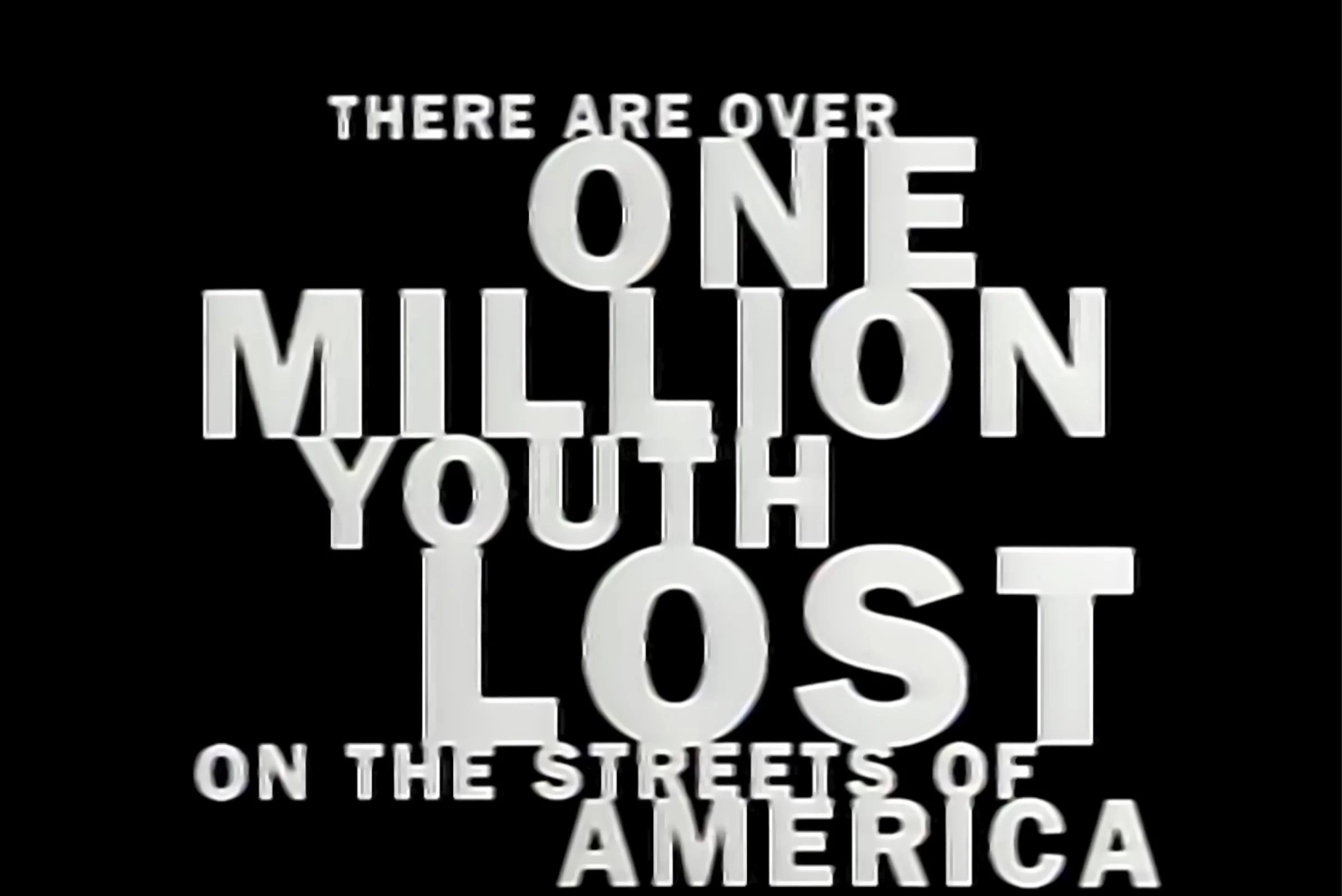
The opening shows those stats for lost youth, underscored by a whoosh of traffic and police sirens. The songs starts, the band playing in a yellowy glow, but almost immediately there are flashes of other people. Mostly everything is in close-up at first, which is disorienting but mood-building. We see tears on a cheek, a door slammed, Dave Pirner looking directly at us. Soon, multiple narratives unfold, each centering a child experiencing abuse or crisis.
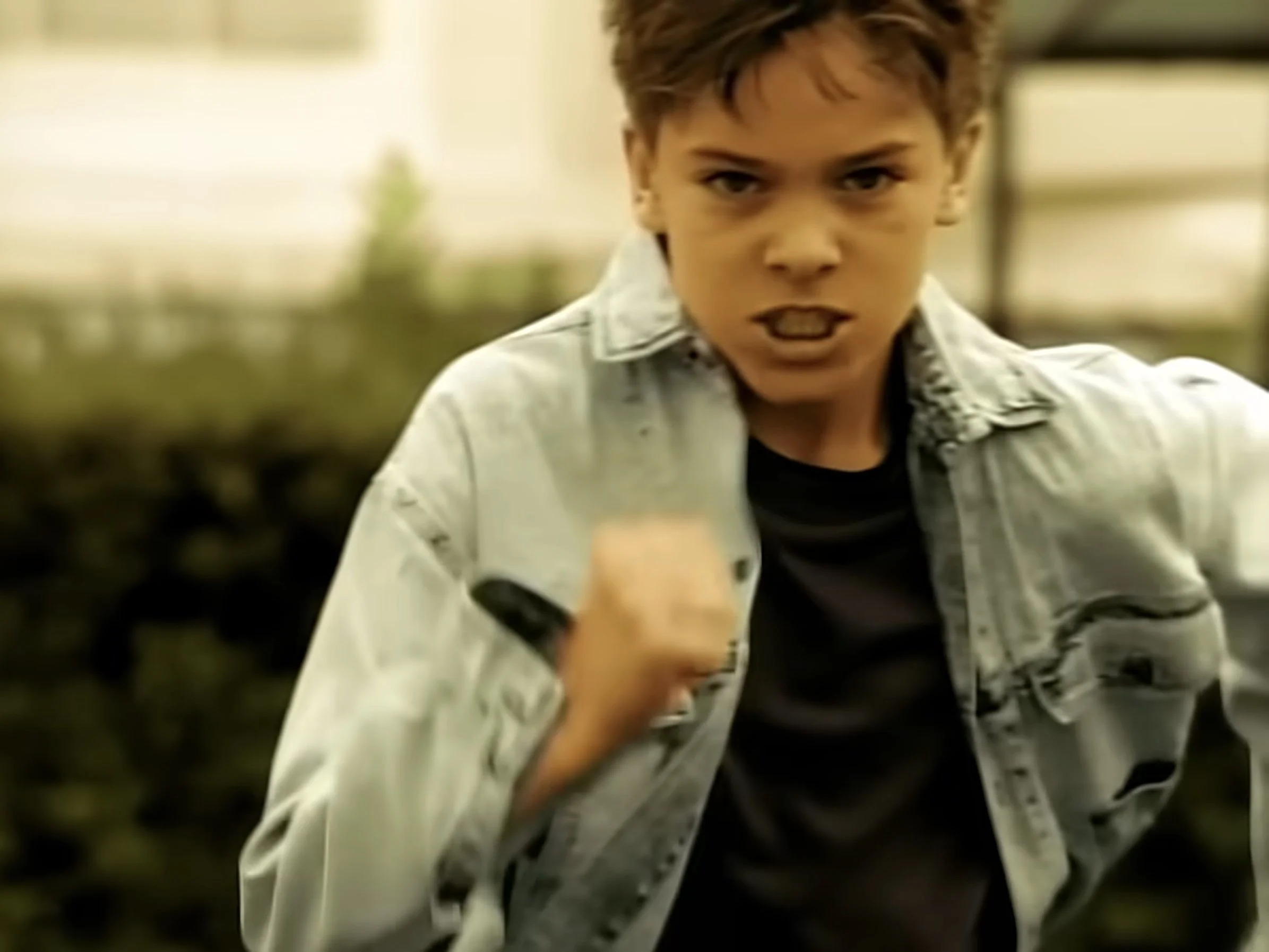
First, an older man beats his wife to death, and a young boy, likely the grandson, witnesses and tries to hide. The boy escapes, running in slow motion, fear in his eyes. The video uses hallucinatory and jumbled visuals which converge and overlap in quick cuts and collage, but then we have moments of clarity like this, this terrified boy running toward us. A quick cut to a child taking candy from a white-haired man, then the chorus kicks in, and the video’s agenda is clear. Photographs of real “lost youth” appear, each followed by a black screen showing their names and “missing since” dates displayed in white text. It’s jarring, even though I’ve seen it so many times, this sudden movement from blurry, active violence and escape to a smiling photo of a real teenager who might be dead.
The band moves into the next verse. A little girl in makeup shivers on the street with a group of sex workers. Pirner sings “Can you help me remember how to smile?” and there’s a cut to a smiling infant in golden light. Then back to the girl, where an old man—the same grandfather—is pulling up. He has big glasses and big teeth, a cartoonish exaggeration in line with a child’s nightmare. The frequent cuts mimic memory. We see the smiling baby with its mother, Soul Asylum playing in a dilapidated house. Another cartoon-like villain, a frightening older woman with sharp eyebrows and thin lips, drives and smokes and watches. The little girl is forced into a van. Soul Asylum plays, and something appears over the scene, an impressionistic image superimposed, the face of a child. Is this a ghost child? Has one of these scenes gone too far? Or, is it representative of a child’s face reflected in a TV, like my own child’s face must’ve been, watching the video?
The men in the van take off their shirts. A flash of red, an ambulance, the girl on a stretcher with a bloody lip, the band in that yellowy light again, the house’s peeling paint, the dirty kitchen. Flashes of children’s drawings in black ink. It’s unclear if they’re witness sketches, or simply products of a child’s imagination.
The solo starts and the collages become more complicated and disorienting, but the children are gathering, these injured and abused children, and they’re heading somewhere green. More children run in slow motion, a girl’s grimace so full of pain, a kid with a black eye, a flash of the bleeding grandmother. And then all the kids are together, trying to hide under a white blanket or tarp, which is actually a blown-up image of one of the missing photos. But maybe they are safe now in this makeshift fort, this childhood symbol reminding us of the childhood they’ve been denied. This scene is miniscule, gone in the blink of an eye.
While the mother and the smiling baby stroll down a busy street, the thin-lipped woman smokes and hunts. The mother looks in a shop mirror, and the woman, her severe shoulderpads enhancing her predatory look, snatches the baby. Now the mother is the one running in slow motion, and the last image is the biggest gut-punch of them all: a photo of a real-life toddler, then the words “THOMAS GIBSON, missing since 1991.”
Director Tony Kaye was inspired by a kid on a milk carton to create a video with “social relevance,” but he says, referring to the strength of the song, that he “could have filmed a brown paper bag for three minutes and it still would have been a hit.” He mentions in this same interview that 21 out of the 36 children featured in the video have been found. “I’d argue that it was the single most important thing that happened in the history of MTV,” he says, “because it saved young people’s lives.”
But it’s complicated, because there are other factors at play. Kaye concedes some of this, albeit vaguely, noting how “it wasn’t always plain sailing for the families afterwards—kids don’t run away from happy homes—but maybe things had changed when they went back or they were older and able to cope better.” Guitarist Dan Murphy goes into more detail in a 2006 interview with Pasadena Weekly:
Some weren’t the best scenarios. I met a fireman on the East Coast whose daughter was in the end of the video, and he’d been in a bitter custody battle with his wife over her. It turned out the girl hadn’t run away, but was killed and buried in her backyard by her mother. Then on tour, another girl told us laughingly ‘You ruined my life’ because she saw herself on the video at her boyfriend’s house and it led her being forced back into a bad home situation.
There were other kids [2] who met equally horrific fates, some of whose cases have only been “resolved” more recently. Aundria Bowman’s adoptive father admitted [3] only a few years ago that he murdered her and buried her remains in his backyard. But in the 90s, before she went missing? Aundria had told adults at her high school she was afraid to go home, eventually telling police her adoptive father was molesting her. He denied it, blamed her adoption for causing her “rebelliousness,” and moved the family. Another boy, Curtis Huntzinger, was murdered by a family friend, his remains found in 2008. Thomas Gibson, the toddler shown at the very end, is still reported as missing. His father, Larry Gibson, a former deputy sheriff, spent some time in prison after being convicted of second degree manslaughter. It was alleged he shot at a stray cat in his yard and accidentally killed Thomas, but it’s also said his four-year-old witnessed an unidentified couple come into the yard and abduct Thomas. And that story was later changed, with the four-year-old witnessing Larry beating Thomas to death. Every detail of every version is horrific. No body has been found. Larry Gibson was eventually released and maintains his innocence. According to The National Center for Missing and Exploited Children, who have provided an age-progressed picture of him, Thomas “was last seen in the front yard of his home at approximately 11:30 a.m. He was wearing a purple sweatshirt, grey pants, and black and white checkered tennis shoes. He has a gap between his teeth.”
This is the information that comes to the forefront when researching these children, these heinous true crime accounts, some pieced together by highly focused amateur sleuths, or the age-progression photos for those still missing, vigils held by families but largely presented by NCMEC. But holy hell, I’ve got to intervene here. I have to tell you that seeing and reading about Thomas Gibson so often has fucked me up royally. I have to tell you that I’ve been working on this essay for months, hoping to write maybe a bit more about, oh I don’t know, Dave Pirner’s hair, or the SpaghettiO’s shirt he wore at the 1993 VMAs, instead of missing and murdered children. But of course that is tangential clouding bullshit that can only go so far, because the kids are really the thing about the song, the reason for its cultural and personal impact, but also the reason it is so, so sad.
I’d only really started hitting my stride in the small pockets of time during Christmas break, which meant I had to keep mentally switching back to parent mode at a moment’s notice. I have to tell you that Thomas Gibson looks a lot like my son when he was two years old, gap in his teeth and all, and that every day, every fucking day, I have been reading about Adam Walsh getting decapitated after being abducted at a mall, and that in the chaos of trying to read and write and switch and write and switch, I had forgotten I’d promised to see the new Spongebob movie with my son, which was at the mall movie theater, and I had forgotten, too, that I’d be doing it alone, because my husband had an appointment, which is why I’d chosen that time to take my son in the first place, to give us something fun to do, and I’d forgotten, too, that it gets dark really fucking early in January, and can I tell you how much I’ve cried these past few weeks?
Well, here’s something good, finally, maybe the only little bit that I’ve got. Here is Elizabeth Wiles, the most publicized case of “found” youth.
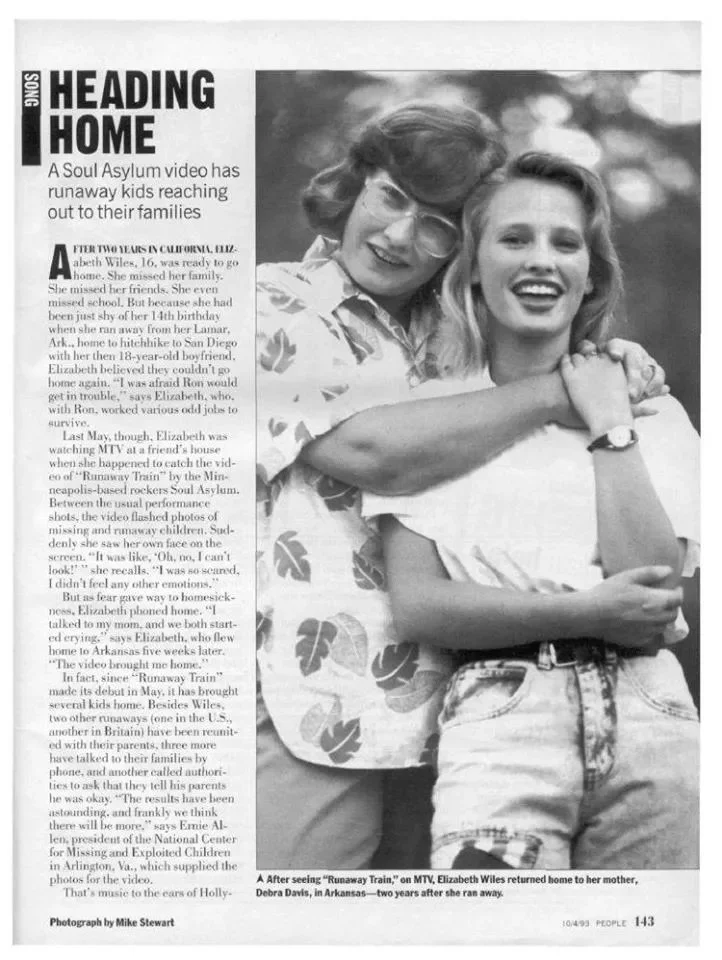
People documents how it went down:
Elizabeth was watching MTV at a friend’s house when she happened to catch the video of “Runaway Train” by the Minneapolis-based rockers Soul Asylum. Between the usual performance shots, the video flashed photos of missing and runaway children. Suddenly she saw her own face on the screen. “It was like, ‘Oh, no, I can’t look!’” she recalls. “I was so scared, I didn’t feel any other emotions.” But as fear gave way to homesickness, Elizabeth phoned home. “I talked to my mom, and we both started crying,” says Elizabeth, who flew home to Arkansas five weeks later. “The video brought me home.”
Elizabeth’s story is a lovely reprieve from the pain. And as much as I’d like to stay there, it’s impossible. Because what of the other 21?
Nick Keppler wrote a fantastic article for Slate in 2023 that clarifies a lot of what actually happened to these kids, these 21 that were “found” and the role the video played in their lives. He talks to some of them, noting how “all were determined runaways and none of them said they were ‘saved’ by the video.”
Through Keppler’s interviews, we now have documents that show a point of view we haven’t really gotten: the “found” kids from the video who didn’t have an Elizabeth Wiles type of homecoming. Through these interviews, he’s able to drive home a crucial point. “The actual lives of ‘Runaway Train’ kids were more complicated,” he writes in summation, after detailing how many of the children featured did something closer to escaping. “They ran from sexual molestation, cycles of abuse, and school days that filled them with dread. Some, impressively, found stability. It wasn’t always by coming home.”
But if these kids who ran away were escaping, shouldn’t we want them free? We should want them to run like the kids do in the video, away from the danger. Isn’t that what adults had taught them? And if that’s so, what are we to make of Thomas Gibson, of his inclusion in the video?
The kidnapping throughline is what scared me most as a child. Keppler mentions “the moral panic over abducted children,” linking to a Jezebel article called “Half-True Crime: Why the Stranger-Danger Panic of the '80s Took Hold and Refuses to Let Go” by Rich Juzwiak. Between research, Juzwiak weaves in his own experiences growing up in the early 1980s, and they closely resemble the world I grew up in a decade later, this panic bleeding well into the ’90s, even echoing and influencing today’s parenting. While reading, I vacillated between the dumbfounded epiphany that, besides the more personal and familial aspects, I wasn’t alone in my childhood terror, and surges of anger and frustration that the mechanisms behind my fear were actually far-reaching national efforts to cause the fear. I spoke to my sister about these childhood feelings a few days ago and she said, “The thing about the ’90s though is that you always thought you were gonna die.”
Juzwiak focuses on the ways the moral panic of missing children and “stranger danger” in the early 1980s infiltrated our society, how a few brutal “nightmare scenarios” (most notably the Adam Walsh case) changed legislation and paralyzed children with fear, a fear that, he posits, was caused by NCMEC’s grossly inflated numbers. He cites a Pulitzer-Prize winning article by Diana Griego and Louis Kilzer that says, for example, “The FBI reports that it had 67 cases of children kidnapped by strangers in 1984. The National Center for Missing and Exploited Children says that it has firm records on 142 cases.” Juzwiak explains that the number became inflated because “runaways were often lumped into statistics about missing children—as many as 95 percent of children reported missing were runaways, and most of that group returned home within three days.” And this was 1984, a decade before the Soul Asylum video. In that video, those two separate issues are absolutely conflated, echoing the same type of meaning-merging the song and video experienced.
Juzwiak speaks to Joel Best, author of Threatened Children, who explains why this phenomenon took place, and perhaps why it continues:
We take our anxieties about the future and we translate them into efforts to protect children [...] We have this sense that the future is uncertain. Children are the walking, talking future. There is a sense of powerlessness and a sense of fear. We seize on protecting children as a way of, ‘We can do this.’
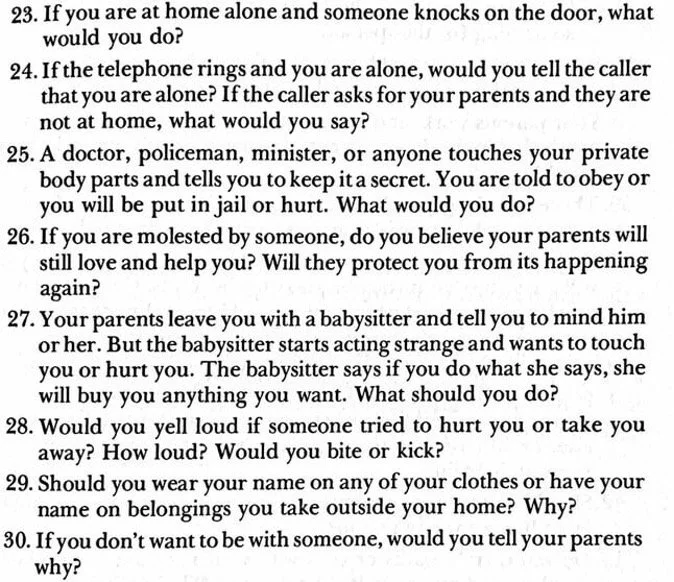
This overcorrection and overprotection has its root cause in fear, but that only begets more fear. “In 1986, the classroom-distributed periodical for kids Weekly Reader found in a poll that Stranger Danger and the threat of nuclear war were among the biggest concerns of kids in Grades 2 through 6,” Juzwiak notes. He cites Weekly Reader’s editorial director Dr. Lynell Johnson as saying “I think we have scared kids too much.” He underlines this point by including an image of the 50-question Protect Your Child survey by Laura M. Huchton, a much more intense version of what appears in my KidCare ID:
The cycle continues. The fear still infects us, as the near-inescapable bombardment of news, of online content, reminds us of danger. Putting aside all the other gigantic threats going on simultaneously in our world, there are the child-centric, whether real or imagined, or “half-true,” as Juzwiak mentions in his article’s title—the spectre of the Epstein files, the QAnon conspiracies, Chris Hansen’s popularity, rumors of Pinterest child pornography, school shootings, radicalization on Fortnite, child predators on Roblox, AI chatbots pushing children to suicide. We keep them home, but we allow them on devices that threaten. There is always a threat, so our fear is seemingly always warranted. In an article for The Atlantic, Kaitlyn Tiffany describes the perfect storm that created the fear and propelled the movement in the ‘80s:
‘Family values’ political rhetoric drove paranoia about the drug trade, pornography, and crime. Second-wave feminism had encouraged more women to enter the workforce, though not without societal pressure to feel guilt and anxiety about leaving their children at home alone, or in the care of strangers.
So much of this sounds like a version of what’s happening now in our tech-dominated world, which is part of Tiffany’s point, as she goes on to explore the ways child sex trafficking conspiracies spread easily, with usually-reasonable people falling for misinformation because who wouldn’t want to help a child? She writes about the internet’s role as both a problem and a tool that “gives each of us the power to take on work as champions of morality and marketers of fear.”
There’s even reflection back in our media again. I watch with my son as the evil entity Vecna on the 1980’s-set cultural juggernaut Stranger Things explains how he preys on children because they are weak, how he picks out the especially weak ones. It’s no accident that he’s styled in so many ways after Freddy Krueger, the spectral embodiment of a literal child molester who was burned to death by overprotective parents. And, spoiler, it’s Winona Ryder—who lived in the same community as Polly Klaas, who offered $200,000 for her return, and who was once, interestingly enough, Dave Pirner’s girlfriend—as Joyce Byers, the mother of the abducted “lost” kid[4] in the series, who gets to decapitate Vecna at the end.
I have to tell you something else, too. I’m writing this from inside a depressive jag, which is also part of why I’ve been crying so much. This research is definitely contributing, but more likely, it’s this time of year.
My father died five years ago, and that Christmas was spent watching him in hospice, much like I’d watched his father when I was five. The disintegration of a person, of a body. I spent the time wanting something different to happen. The fear consumed me, anticipatory grief a heavy rock on my chest. When it became abundantly clear something different was not going to happen, when I understood all they could do was give more morphine, when I understood he’d no longer wake up, the fear dissipated almost immediately. Maybe this is because I’m an adult now, and can sort through these emotions more deftly. I can’t say any of those emotions felt good, but it felt good not to be afraid anymore. The sadness, which I’d only come to understand during the ensuing year, wasn’t as bad as I had assumed it would be. It was the fear that was worse. And I started to see how the fear is always worse, how fear has paralyzed me throughout my life, how it kept me from understanding reality.
I hate the holidays, too, because someone I love very much, someone I’m too scared to name here—fear still exists in me more fully than I’d like it to, but I’m seeing this paragraph as a step forward—physically assaulted me before Thanksgiving when I was fifteen. My mom was too scared to call the police, so we waited until a teacher noticed my black eye. The teacher called the Department of Children and Families, but by the time they showed, my bruises were fading. When we got the pictures we’d taken back from the lab, we saw how the injuries and marks on my arms had been washed out by the flash. By January, I’d tried to kill myself. And even so far away from all of that now, early winter still reminds me of the days I spent in the hospital trying to imagine a home I could return to, one infinitely better and safer than the one I left.
I think when I watch the boy running out of the house in the “Runaway Train” video now, it makes me cry because I wish I’d run, too.
When the fear comes, because it always does, I try to make it useful. But it’s hard. Sometimes I turn on PlutoTV’s 90s music video channel before I leave the house as background noise for my dogs. The other day, when I was getting ready to take my son to school, “Runaway Train” came on. “Oh!” I told him. “This is the music video I’m writing about.” In my excitement, I wasn’t thinking beyond that.
“What is it about?" he asked as we stood inches from the screen. “What happens in it?”
I paused. I tried to explain, how it’s a story. It’s not real, those frightening people aren’t real, but the pictures are, how they made the video to help the kids. “But I was so scared of it when I was your age,” I said. And then of course he asked so many more questions.
How was I supposed to explain it without scaring him? This was one of those parenting moments where time seems to freeze and you have the opportunity to do something different than what was done for, or to, you. “You know stranger danger, right?”
He laughed, said, “yeah, guys in vans.”
Why was it funny? Do they teach stranger danger in Health class? Had I already told him this? We’d gone over bodily autonomy, consent and privacy, how sperm meets egg—so many conversations I powered through in hopes to normalize and inform, to reset generational harm. Or, fuck, tried to. And now I have these statistics, this knowledge.
The fear creeps in, so I try to decide how to use it. But the impulse is there—to pass it along. I want to scare him.
What would you do if a man asked you to help find his puppy? I want to ask. If someone grabbed you, would you scream? Would you kick and bite? Would you run, and run, and keep running, and not look back?
[1] There are reports Klaas was featured in a version of the music video, but it’s difficult to confirm.
[2] The UK video had different pictures, and at least two of the lost kids, Vicky Hamilton and Dinah McNicol, were the victims of serial killer Peter Tobin. In Australia, a number of the pictures shown ended up belonging to victims of serial killer Ivan Milat.
[3] While in custody for charges related to the 1980 homicide of 25-year-old Kathleen Doyle.
[4] The first episode is called “The Vanishing of Will Byers,” and brings to mind so much of the cultural fears of this era (and the following ones).
Emily Costa is the author of Girl on Girl (Rejection Letters) and Until It Feels Right (Autofocus). Emily writes semi-regularly as half of LISTLESS on Substack.
Failure Is an Option: kathleen rooney On the Adamant Sadness of “You Don’t Even Know Who I Am” by Patty Loveless
“You Don’t Even Know Who I Am” by Patty Loveless is why I don’t have kids.
Okay, not quite. For various reasons relating to the atmosphere and circumstances in the household in which I grew up, I intuited that the nuclear family might be a death cult. Why else would an arrangement that revealed itself daily to be oppressive and disappointing to everyone under our roof be relentlessly pushed by the broader culture as the highest measure of adult success and moral achievement? Something seemed fishy.
But it took me years to gather and analyze the evidence and to form an articulatable rationale for why I never—truly never!—wanted to become a parent: the anger, the grind, the resentment, the cost, the drudgery, the unfulfillment and so on.
Without knowing I was doing it, I began to keep an archive of art that swam against the current pushing me to aspire to what everyone was supposed to aspire to: getting married and reproducing myself. I paid special attention to any song or film, TV show or story that showed why that style of life might prove unsatisfying.
Unremittingly sad and calmly realistic, “You Don’t Even Know Who I Am,” was one of these art works.
The specifics of my childhood are luckily not the point of this essay. The point of this essay is that “You Don’t Even Know Who I Am” is without a doubt the saddest song of the 90s, hands down, in any genre. The saddest song by a country (ha) mile, if you will.
One of 10 tracks on Loveless’s seventh studio album, 1994’s When Fallen Angels Fly, “You Don’t Even Know Who I Am” was released as a single in March of 1995, reaching number five on the Billboard U.S. Hot Country chart. I remember hearing it repeatedly that spring and summer on U.S. 99, the country music station broadcast from Two Prudential Plaza in Chicago’s Loop and the radio station of choice in the pickup truck my dad—originally from rural Nebraska—drove around the suburbs.
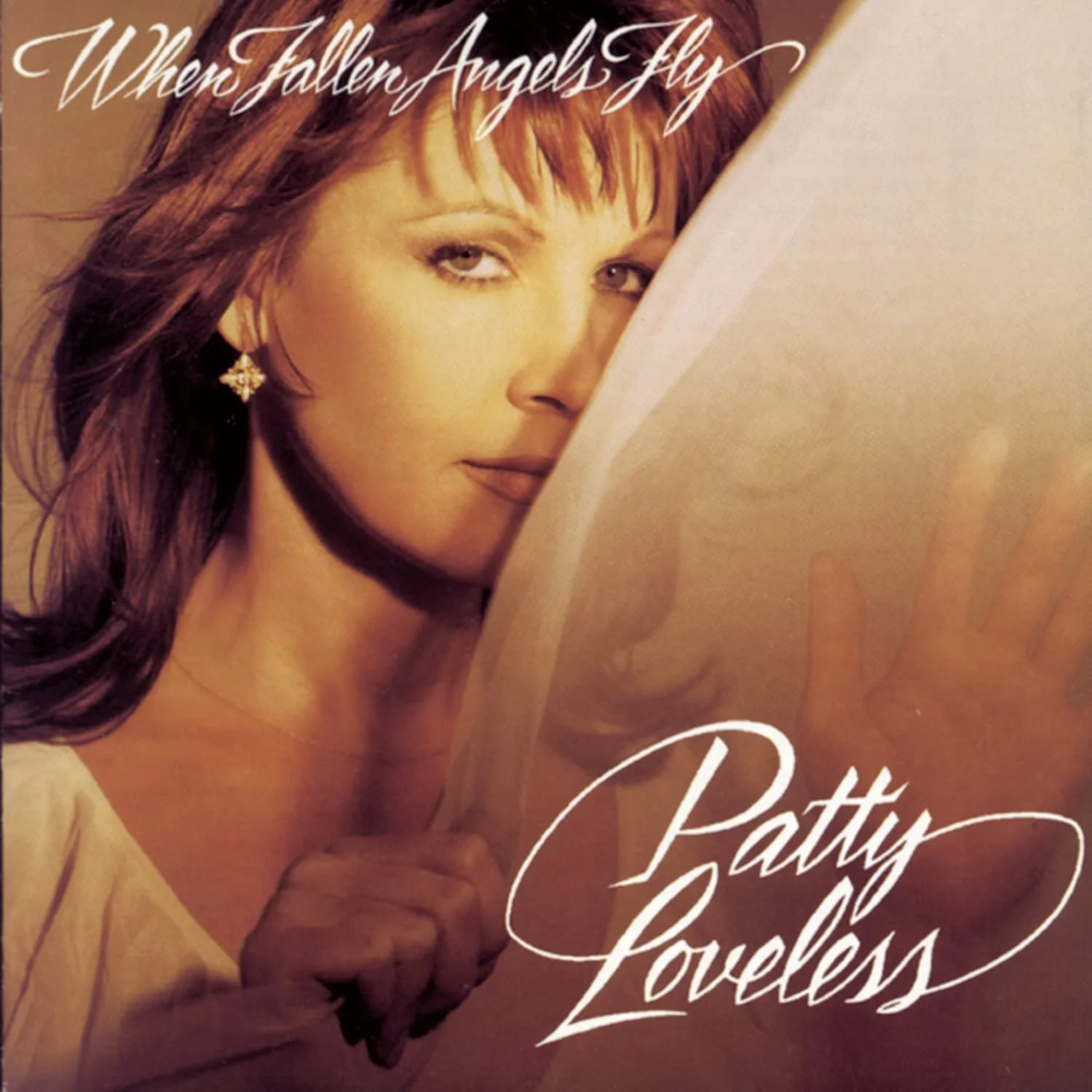
The melancholy kicks in before the words do, with the strummed guitar, mandolin, and pedal steel. When Loveless begins to sing, her powerful and expressive alto envelopes the verses with quiet restraint, delivering a catalog of domestic disillusionment:
She left the car in the driveway
She left the key in the door
She left the kids at her mama's
And the laundry piled up on the floor
She left her ring on the pillow
Right where it wouldn’t be missed
She left a note in the kitchen
Next to the grocery list
The understated intimacy with which she describes this defeated departure contrasts with the sudden dynamic leap of the chorus. Before we even have time to wonder, “What did the note say, Patty?” she’s not-quite shouting:
It said, “You don't even know who I am
You left me a long time ago
You don't even know who I am
So what do you care if I go?”
The tension of this accusation lets us think for a moment that we might be treading familiar country music territory. Tales of betrayal and breaking up are the stock-in-trade of the genre, and they can be sad, certainly, or they can be a ton of fun. By 1995, I was already a Loveless fan based in no small part on her witty single about a faithless boyfriend called “Blame It On Your Heart.” Its hilariously lengthy chorus—“Blame it on your lyin’, cheatin’, cold dead-beatin’, two-timin’, double-dealin’, mean mistreatin’, loving heart”—sent the song to three weeks at number one and helped its album, 1993’s Only What I Feel, go platinum.
Based on the first verse and the chorus, a listener might assume that “You Don’t Even Know Who I Am” is simply a more serious take on yet another scenario in which a man has, predictably, let his woman down. To be clear, thanks to Loveless’s voice and delivery, as well as the arrangement and production, not to mention the writing itself, were this the case, “You Don’t Even Know Who I Am” would still be really good. It would be a sad song for sure, although not the saddest.
But the ballad is doing something more sophisticated, and therefore vastly sadder than its break-up song peers. Because here comes the twist. We cut to the husband:
He left the ring on the pillow
He left the clothes on the floor
And he called her to say he was sorry
But he couldn't remember what for
Rather than leaving the wife’s question “So what do you care if I go?” rhetorical, he gets to answer:
So he said, “I've been doin’ some thinkin’
I've been thinkin’ that maybe you’re right
I go to work every mornin’
And I come home to you every night
And you don't even know who I am
You left me a long time ago
You don't even know who I am
So what do I care if you go?”
Dang. The problem is not what we presumed. She’s not a martyr and he’s not an asshole. He goes to work every morning and comes home to them every night! Their situation cannot be pinned on the misbehavior of either person. Their loneliness comes down to perhaps a third, worse thing: the structure of marriage itself, an institution in which it’s totally possible for both parties to do their best and still end up failing. (More specifically, it’s the structure of marriage under the conditions of capitalism. The grocery list in the first verse and the going to work in the second seem like they’re in there for a reason.)
Written by powerhouse songwriter Gretchen Peters, “You Don’t Even Know Who I Am” is in the third person, a phenomenal point of view for an old-fashioned story-song with a plot and characters, pathos and themes—themes which Peters treats with nuance. Her chosen perspective allows the narration to stand outside both spouses, while evenly depicting their actions and states of mind, with their first-person material coming only in dialogue.

Knowing that after the first verse, most listeners will be on the side of the wife, Peters subverts expectations. And that’s what makes this the ne plus ultra of break-up songs, sadder than all the rest: it dares to distribute the blame equally. The wife is not a saint, the husband is not a dickhead. Nobody cheated on or abused anybody else. They both failed to keep up a healthy relationship, an erosion that occurred slowly over time to the point of no repair.
This balanced approach to who or what is at fault is why, to me, “You Don’t Even Know Who I Am” is a perfect country ballad, “a narrative composition in rhythmic verse, suitable for singing.” Merriam-Webster adds to this handy definition that a ballad is “a popular song, especially: a slow romantic or sentimental song” giving as the usage example “a ballad they danced to at their wedding reception.” (Although to dance to this one there would be like cursing yourself, unless what you want from a partnership are heartache and loss.)
Loveless supposedly wasn’t keen on the song after the first verse, thinking it might be another run-of-the-mill sob story about a man doing his lady wrong and her suffering as a consequence. But when she got to the midway shift in Peters’ story, she was sold.
Interviewing Loveless for the Providence Phoenix in 1998, Jim Macnie asks, “Do men and women hear songs differently? Ever sang one that's gotten a different reaction from both camps?” Loveless replies:
The one that got a lot of reaction was “You Don't Even Know Who I Am.” It starts out and you think, “Okay, here's another woman crying about something,” and then it swings around and it says he finds her ring on the pillow and he starts to think, “Hey, you didn’t know who I was either.” They got to the point in their marriage that they didn't know each other anymore. There’s been a lot of men that this song just tears up. I’ve often said that country is the cheapest therapy you can get. Music can be good for your soul. People can be moved to tears.”
I don’t know if Peters or Loveless has ever read Samuel Taylor Coleridge’s Table Talk, but this song is a concise illustration of his assertion that “Good and bad men are each less so than they seem.” This song’s refusal to reduce the scenario to a scoreboard is exactly the kind of subtlety that I had already begun to like in art back in 1995.
“You Don’t Even Know Who I Am” feels like it could have a third verse and then devastatingly doesn’t. A bunch of aesthetic conventions—the Rule of Threes, the expectation that a thesis and an antithesis will be followed by a synthesis, etc.—lead us to anticipate the third-person narrator to step in at the end to objectively resolve or clarify or ameliorate the impasse between the spouses, but the song just concludes and you want to jump off a bridge. (Or maybe more precisely the song abruptly puts this task of sorting out on the listener.)
It’s a novel’s worth of narrative in 188 words; an ocean of sorrow in four minutes and four seconds. I was tempted to write that it’s like a Raymond Carver story with all that kitchen-sink realism. But even better, it’s more like something by Larry Brown, an author who is not afraid to show a doomed situation from every angle, declining to polish it up to be in any way pleasant, but also declining to be cynical. The song’s characters would not be out of place among those in Brown’s Tiny Love, which Woody Haut describes in the Los Angeles Review of Books as “short sharp shocks about human frailty, hope, despair, temptation, and desire, focusing, as they do, on those who do whatever is necessary to make it through the day, failing and failing better to make things work.”
Brown’s collection has a blurb by country star Tim McGraw: “Larry Brown wrote the way the best singers sing: with honesty, grit, and the kind of raw emotion that stabs you right in the heart. He was a singular American treasure.
American literature and music do have an abundance of treasures. There are so many fabulously sad songs—country and otherwise—to enjoy and praise. For this tournament, I considered choosing “Neon Moon” by Brooks and Dunn, one of the best songs ever, no matter its emotional palette, a song so well-crafted it could be covered by anybody and come out well, a song that should be a standard in the American songbook. But “Neon Moon” makes feeling sad sound sexy—an emotional state that stings a little bit, but mostly suffuses its feeler with an enviable worldliness; its sadness has a romantic quality and conveys that the feeler has begun to heal.
“There’s always room here for the lonely” is a welcoming declaration. Watching one’s “broken dreams / dance in and out of the beams / of a neon moon” is picturesque, an image arguing that it’s okay to be a heartbroken mess; maybe it’s even fun or elegant. “You Don’t Even Know Who I Am” traffics in a harsher sadness.
Similarly, I came super-close to requesting another US-99 stalwart, “The Dance” by Garth Brooks, which is legitimately brilliant and extremely sad, like sad to the point where I hear the first 15 seconds and start to weep because it stabs me in the lizard brain. But Garth is undeniable—an oft-praised titan of his era and genre, an artist not in need of advocacy, and given the chance I go for the underdog.
Besides that, unlike the uncut sadness of “You Don’t Even Know Who I Am,” “The Dance” offers hope and uplift as well. The speaker’s conclusion that, “Our lives are better left to chance / I could have missed the pain / But I’d’ve had to miss the dance” has an “Invictus”-like ring. We hear a person who has suffered taking solace in what that suffering has taught him, feeling gratification at the stronger man that experience has made him. There’s a glamour to the sadness in “The Dance” as Brooks delivers a statement of a hard truth, which then becomes a celebration of enduring that hardness.
Thus, as sad and excellent as those songs are, “You Don’t Even Know Who I Am” is sadder, and as luck would have it it’s by two women, the infamous “tomatoes” in the salad that is commercial country radio.
Nominated for a Grammy for Song of the Year, “You Don’t Even Know Who I Am” helped Loveless win Album of the Year from the Country Music Association, making her only the third woman in the history of the awards to do so. Yet I’d still argue that the song, as well as its singer and its writer, are underrated.
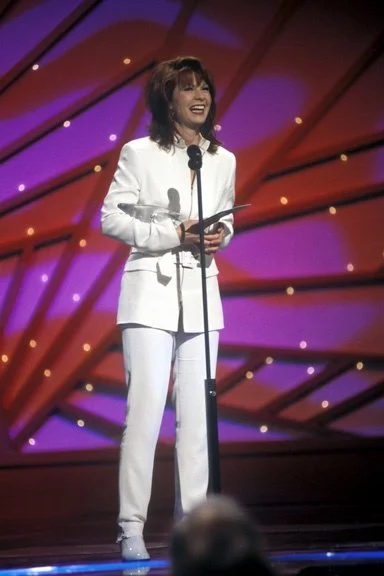
Born in 1957 in Pikeville, Kentucky, Loveless is related on her father’s side to Loretta Lynn and Crystal Gale, and like them she’s a coal miner’s daughter. Her biography, though, has little bearing on the song, written as it is by Peters, and that absence of an explicit autobiographical connection makes me love it all the more. The story is fiction—imaginary, made-up—but so inhabited by Peters’ writing and Loveless’s interpretation that it feels as real as anything that could have actually happened.
Peters was also born in 1957, but in Bronxville, New York where she wrote her first song with her sister at the age of five. In 1988 she moved from Boulder, Colorado to Nashville where she penned hits for luminaries including Etta James, Neil Diamond, Martina McBride, Trisha Yearwood, Anne Murray, George Strait, Shania Twain, and Bryan Adams. In 1996 she released the first of her own 14 studio albums to date.
Neither Loveless nor Peters are flashy attention-seekers; neither spills her guts to reporters. The admiration they attract comes from their showing up and putting in the effort for decades, and their work ethics have made magic happen for the duration.
Country music, like everything in this stupid nation, is politicized. It always has been and is now more so than ever, as is literally everything else under the general sense of hovering malice created by the current administration. But the best art is valuable unto itself, not for its supposed politics, and this song is such a work. It’s a moving double portrait of a lose-lose situation, and I adore it for its irreducibility.
What Coleridge meant by his statement in Table Talk, of course, is that binaries are reductive and every person is a mix of the dark and the light, the abject and the noble. From there, one can extrapolate that empathy yields greater insight than the rapid passage of a verdict on who is good and who is evil.
That’s why “You Don’t Even Know Who I Am” kills me. It’s a song of astonishing simplicity on one level—the purity of the sadness, straight no chaser—and admirable complexity on another. It’s not a binary feminism-versus-the-patriarchy song, but a story that unfolds in a morally gray area that we’re rarely allowed to set foot in these days, days of making sure that art has a message that’s clear and socially useful.
Loveless’s surname is a variation on the last name of her first husband—Terry Lovelace, the drummer for the Wilburn Brothers Band, which she joined as a touring vocalist after she graduated high school—whom she married in 1973. There in my dad’s pickup truck, hearing the song for the first time, I was struck that I was listening to a song by Patty Loveless about a marriage that has itself grown loveless. As had become my wont, I categorized it as a song that belonged in my archive, deflating as it does any naïve daydreams one has been encouraged to dream about the nuclear family.
That summer marked the end of my freshman year of high school and the height of my babysitting career, the apex of something I’d been doing since I was 12, and something I’d soon stop doing to focus on steadier jobs, like being a library page. The main lesson I learned by taking care of other people’s kids—going into their homes and seeing their furniture and decor, the insides of their pantries and fridges, their backyards and garages—was mostly that having babies you didn’t give back at the end of a pre-agreed-upon timespan was a trap.
To its credit, “You Don’t Even Know Who I Am” doesn’t put anything as bluntly as I just did. It shows rather than tells. It conveys an emotion more than a message, presenting the pain of domestic discontent and how any family can come—not through a great cataclysm, but through a slow disintegration—to feel stunted and numb.
What I admire most about this song—and what proves that it should proceed to victory in this or any other contest pertaining to sadness—is that it does not gild its sadness with a silver lining. It’s just sad sad sad, a rock-bottom bummer that ends with no redemption, none whatsoever. This move strikes me as both rare and awesome. Both Peters and Loveless resist the impulse to mitigate the sadness or to add a sprinkle of self-help sugar on top. Their ballad has the courage not to equivocate, but to say flat out that sometimes you have to go face-first into the failure and accept it for what it is: the truth. It’s a song that shows how relationships can break irrevocably and that no amount of Pollyanna positivity or couple’s counseling or chore charts or forcing yourself to learn from the situation is going to make the experience something you’re kind of glad about once it’s over.
Often, if you say that you’re quitting or stopping or giving up, or that something is not for you, or that it’s not working or not worth it, somebody rushes in to insist that you’re being negative and should have a better attitude or try harder or whatever. “You Don’t Even Know Who I Am” is refreshing because it admits: you can fail, and you can quit, and sometimes you have to.
In an interview with Americana Highways, Gretchen Peters speaks to the power that sad songs have to let listeners hear that they’re not alone in their unhappiness:
…the thing I always come back to is that I love sad songs. I admit it. The thing that’s sadder to me, though, would be not talking about that stuff. Because what is cathartic to me, is saying the thing that people are afraid to say but are thinking about it all the time. It’s incredibly cathartic to say it, and to have people say they feel it too, or they think about it too. To me, the saddest thing is the isolation that comes with thinking it and not talking about it.
I’m drafting this essay in August of 2025, August 13th to be exact, the day of my 20th wedding anniversary to fellow writer and frequent Xness participant Martin Seay. I confess that I have done, and am still doing, a little bit of what the song warns about and mourns: the marriage part. But not the kids. Would Martin and I still be together—and together so happily—if we’d reproduced ourselves? Maybe, but I think the odds would be way lower. Ultimately, we’ll never know.
But if you’re not afraid of being labeled a downer or a defeatist, then here’s to the songs that help us say “we quit,” and to the ones that let us say “I’m not doing that in the first place.”

Kathleen Rooney is a founding editor of Rose Metal Press, a nonprofit publisher of literary work in hybrid genres, and a founding member of Poems While You Wait, a collective of typewriter poets who do commissioned poetry on demand. Her fifth novel Man Overboard! will be published by Gallery Books in July of 2026 and her debut picture book Leaf Town Forever, co-written with her sister Beth and illustrated by Betsy Bowen, was released by University of Minnesota Press last Fall. She lives in Chicago with her spouse, the writer Martin Seay, and teaches at DePaul University.