
first round game
(16) Mineral, “Parking Lot”
TROLLED
(1) Red Hot Chili Peppers, “Under the Bridge”
80-62
and will play on in the 2nd round
Read the essays, listen to the songs, and vote. Winner is the song/essay with the most votes at the end of the game. If there is a tie, we will play a one-hour overtime (and repeat until we have a winner). Polls close @ 9am Arizona time on 3/5/26.
“Under the Bridge”: Isolation and Witness. His Addiction, My and Out Addictions by Timothy Gager
Before the sad 90’s, before, Under the Bridge, there were the sad 80’s when Anthony Kiedis stole my drugs. The Chili Peppers in their full-on funk, white socks worn on their penis mode, were at The Paradise Rock Club in Boston. I was a big fan of them and of cocaine so this was going to be awesome. And it was. After their encore rumors flew around that the band was going to be at a party nearby, so I was in.
At the party, my obvious jaw swinging alerted people that I was holding, and I was cornered by Kiedis, who asked if I had any coke. Holy shit, I thought, I’m going to party with the Red Hot Chili Peppers.
“Yeah,” I said.
“Give it to me,” he said, which I did.
Then he led me a back bedroom of the apartment, two steps ahead of me, and quickly closed the door behind him.
Knock-knock-knock.
“Anthony?”
Knock-knock-knock.
“Anthony?”
Knock-knock-knock.
“Anthony?”
Seven years later when the Red Hot Chili Peppers released, Under the Bridge, things had changed. The song too vulnerable to be a stadium anthem, too confessional to be background noise, became a huge hit. It articulated a condition so many people inhabit without language: the loneliness that survives even after one becomes clean. In that sense, Under the Bridge belongs as much to the recovery world, which I live in now, as it does to the broader spectrum of modern life’s isolation. Kiedis is more representative of an addict than the public might think. They think many addict live under a bridge, dirty, unshaven, and scummy.
Anthony Kiedis wrote the song in the aftermath of addiction, not during the frenzy of it, when he was doing my drugs. That distinction matters. Under the Bridge is not about using drugs; it is about what remains when the drugs stop working. The city is still there. The damage remains. The self has not been replaced by something cleaner or whole. It has simply been left alone, as if your best friend had left you, even if that friend was abusive.
I have written repeatedly from this same location. In Shadows of the Seen, I wtore, “There’s the act, and then there’s the rest of your life where you have to explain it to yourself.” That sentence could serve as an epigraph for Under the Bridge. The song is not an explanation to the world; it is an explanation to oneself inward, where the excuses no longer hold.
“I don’t ever want to feel like I did that day.”
The line sounds simple, almost adolescent, but it represents the rewinding of a VHF tape of Kiedis’ life. It is not a vow of transformation. It is a punch in the face against relapse. Some of my own characters understand this intimately. In Joe the Salamander, I wrote, “I wasn’t asking to be saved. I just wanted the noise to stop.” That is the same request Kiedis makes: quiet, desperate, and modest.
In Under the Bridge, Los Angeles, where he was living becomes both refuge and witness. The city shelters the narrator mentally. His home is a place to stand, to exist, but offers no warmth. “The city I live in, the city of angels / lonely as I am, together we cry.” This is not metaphorical loneliness; it is civic. Structural. It is the group of people that live there, they cry with him, that are experiencing things the same way.
In Shadows of the Seen, a character remarks, “The city didn’t judge you. That was the problem. It didn’t care enough to.” The bridge, like my own created streets and bars and courtrooms, is infrastructure—something built to move others past you efficiently.
Under the bridge, Kiedis finds community, through connection of shared experience. Alcoholic and Narcotics Anonymous using this as a major building block. The opposite of addiction is connection. Other addicts. Other ghosts. No dialogue, no solidarity, just shared understanding. This refusal to romanticize addiction are not cinematic. Addicts, like the rest of us worry about mundane things. They remember smells. They miss people who no longer are able to miss them.
“Addiction isn’t chaos. It’s repetition that feels like fate.” That line of mine could be spoken Under the Bridge. The song is circular, almost static. There is no forward momentum, only returning to the same emotional location and naming it again. This static is what leads addicts back to their drugs of choice, the conflict of if nothing changes emotionally, nothing will change.
“I don’t ever want to feel like I did that day / take me to the place I love.”
That “place” is never defined. It could be memory. Childhood. Sobriety. It could be nowhere. It could also be that familiar feeling of being high. In Every Day There Is Something About Elephants, I wrote, “Memory doesn’t rescue you. It just proves you once stood somewhere else.”
The chorus’s plea is answered not by a god, but by a great wall of voices. The song ends not in solitude but in those voices—a communal that tells Kiedis that he is not alone. This matters. Under the Bridge ends in being heard, and being answered.
Again looking at my own work, I’m struck by the similarity of themes. In Shadows of the Seen, “Some stories don’t end. They just stop being told. To tell them at all is the act of resistance.”
In the larger world, the song endures because it names a condition that we all can identify with. That condition is called disconnection, and it is the norm, not the exception. Even before the dreaded social media, cities were faster, louder than ever, filled with people who feel functionally invisible. The bridges have multiplied through algorithms, institutions, economies, but the space underneath remains crowded.
Under the Bridge survives because it doesn’t lecture. It never offers solutions. The song insists that clarity without comfort is still worth having.
And maybe that is the quiet gift if it: the reminder that loneliness, when articulated honestly, becomes a form of connection. Not salvation. Not escape.
Just recognition.
Sometimes, that recognition is enough to keep us going.
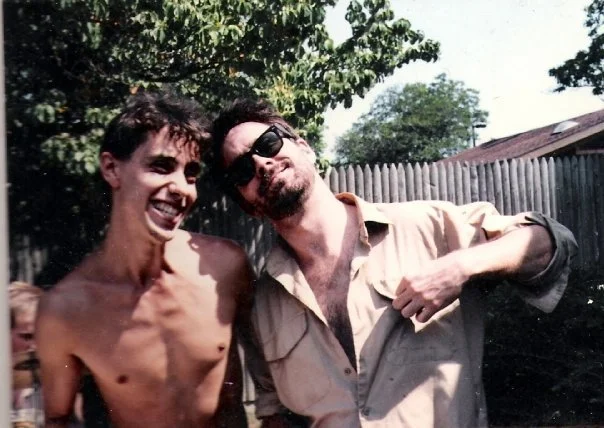
Me and the late Jones Purcell—sometime in the late 80’s.
He was a hell of a musician. Under the Bridge speaks to him too.
Timothy Gager is the author of 20 books of fiction and poetry, which includes his fourth novel, Shadows of the Seen, and his most recent collection of poetry, Almost Bluing for X-Tra Whiteness. He hosted the successful Dire Literary Series in Cambridge, MA from 2001 to 2018, and started a weekly virtual series in 2020. He has had over 1000 works of fiction and poetry published, 19 nominated for the Pushcart Prize. His work also has been nominated for a Massachusetts Book Award, The Best of the Web, The Best Small Fictions Anthology and has been read on National Public Radio.
brittney uecker on mineral’s “parking lot”
Mineral - Parking Lot. Last song, last show ever @ Best Friends Forever
There’s a moment just before Mineral’s final—like, final final—performance of “Parking Lot” at the Best Friends Forever Fest in Las Vegas in October 2025 where lead singer Chris Simpson mumbles something barely intelligible, possibly something about a whale, before laughing it off. “This song’s about being happy,” he says before launching the song’s initial lamenting notes, the last time they will ever be played on stage. Behind him, the band’s name is projected in huge bright green letters against the backdrop of the enormous mainstage, a crowd of thousands of elder emo apologists screaming in anticipation. The lead up to this iconic riff and all the finality it holds is expected, the same kind of prepared sadness one feels when you have to put your dog down or sign divorce papers—you know it’s coming, and you can brace yourself for the grief. But on the surface, right here on the stage as it’s happening, the dissolution of Mineral—for the second time around—is smooth. It has the calm of muscle memory, of something engrained. It’s an undoubtedly loaded moment, as the band looks out over all they’ve done, all they’ve gathered in their short yet impactful career, but perhaps it’s just another iteration, another “Parking Lot” closing out the show.
Mineral "Parking Lot" @ Knights of Columbus Hall. Orlando FL 9/13/1997
“This wouldn’t be a Mineral concert if we didn’t end it with ‘Parking Lot’,” Simpson tells an audience twenty-eight years earlier at a show at the Knights of Columbus Hall in Orlando. It’s September 1997. The video is grainy and discolored, the fluorescent overhead lights reflecting harshly off of Simpson’s blond, middle-parted hair. The group of kids encircling the drumset is focused and still. It’s hard at first to tell who is the band, where the calm, whispering croon is emanating from when the song begins, but eventually the environment settles and the source reveals itself in Simpson. He’s tall and gangly, craning down over a mic stand he refuses to raise, his eyes downcast, his voice warbly and unsure, almost Oberst-esque. He turns away from the direct gaze of the crowd at every opportunity, maintaining his calm murmur even after the breakdown around ninety seconds into the song, after the agonizing sob of Scott McCarver’s guitar takes over and an overwhelm of feedback envelopes the room like a weighted blanket. Even after this energy is injected into the song, swallowing the open rafters and janky ceiling fan and droplets of sweat dripping down the concrete walls, the band remains molasses-y slow and deliberate, the crowd giving up little more than a head bob in response. The guitars are off-tune and the tempo is all over the place, as if they haven’t really decided how they want to play this song, as if the distant punk influence can’t help but eke through.
This tableau repeats itself in every tinny, blurred video of Mineral you can dredge up from the depths of YouTube, from basement shows and DIY festivals and VFW halls, these holy crystalized performances from the mid-90s. In this way, it’s a sacred relic—you don’t see a cell phone held aloft or skinny jeans or copious amounts of eyeliner, just kids completely present and dressed for the discomfort of a sweaty basement. This was back when emo was purely linguistic, a truncation of the word ‘emotional’, characterized by little more than bleary-eyed despondency and an anguish so potent it transcended image and theatrics.
When emo emerged in the mid-eighties as an outgrowth of DC and California hardcore punk, it was a reaction to the growing aggression within these scenes. While hardcore, punk, and various combinations of the two targeted the sources of its listeners’ despair—politics, bigotry, societal conformity, etc. —, emo zeroed in on the despair itself. Lyrically, it was introspective, confessional, and deeply personal. It dealt heavily with relationships, particularly the thwarted and dissolving, and subsequently skewed toward the emotional. Musically, emo shifted away from the hard, fast spewing of punk toward more melodic elements that let the content of the lyrics shine through, including longer song structures and dynamic shifts in sound, volume, and pace. As emo spread inward from the coasts, it continued to soften, moving further from its punk roots of self-righteous violence and activist anger towards themes of breaking up, growing up, and feeling it all.
As the overall genre evolved over several decades into 2nd, 3rd, and some would argue 4th waves, some bands embraced the label while many, including Mineral, eschewed it, finding the categorization limiting and derogatory. Admittedly, seeing what the term ‘emo’ would come to encompass and be associated with in the later years, perhaps this rejection was more prophetic than anything. Emo continued to splinter and speciate, drawing on not just musical influences as varied as pop, indie, prog rock, and metal, but cultural. The mass migration of music and society in general to the internet, namely social media, turned the lens (literally) toward the aesthetic. Emo is far from the only subculture, let alone musical genre, to atrophy within the grips of commercialization—cue Hot Topic, Warped Tour, and Emo Nite—but such a hard fall, a blatant squandering of potential, fucking hurts. Bastardization seems like a fitting term.
But if anything about emo’s birth can be considered intentional, its initial intention was to expose internal pain to external light, to create a space for expressing deep, personal emotions and witnessing the reality and universality of heartache. While Mineral’s short-lived, two-breakup career was arguably overshadowed by those of contemporaries like Jimmy Eat World, Sunny Day Real Estate, the Promise Ring, and American Football, they were subtle masters of the craft. What sets Mineral apart lyrically and thematically is that their expression of emotional pain is always accompanied by aspiration. Their biggest release, 1997’s The Power of Failing, as well as “Parking Lot” specifically, bypass direct focus on love and grapple with other inherently vulnerable themes including crises of faith, embrace of personal imperfection, the search for identity, and the delicate intertwining of hope and despair. There’s no wallowing for wallowing’s sake. These songs aren’t just “about being happy.” They are about getting happy.
*
Max and I had a tumultuous, isolated relationship—tumultuous in the way it exploded my marriage, my identity, and my life, in the desperation and anguish of our push-pull, guilt-filled dynamic; isolated in the fact that it was a secret. As my marriage was shriveling into nothing in the face of multiple miscarriages, my husband’s alcoholism, and our shared despondency, I craved attention, however hollow and immediate, and found it in Max.
We couldn’t have been more unalike. Though he was only three years younger than me, there was a lifetime of experience separating us. I was a mother, a wife, a homeowner. I had a career, a Master’s degree, a car, health insurance, an overwhelming amount of responsibility, all things he did not have. He was unattached and unburdened, working part-time at a grocery store and skating through life without direction or responsibility, which was what drew me to him, why I attached myself like a barnacle. I was envious of his apparent freedom, tantalized by the prospect of giving it all up in order to feel an ounce of relief from the pressure of fulfilling all the roles I was required to fill. “I shouldn’t be attracted to this,” I wrote in my journal. “He’s inconsistent, unreliable, describes himself as chaotic. But I am so inexplicably drawn to the mess of him, to the tiny bit of panic I get when I see the way he lives.”
What began as an excruciating crush escalated into a feverish, clandestine affair, and as my marriage inevitably ended, it became a numbed-out path of self-torture. Things would eventually settle down, and as I began to reassemble my life on the other side of a divorce, Max and I would salvage some sort of tenuous friendship, but it never felt normal, despite our best efforts. I could only compartmentalize so far. Maybe that’s why we don’t speak any more.
*
The lyrics of “Parking Lot” have nothing to do with a parking lot. The title pays homage only to the song’s provenance—allegedly, the opening riff came to McCarver as a flash of divine, random inspiration while driving, prompting him to pull over in a nearby parking lot to capture it. Yet, after the fact, a parking lot seems like the most fitting setting for this song, for feeling devoid of belonging. A parking lot is a holding pen, a place that inherently lacks permanency. You aren’t meant to be there for long. It’s where you go when you can’t go anywhere else, when there is nowhere you can call home. A parking lot is liminal, and in that fragile state, it makes it a breeding ground for moments of vulnerability.
Each section of the song is a movement, a phase in a journey, such that there is undeniable forward motion, both lyrically and musically. The song begins with a quiet acknowledgment of one’s current pain, stated plainly. There is a recognition of hopelessness, of rock bottom, but it isn’t dramatic. It’s stated as an honest fact, so universal that the source doesn’t even have to be named:
I wouldn’t mind if you took me in my sleep tonight
I wouldn’t even put up a fight
I wouldn’t care if you took it all away today
I’m sure I wouldn’t even miss the pain.
This inevitability is further emphasized in the next verse, where the voice makes the massive, cosmic discovery that life is pain and admits their own insignificance in the grand scheme of it all. Rather than burdening themselves with the realization of this immateriality, there’s a sense of relief in this realization, in its humanizing beauty:
But I know I’ve got to live my life
And roll around on the ground and feel the strife
And realize along the way that I’m nothing more
Than a grain of salt in the salt of the earth
And everything is grace.
What strings these two sections together, what carries us from the fact of life’s pain to the relief of one’s lowly human insignificance, is the most devastating guitar riff I’ve ever heard. When McCarver’s guitar barrels into this song, it’s as if his guitar is not just crying, but keening, moaning in absolute anguish. It’s almost hard to listen to as it howls, slow and grief-stricken. Better than the lyrics, better than Simpson’s voice, that single guitar riff rips you right into the emotional crevasse that this song insists that you be in. How can something that sounds so impossibly sad possibly be about happiness?
From there, the tempo picks up just slightly, the guitar takes a breather, and Simpson’s voice gathers strength as the lyrics shift from the recognition of life’s inevitable suffering to actively coaxing that suffering to manifest:
So come on with the darkness
Come on with the fear
Cause I’ve got to start somewhere
And it might as well be here.
It is both humble and cocky, taunting the fates while also acknowledging, once again, one’s current location at rock bottom, recognizing that the only way to go is up. The only way to move is to explode. There is vulnerability in this admission, very “God sees your plans and laughs”, but also confidence. This is further emphasized in the closing lyrics:
When I’m finally naked and standing in the sunlight
I’ll look back at all of this selfishness and foolish pride
And laugh at myself
Laugh at myself
Laugh at myself
Laugh at myself
Laugh at myself.
We are left on that lasting final image, of a person stripped and submitting, laughing in a manner that I can only picture as maniacal. From the keening devastation we met three minutes ago to the stark, bared soul open to whatever the world is going to bring, this song comes full circle. It’s just the start of something, but it feels complete.
*
We had our fair share of parking lots, Max and I. When you have nowhere to go, no place in which you can legitimately be together, you find yourself in a parking lot. We met in parking lots to hook up, to hide, sometimes just to talk. From behind a cracked windshield, in the jagged shadows cast by floodlights, looking at the yellow slashes on the pavement, I could forget for just a moment about the world outside, about my real life. The setting lent a sort of backwards permissibility: if we only existed in this liminal, not-real place, it could be okay.
Early on, when my paranoia and guilt hadn’t yet given way to despondency and numbness, I met him one afternoon in the parking lot of the grocery store where he worked. Sitting in my car looking at the loading dock, I tried to explain the stakes of this mess we were getting ourselves into, how this could completely destroy me—my marriage, my reputation, my self-worth. I wasn’t sure if I was trying to tell him all the reasons why we should stop or all the reasons why we needed to be careful.
“This could ruin me, you know. If anyone finds out, I’ll lose everything.” He was single, fledgling, with little more responsibility than keeping himself alive. I was the one with everything to lose.
“It’s going to be okay, right?” I asked him.
“Yes,” he said, full of presumption and naivete. “Of course it is.”
The next year was a blur, punctuated with moments of agonizing pain before there could be moments of joy, and through it all, Max faded away. My husband and I divorced, split our life in half, and I reassembled the pieces into a Frankenstein-ed semblance of something new. I met someone else and fell in love. I dreamed up a scheme to leave the shithole town where my life had entirely imploded and put the pieces into place—new relationship, new career, new home, new life. The painful interim between these chapters would remain just that—an interim. Liminal. A parking lot.
A few weeks before I moved away, I met Max for a drink and a final goodbye. I had been doing this with many friends in the lead-up to leaving—meeting up for the last time, pretending that I was going to miss any part of this place, offering hollow assurances that I would keep in touch. Our conversation was pleasant, but felt forced. Without the scarcity and feverish risk that our interactions used to hold, it now just felt awkward. I let myself disassociate from the man sitting across from me, from someone who used to have me in an emotional chokehold but was nothing more than another reminder of a chapter that was over, as I drank cheap beer and watched the old cowboys at the bar playing pool.
In the parking lot as we parted ways for the final time, we both said “I’ll miss you” with the best of intentions, the benefit of the doubt. In just a second, I’d finally be able to breathe. I didn’t feel sad.
As we parted, he moved forward to kiss me. There was a disbelieving moment where I almost let it happen, where I forgot who he was and my body fell into the old pattern of his affection like it was something I should be doing. Before I snapped back to reality and realized that it wasn’t, that this, him, was not the life I want, I was knocked into a swimmy, liminal dimension between the things I used to want and no longer did, between the past and present. By the time I paddled to the surface, I was pushing him away, shoving my hands in my pockets to tether myself back to earth and walking in the other direction.
“You can’t fucking do that, you know,” I turned to scream across the empty parking lot between us. “You can’t do that anymore.”
This parking lot was a rock bottom for both of us, a bottom from which we would follow opposing trajectories: him towards stagnancy and wheelspinning, and me towards resilience and rebuilding. In the background, deep in my mind’s ear, I could hear Chris Simpson’s begging wail:
So come on with the darkness
Come on with the fear
Cause I’ve got to start somewhere
And it might as well be here.
There is so much fragility in this moment, so much potential for destruction. It could have so easily gone the other way—I could have leaned in, accepted this moment that my memory wanted, and destroyed everything I had going for me, just like I had before. It’s frightening to consider.
I wonder where he went from here, if this moment was as significant in the trajectory of his life as it was in mine, if this parking lot moment also lodged itself into his memory.
I never saw him again.
*
As is expected in the throes of all-encompassing infatuation, several songs felt relevant during this time and have, for better or worse, inextricably bound themselves to it —“Your Graduation” by Modern Baseball, “Constant Headache” by Joyce Manor, “Stockholm Syndrome” by blink-182, and obviously, “Parking Lot”. They are so potently attached that, years later, it still hurts. Whenever the looping opening riffs of any of these songs strike, a knot forms in my stomach. I am instantly thrown back into the well of guilt and desperation, desire and despondency, that colored the most difficult era of my life. It’s the lyrics only in part—I swear this has gotta be the hundredth time I’ve thought of you tonight from “Your Graduation”, I never ever felt so cool disguised in your sheets from “Constant Headache”, I’m sick with apprehension, I’m crippled from exhaustion from “Stockholm Syndrome”. What feels significant is the overwhelming melancholy of the music itself, the shrieking guitars, both feverish and syrupy, the desperate, relentlessness of the drums, the off-tune, beaten-down voices of Bren and Barry and Mark. It’s meant to rip the heart right out of you, and it does. I’ve tried to resurrect these songs years later, tried to provide corrective experiences that can make them listenable again, yet there still exists that slightly pleasurable pain of poignancy, of nostalgia, that makes me feel like a walking advertisement for whatever the fuck emo is.
“Parking Lot” is the exception, because while those songs were about him, about being stagnant in despair, “Parking Lot” is about movement, about despair’s inevitably intertwining with hope.
*
Nearly a year after that last parking lot incident, my phone rang on a Sunday morning, a number I didn’t recognize. I’d normally ignore this kind of call, but something that day compelled me to pick up. On the other line was Max, his number long since deleted. I hadn’t heard his voice, seen his face, or allowed more than a fleeting thought of him to graze my mind since our last moment in the bar parking lot, and to map his existence onto my current experience was a mindfuck.
His voice was shaky and cracking, like he’d been crying. “I didn’t know who to call,” he said. He told me he was sitting in the parking lot behind the grocery store, chain smoking cigarettes and clattering into another parking lot rock bottom. For whatever reason, he had woken up that Sunday morning and taken stock of his life—working the same dead-end job, sleeping on an air mattress in his parents basement, broke, alone, directionless—and saw it all in stark realism for the first time. The aimlessness that had drawn me to him in the first place, that I had once seen as freedom, had revealed itself to be emptiness.
“I don’t even know who I am any more,” he told me. “I need to get the fuck out of this town.”
It was an experience I was acutely familiar with, exactly what I had been feeling when we’d met. I’d felt a complete lack of identity, lost in a place I didn’t want to be, and trapped in the life I’d built. I knew what it was like to feel like I had no options, that I couldn’t escape unless I blew it all up. It was why I had chosen the explosion of him. It was only from the rubble of a shattered life that I could begin to build a new one. Maybe it had to be the same for Max.
He talked of moving to California, of selling his things and leaving everyone behind, of starting from scratch. He had a history of drug use in the past, and I hoped that a blank slate wouldn’t be a breeding ground for that kind of self-destruction, but I understood its allure. I had done the same—left my marriage, sacrificed half my life with my kids, quit my job, moved away, and started from scratch. It was hard as hell, and from the bottom of the well I could barely see a hint of light, but it had been worth it. I was reconstructing happiness. I could only hope the same for him.
Again, “Parking Lot” howled in the background of my mind:
But I know I've got to live my life
And roll around on the ground and feel the strife…
'Cause I've got to start somewhere
And it might as well be here.
“You are good,” I assured him. “You are going to do great things. You are going to get the fuck out of that town and you are going to be okay.”
“Do you really believe that?” he asked me.
When I'm finally naked and standing in the sunlight
I'll look back at all of this selfishness and foolish pride
Laugh at myself.
I never talked to him again.
*
When Chris Simpson said that “Parking Lot” is a “song about being happy”, he didn’t mean the state of happiness. This song isn’t an ode or a glorification of a feeling, nor is it a lamentation over a lack of it. It’s not about being happy—it’s about the path to getting happy. It’s about admitting that while you aren’t happy now, you’re going to be, and that without this distinction, it’s not worth talking about in the first place. It’s not static. “Parking Lot” witnesses an entire journey. Perhaps that makes “Parking Lot” quintessentially emo in its purest sense, or maybe that’s what makes it categorically something else.
*
With nothing to go on, no clues or communication upon which to brace my assumptions, I imagine what Max’s life might look like now. What happened to him after all those parking lots, after that last phone call, after I promised him that he would eventually be okay? Because despite all the shame laced through my memories of our relationship, despite all the pain it wrought, I do want him to be okay.
Did he go to California like he mentioned, start completely over from nothing? Is he still in that small town doing the same shit he’s always done, still directionless, still perpetually adrift? Something brighter? Something unimaginably worse? Did he find himself in more parking lots, in more liminal meanwhiles, killing the time, putting off the inevitable, or is he standing in the sunlight, looking back at all, and laughing, laughing, laughing at himself?
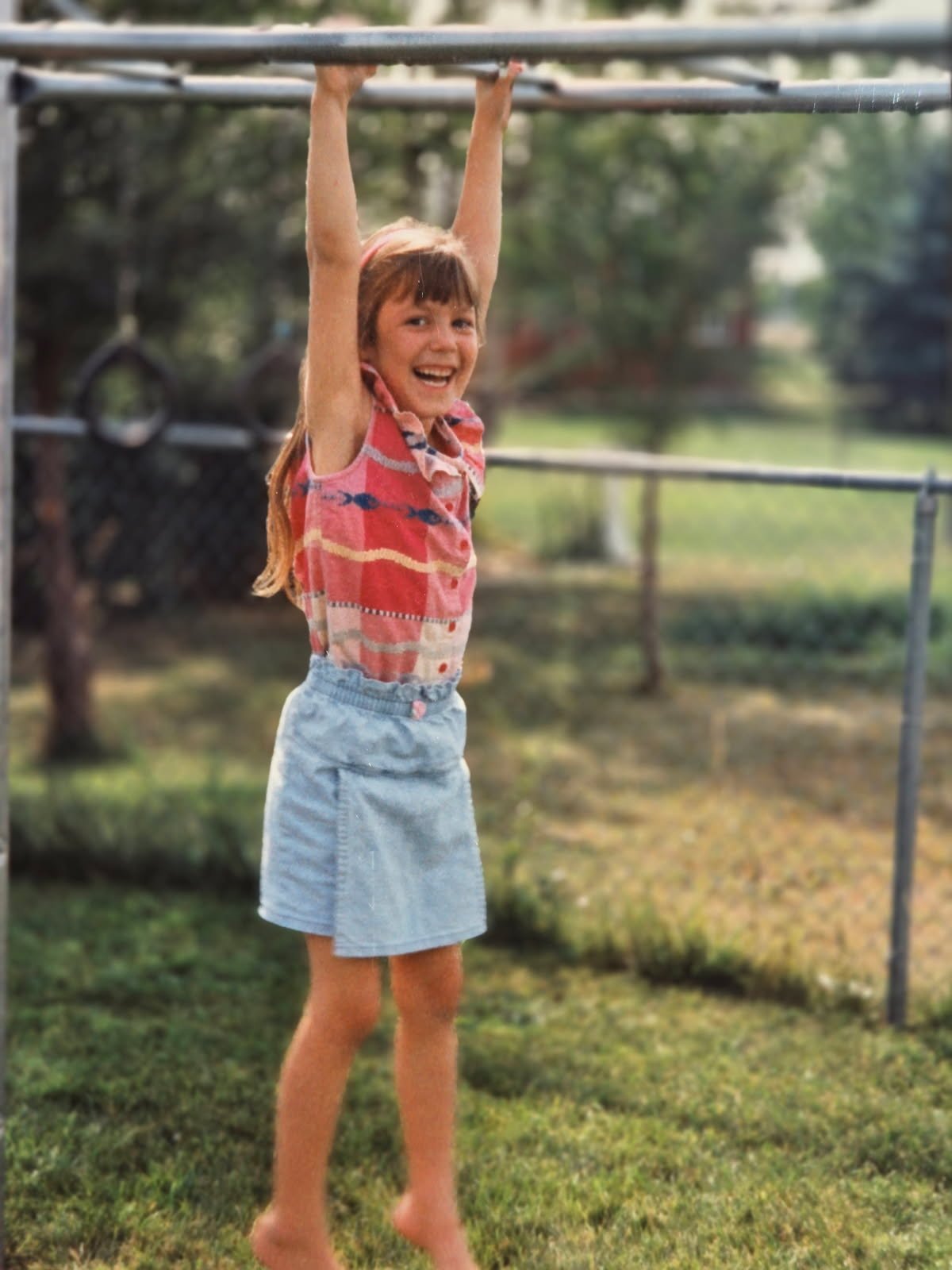
Brittney Uecker is a writer, mother, and school librarian living in central Montana. Her work has been published by Pithead Chapel, Short Story, Long, Taco Bell Quarterly, and others and is a Best of the Net nominee. She is a Scorpio sun, Cancer moon, and her favorite Dewey Decimal number is 597.96 (snakes).