
first round game
(2) Bonnie Raitt, “I Can’t Make You Love Me”
ENDED
(15) Portishead, “Roads”
99-64
AND WILL PLAY ON IN THE 2ND ROUND
Read the essays, listen to the songs, and vote. Winner is the song/essay with the most votes at the end of the game. If there is a tie, we will play a one-hour overtime (and repeat until we have a winner). Polls close @ 9am Arizona time on 3/3/26.
casey powaga on bonnie raitt’s “i can’t make you love me”
Anyone who sings a lot of karaoke like I do has their list of go-tos. I tend towards 1980s male vocals, singers like Tom Petty, David Byrne, and Peter Gabriel. Avid karaoke singers also keep a secret list of their all-time bombs, performances that were so poor the singer shrinks at the memory of them. Even years later, these performances inspire cringes in the shower or behind the wheel or wherever else past embarrassments seem to creep up.
Sometimes, it’s the singer that’s the issue. They’re too drunk or they don’t actually know the words to the song or otherwise can’t keep up with its tempo. Some songs, however, have no business being sung at karaoke by novice singers. For songs like these, you almost can’t blame the singer for their hubris in thinking that they have the pipes to bolt out a given hit, a song so powerful in its presence and resonance that of course someone would want to belt it at the top of their ill-prepared lungs to a room of strangers.
I have a handful of karaoke bombs in my quiver. The most awful bomb must be “I Can’t Make You Love Me” by Bonnie Raitt, sung in the early evening to a near empty Tucson gay bar called, “It’s About Time” or IBT’s for short. This was in late-summer of 2010 and I was at IBT’s with my then-girlfriend Sara who had helped me move from Portland to Tucson for grad school. I sat at the bar while I sang, a small consolation to my embarrassment, a way to hide my shame and I struggled through the song. My voice shook as I strained to hit any of the notes. The slow melody seemed to drag out longer than the song’s 5:33, which is already too long for a karaoke tune.
The song had snaked me, jumped up from the grass and bit me on the calf. I’d heard it a million times before and had thought that surely, the slow and steady tune with the plaintive lyrics would be in my wheelhouse. It would be doable. The song’s seeming simplicity had tricked me. The chorus is so direct and human, so relatable: “I can’t make you love me if you don’t.”. Who among us hasn’t felt that degree of unrequited love? It’s more than that though. Somewhere in the song’s deeply simple lyrics and melody lies the plainness of love, its binary nature. You either love someone or you don’t. Someone either loves you or they don’t.
The instrumentals and tone of the song are as stark as its message. Mike Reid and Allen Shamblin, the writers of the song, reflect in an interview about these instrumentals. Bruce Hornsby plays piano on the recording. “Bruce really took the intro and he articulated what I wrote,” Reid said. “He did it through the Hornsby filter, which really kicked it up to another level.” Shamblin added, “I thought [Bruce’s part] was transcendent. It was spiritual.”
After the song’s initial recording, co-producer Don Was set to adding overdubs and embellishments. The producers soon realized that they needed to strip away everything that they added. “It took me a minute to figure out to get rid of all that stuff,” said Ed Cherney, the song’s engineer. “It didn’t have that emotion anymore. I started hearing the work we were doing instead of the moment of somebody bearing that soul. All that other extemporaneous stuff got in the way of it. I was trying to get back to that feeling, that total feeling of empathy for her and that deep sadness, that deep feeling of that loss.” The track’s spare nature is a part of its appeal. Less is more.
While I struggled through my karaoke rendition of “I Can’t Make You Love Me,” unrequited love was the furthest thing from my mind. I was deeply in love with Sara. And she was deeply in love with me. We were enamored with one another. Our happiness betrayed the mess of the start of our relationship. Our romance had started in scandal up in Portland. Sara and I had known each other for years before we started dating. She’d been the on-again-off-again partner of my best friend, Alex. A few weeks after Alex and Sara broke up for what would the last time, Sara and I met for drinks. The rendezvous was at first completely innocent. We wanted to remain friends after the breakup. We wanted to catch up. What happened instead was we fell madly in love, first that night over drinks when we admitted to one another creeping mutual crushes.
Alex and I had been friends since high school back in Minnesota. She had transferred to my big, public suburban high school at the start of Sophomore year after getting kicked out of her Christian high school for giving flowers to another girl. We met for the first time in Frau Ortenzio’s German class, where we stumbled over the language’s inscrutable grammar but mostly just goofed around in the back of the room. Alex and I shared a sense of humor at the absurdity of high school, our teachers, and the overall mores with which we were both raised, Alex, evangelical Christian, and me, Catholic.
We also shared the trappings of turn-of-the-millennium teenage queerness: interest in women singer songwriters, crushes on female teachers, and an abiding interest in the show Xena: Warrior Princess. Despite all the evidence of our gayness, we were both still closeted to ourselves and others and wouldn’t come out to one another until college when we had both finally got away from our homes and explored life and romance out on our own. After college, I would visit Alex in Minneapolis and we’d go out to gay bars and tear shit up. A few years later, Alex moved to Portland, Oregon, where I’d eventually follow her from the East Coast after a bad breakup with my first girlfriend.
In Portland, Alex and I became young adult friends, meaning we’d meet each other after work for happy hours and complained about our jobs and our love lives. We took to calling the “happy hours” simply “hours” because each of us were deeply unhappy with our entry level jobs, our farcical romances, and strained relationships with our Christian parents. Alex and I were devoted to one another. We spent weekends together hiking and exploring Oregon. We engaged deeply in the process of growing up, together.
The fact that Alex was the Great Platonic Love of my twenties made my revelation to her that I was in love with her recent ex excruciating. Alex and I had plans on a Tuesday to go to a concert at the Doug Fir in southeast Portland. The concert had fallen less than a week after my happy hour with Sara that had evolved into confessions and the weekend that had devolved into lots of sex. The night of the concert, Alex pulled the car up to my home and before getting out, I told her that I wanted to date her ex, Sara. Alex was shocked. She angered, told me to get out of her car. We wouldn’t speak again for years.
“I Can’t Make You Love Me” is a devastating song, slow and mornful, not typical top forty fodder. From the get, you hear the singer’s abject longing, her swallowed pride at the confession that yes, she’s in love with the you of the song even though there’s no chance that they’ll be together after this final night. It’s the last straw for the singer, one last attempt to hold and touch and look at the beloved with the hope that they’ll love her back. They do not love her back. They never will. The singer knows this, despite herself.
Somehow, Bonnie Raitt recorded this perfect song in one take. According to Raitt, the song was so sad she couldn’t recapture the emotion of the tune in additional recordings. Artists know: When you have it, you have it. “I Can’t Make You Love Me” became one of Raitt’s biggest hits.
Towards the middle of the song, Raitt falls into a painful double negative. She sings: “I close my eyes, then I won’t see the love you don’t feel when you’re holding me.”
A lot is made of the blindness of love, how one doesn’t see the flaws in a romantic partner or other possible constraints to the partnership. But there’s also a looking away required of people in unrequited love, a willful ignorance around the affections of another person. Bonnie Raitt captures this sad knowledge, the recognition that what’s felt in one’s mind and body doesn’t necessary match real world circumstances.
The inspiration for the song had come to Reid and Shamblin from an anecdote in The Tennessean about a man who, having succumbed to alcoholism, lived under a bridge in Nashville. One day, the man’s wife came to pick him up to bring him to the courthouse to get a divorce. “We hugged, and we cried, and then we went through with the divorce,” the man said. “You know, you just can’t make a woman love you.”
It's telling that the man did not blame himself or his alcoholism for the divorce but rather the absence of love. His fortunes had been decided by a woman’s whims rather than his own problems. Instead, his divorce was on account of a lack of love, a coinflip of the heart which landed on “loves me not”. Most situations are tinged by the subjectiveness of those involved. A drunk always holds an unreliable point of view.
Now, with the clarity of half a decade of sobriety, I reflect on my drinking days with Alex as a sort of cudgel against the loneliness of one’s twenties. Back in the day, Alex and I would throw back the drinks at our “hours”. Beer after beer. Gin after gin. If it was the weekend, we were drunk. Our jobs and love lives were difficult, so we drowned our sorrows. For a time, Alex had Sara, though, despite the ups and downs of their relationship. My love life was especially desolate. Upon moving to Portland, I’d thought that I’d have dates lined up out the door. The city was a queer utopia, I’d imagined, a place of endless romantic opportunity. Instead, and over the course of two years, I’d had several one-night stands and women who, despite my pursuit, weren’t really interested in me.
My many failures made my eventual revelations towards Sara even more irresistible. Me and Sara were in love with each other. We were over the moon. I was accustomed to rejection at this point, so the mutual love felt special. Our love was requited. It was good.
Sara and I dated throughout the spring. I lost my best friend, but also a few others in our friend group who sided with Alex in the conflict. Of course, you don’t date your best friend’s ex. Even in queer circles, where the dating pool is considerably shrunken from that of the straight world, this behavior is taboo. I’d spent hours and hours with Alex drinking and imagining my life improved by the presence of a girlfriend. And then, when I finally got a girlfriend, I became a pariah to my friends. Portland was cursed, it seemed. I was either single with friends all around or partnered with no friends, loneliness served two ways.
When I was accepted to the MFA program at the University of Arizona in Tucson, hundreds of miles from Portland, my future with Sara came into question. She’d just received a promotion from work and didn’t want to leave. I was going to Tucson, no matter what. We decided that we’d make long distance work.
In the song, Raitt asks for nothing other than the truth:
Lay down with me, tell me no lies
Just hold me close, don't patronize
Don't patronize me.
This plea acknowledges something exceedingly painful about unrequited love, the propensity of people to try and let others down easy when really, the truth sets a person free. The only thing worse than someone not loving you back is that same person putting on false kindness with a tinge of superiority. The object of affection is, after all, in the position of absolute power. They have nothing to lose except for an admirer and most times, no admirer at all is better than one on such an uneven playing field.
My relationship with Sara only lasted until Thanksgiving. I visited her in Portland for the holiday and knew immediately that something was off. There was no longer a sweetness between us, no longer the urge to incessantly touch and be touched. We were done, as simple as that. Now fifteen years later, I still think of Sara as one of the great loves of my life. I also think about Alex as one of the great losses of my life.
I saw Alex two years after Sara and I broke up at the wedding of “The Moms”, my former roommates from Portland, a lesbian couple who were in their thirties and thus advanced in age compared to us twenty-somethings. Alex ignored me in the buffet line, her new girlfriend giving me the stink eye the entire event. I, too, was there with my new girlfriend, Sarah. It was all very dramatic and very lesbian. It was also not lost on my that my new girlfriend had the same name as my prior one, but what can I say? A lot of dykes born in the eighties are named Sara/h.
Alex’s snubbing of me at the wedding hurt me a lot. We’d grown up together, yet she couldn’t set aside my transgression. At the time, I didn’t think that I needed to be forgiven. I had operated out of love, selfish love but love, nonetheless.
Now in retrospect, I regret betraying my friend. I had put romantic love over platonic love and in doing so, had ruined a decade-long friendship for what ended up being an eight-month relationship. Alex could have been more understanding. Sara and I were in love. Love! It’s the greatest thing around and we should move mountains to feel it. I could have been more understanding. Of course, Alex would feel a way about me dating Sara. They’d been in love for two years, even if their relationship had not proven durable.
In the world of “I Can’t Make You Love Me”, you love someone or you don’t, love is a zero-sum game. In the Sara-Alex-me love triangle, the three of us loved each other and hated one another all at once, in a thick cloud of emotion. Sometimes, love is nebulous, there but not, elusive. And just because a relationship ends, doesn’t mean that the love between to the two people is gone.
“I Can’t Make You Love Me” is now a standard and has been covered by countless artists, including Prince and Bon Iver. Carrie Underwood sang the song on American Idol. Prince’s version is weirdly horny, while Bon Iver is characteristically spooky and soulful. The song’s beauty proceeds it so that whoever sings it, they tend to nail the emotional complexity (save for me at karaoke, of course).
In the Stereogum interview, Rait mentions, “The number of people that have written me letters saying that they’ve never seen their husband in tears until they watch him watch me sing that song in concert … it just makes me feel very, very proud and very grateful.” The tune makes grown men cry, an achievement for any mainstream pop song.
Perhaps the most relatable moment comes at the song’s crescendo where Raitt vows:
Mornin' will come, and I'll do what's right
Just give me till then to give up this fight
And I will give up this fight
There’s a time that comes for everyone to simply stop fighting. I eventually apologized to Alex for everything. Years later, we’d make up and be in each other’s lives again in a limited fashion. Today, we’re nowhere near as close as we were in our twenties. A person can get over something without truly rectifying it, it turns out.
I still think about Sara and Alex every time I hear “I Can’t Make You Love Me”. First, I think of bombing at karaoke, Sara at my side in the Tucson gay bar. Next, I remember Alex and the devastation of losing a best friend to love. I think about how you can’t make a person feel one way or another. I think about loss and how everyone knows it. I think about what it means to act for love and how destructive that can be. I think about the totality of love, how it means everything to everyone.

Casey Powaga is a trans non-binary writer whose work has been previously published in Roxane Gay’s The Audacity Emerging Writers Series and Notre Dame Magazine. They have an MFA in Creative Writing in Fiction from the University of Arizona and are working on a novel about brain trauma, alcoholism, and queer spirituality.
danielle geller on portishead’s “roads”
When Portishead’s Dummy was released in 1994, I was just eight, and I lived with my grandmother, who only played the oldies station as we drove around town. I’m not sure what long-lasting impact this had on my musical tastes, but I was out of tune with most kids my age. My favorite album was the 1978 soundtrack for National Lampoon’s Animal House, a boot-legged cassette tape I found in the trash. (My dad was a professional junkman who made his living selling salvaged goods at the flea market, and I was his frequent co-pilot.) My favorite track was “The Riddle Song,” an old folk song made new. I appreciated its absurdity, but I also enjoyed climbing to the top of our favorite climbing tree and belting it at the top of my lungs because it spooked the neighborhood boys, who recoiled from any mention of love, even in the context of chickens without bones.
I didn’t find Dummy until about a decade later. I’d landed a job at a piercing studio/vintage clothing store called Checkered Past. My Hot Topic aesthetic didn’t match the vibe, but one of my cousins knew the owners, and the hiring manager had fond memories of the English teacher who wrote my recommendation letter.
I worked at the store’s newly opened location in the next-town-over. The owners bought a massive 1920’s bank, painted the walls red, and rolled out a leopard-print carpet for customers who would never arrive. The store’s playlist was curated by its employees, a bunch of punks and rockabillies, and this was where I first heard “Roads,” resounding, holy, from the vaulted ceilings above. But it wasn’t then the saddest song.
If I were to argue that Portishead’s “Roads” is the saddest of all sad songs of the nineties, the end, that statement would be false. The veracity of any such declaration depends on the complex interplay of factors including, but not limited to, the song, listener, and medium of sound.
For the statement to be true, I hypothesize that the following conditions must be met:
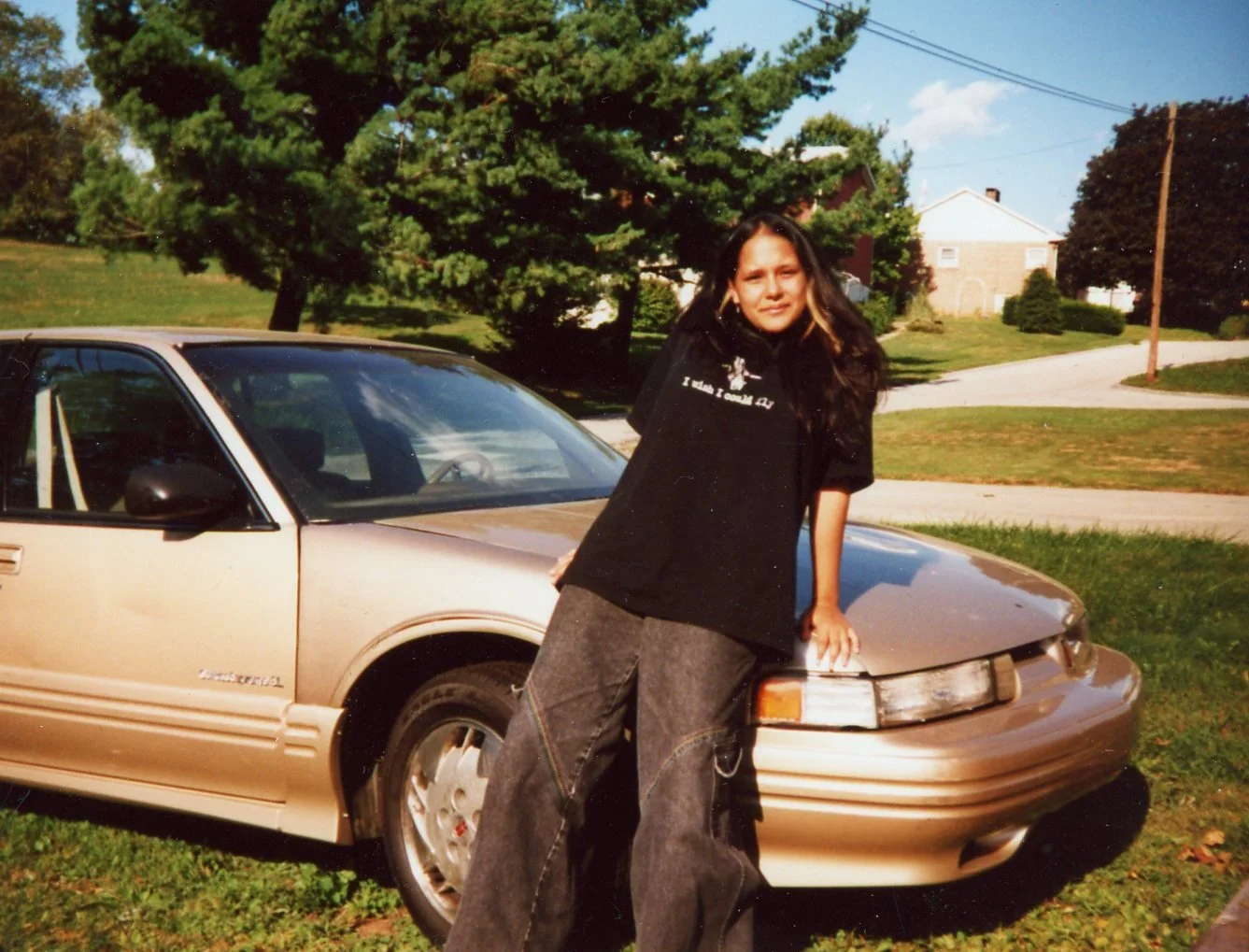
⏯ the song must be played on a charcoal gray Sony Walkman rigged into the sound system of a 1997 Oldsmobile Cutlass Supreme;
⏯ the song must be played when the vehicle is traveling above sixty-miles-per-hour on a twisty-turny back road in central Pennsylvania;
⏯ the song must be played between the hours of 2 and 6 AM;
⏯ the song must be played between 80 and 110 decibels; and
⏯ the song must be precipitated by a distressing event that recurs with discomforting frequency.
Once these conditions are met, the listener will experience a depth of feeling at an order of magnitude verging on despair.
Like many of my fellow millennials, I pirated most of the music I owned, but I ran out and purchased a copy of Dummy first thing. The CD became my Sony Walkman’s permanent resident, and I alternated between two songs on repeat: “Roads” and “Wandering Star.”
If you’re the kind of person who privileges song lyrics, one could reasonably argue that “Wandering Star” is the sadder song, all grief and suffering and infinite darkness. The title alludes to a passage from the Epistle of Jude, the patron saint of lost causes, who warns of those who twist the grace of God:
12 These are spots in your feasts of charity, when they feast with you, feeding themselves without fear: clouds they are without water, carried about of winds; trees whose fruit withereth, without fruit, twice dead, plucked up by the roots;
13 Raging waves of the sea, foaming out their own shame; wandering stars, to whom is reserved the blackness of darkness forever.
In “Roads” there’s a vague reference to a war we should be fighting and a feeling that something is wrong, but it’s harder to say what it’s about.
Most artists are quiet about the meaning of their work, but I went looking just-in-case, and I was surprised to find an interview with Geoff Barrow and Adrian Utley in which they broke down every song on the album. Both seemed hesitant to speak for Beth, who they described as coming from a ‘different place,’ by which they meant a different frame of mind. Utley said he often left their conversations with a giant cartoon question mark over his head, and one of those question marks was her obsession with Braveheart. “I’m not gonna say that’s what it was,” he clarified, “but sometimes it could be quite surprising that she’s massively moved by something.”
I had never seen Braveheart, but I figured I should watch it, just to see if I could glimpse what Beth had seen. But, like Utley, I found the movie painfully cheesy, and I struggled to sit through the full three hours. Every time the camera focused on Mel Gibson’s blue eyes, striking but empty of feeling or depth, I had to pause the movie and walk away.
Nevertheless, I maintain that “Roads” is the sadder song, and I believe my argument is strengthened by the inclusion of this contradictory evidence.
A 1997 Oldsmobile Cutlass Supreme was a strange choice for my first car—I couldn’t reach the pedals without sitting on a folded pillow, tucked behind my back—but I bought it secondhand from my Uncle Marty, who also taught me how to drive. (My dad’s license had been revoked, and my grandmother was a nervous passenger who shrieked and clutched the armrest if I braked ‘too late’ at a stoplight.)
After I qualified for my learner’s permit, Uncle Marty and I spent quality weekends driving around Pennsylvania’s back roads. He’d pop a beer into a worn blue koozie, tuck a couple extras under the seat, and tease me for driving like my grandmother: too cautious, too slow. My first time on the highway, he told me to floor it, and when I hesitated, he swung his leg over the center console to drop the full weight of his foot on mine. I needed to get it out of my system, he insisted, giddy and a little bit drunk. I might have been scared with anyone else, but I always felt safe with my Uncle Marty, and that could be one reason I never got it out of my system, whatever it was meant to be.
My favorite part about working at Checkered Past was the solitude. It was a strange store for a small town in central Pennsylvania, and business was slow. The store was losing money, and we were asked to keep daily tallies of incoming customers; most days there were fewer than twenty people who walked through the door.
Work became a respite from the chaos at home, and to stretch the peace longer, I’d cruise around in my boat of a car, following the back roads to a dark stretch of highway where I pushed the Olds over a hundred, then a hundred-and-ten, near a hundred-and-twenty, just daring a deer to hop in front of my car.
I was dumb and I was lucky and the only ticket I got was for driving seventy-five in a fifty-five zone. (It was a speed trap; the cop, parked under an overpass just past the point at which the speed limit dropped.) My Uncle Kris was visiting from out of town, and when I pulled up to the party at Uncle Marty’s, my grandmother tried to solicit their support in condemning my recklessness. But Uncle Kris was as bad as the rest of us. He was a motorcycle guy, and he was always zipping around the high mountain roads of Colorado, where he suffered more than one painful tumble across the asphalt.
The untreated mental illness and substance abuse in my immediate family shaped the general tenor of our lives. I would be diagnosed with bipolar disorder in my twenties, but some of the signs were there long before: the sleeplessness, the recklessness, the volatility.
For the most part, no one cared that I was crazy as long as I showed up for school and for work and paid my bills on time, and I didn’t start treating my disorder seriously until I got a fancy job in Canada with comprehensive health care. Still it took my dad’s death to push me through the doors of an emergency psychiatric unit, where my compulsive behaviors feel less disruptive, less upsetting to the people around me. The woman on the medical helpline told me to show up as the nurses changed shifts, so I arrived at the hospital in the dark before morning. Then I just had to wait; I just had to wait; I just had to wait until someone could help.
On the wall of the room near the nurses’ station, someone had painted silhouettes of trees in different shades of blue.
When the sun arrived, I was invited into what felt like a conference room and asked to describe how I felt. I began to explain that I was manic, but the nurse stopped me to clarify the answer they were looking for: not manic, not hypomanic, but how I felt. I looked to the thin thread of sky barely visible beneath heavy gray clouds and explained that I was afraid I was crazy, afraid I was losing control, the thin veneer I’d tried so hard to protect.
The circumstances surrounding my dad’s death is a black box I try not to open, but I did go to see him. I gave myself three days, which meant I had to fly. As much as I love driving, I hate flying; I don’t trust planes not to fall from the sky. To distract myself, I study the topography of cities and commit designs to memory: the highways that curve like gray rivers into the sea; the over-and-under-passes that twist like pretzels where highways meet.
There is something about flying, the vantage, that makes me feel as if I finally understand the purpose of a road, but to understand its function, one needs to unravel the motivation underlying the desire to travel from the point of departure to the point of arrival.
The Olds was fueled by insanity, my own and my father’s, which makes me worry I have disproved my own hypothesis. The conditions therein created an emotional resonance, a sense of harmony and coherence that countered sadness, the emotional response to experiences like pain, isolation, and grief.
After I chose to write about “Roads,” I asked one of my colleagues, a sound engineer, what to call its unnerving, wavering sound. He named it tremolo, created by a modulation in amplitude, the distance between the highest crest and lowest trough of a wave. (When I try to replicate the sound with my own voice, my throat pulses in a way that reminds me of trying to choke back tears.) He mentioned I could mess around with the department’s Wurlitzer, an electronic piano with a tremolo feature, but “Roads” was played on a Fender Rhodes, and I’m a stickler for minding the limits of my experiments; a substitution wouldn’t do. (The Rhodes lent the song its name, but the wordplay is contextually jarring, breaking my immersion.)
The audio effect sounds different if you are listening to “Roads” in a car in motion, but I don’t know enough about music to explain why, so I ran to Reddit, as one does, and found a thread in which the thread’s author, u/wilkc, speculated the noise of their tires gated the song into triplets.
u/Fantadrom suggested the effect could be caused by phase cancellation caused by ambient driving noises: two waves crashing, neither arriving at their destination.
Working my way through the comments feels like revisiting a lesson I learned a long time ago and forgot because I didn’t understand it the first time around: sound travels as pressure waves vibrating through an elastic medium, but the medium in question encompasses more than just air. The Olds was the conduit through which asphalt and rubber and metal and heart collided.
u/farvana disagreed with u/Fantadrom’s suggestion. “My understanding of phase cancellation is that it requires a near perfect inverse of the original wave,” u/farvana explained, “which is not possible with all the randomness of a tire striking a road surface.”
The counterargument makes sense in theory; on the other hand, driving down a Pennsylvanian road in the middle of the night is the near-perfect inverse of pretty much everything else.
The winter of my convalescence, I sat on a rainy cliff and watched a starving gray whale surface at fifteen-minute intervals. (A gray whale’s misty exhale is shaped like a heart.) It should have been enjoying the warm waters off the coast of California, but instead it was desperately to fill its belly on shrimp. Melting sea ice has caused their primary source of food to collapse, and fewer gray whales are able to survive the long hron-rād.
The winter of my convalescence, I stalked the gray whale along the coast and tried to make sense of the world that caused it to starve. This is just one road to insanity. There is no escaping this world, of which we all are a part; there is no sure path to the stars.
As the winter transitioned to spring, the gray whale left our coast and traveled out of sight, and I returned home, where I looked for a state of mind that could hold all that grief. The results are promising, but further research is required.
Danielle Geller is a personal essayist who lacks conviction in her own beliefs.