
first round game
(8) Nirvana, “Sappy”
vs
(9) Sinead O’Connor, “The Last Day of Our Acquaintance”
Read the essays, listen to the songs, and vote. Winner is the song/essay with the most votes at the end of the game. If there is a tie, we will play a one-hour overtime (and repeat until we have a winner). Polls close @ 9am Arizona time on 3/10/26.
jennifer gravley: Liner Notes (“Sappy” by nirvana)
If you kill yourself
The voice of your generation died in the cruelest month, your best example of how to save yourself. You assumed you would, one day.
If you fool yourself
You live in the honors dorm, an ivory cinderblock room with a roommate who doesn’t like you. Not one person likes you, including you. The voice of your generation has died inside a jar without breathing holes. Did he ever once think he was happy?
There is a difference between thinking you’re happy and being happy and thinking you’re happy.
You are decades away from a diagnosis in your ivory room in Marks Hall where the heat is an oppressive roommate. You set the fan to going.
If you kill yourself
The voice of your generation reflects back your deepest values—self-loathing, ennui, deep despair. It is for the voice of our generation to tell us what to rail against. It is ourself.
If you fool yourself
The spring of 1994 should’ve been the spring you discovered how beautiful and bright and green spring could be in a land of perpetually watered blooms and good weather, the light a quality artists talk about, but you were in too deep a hole.
If you cut yourself
Your jar is a hole you fall into. You cover yourself with grass.
Your floormate is raped in the night, stereo shattered. No one heard anything. You didn’t hear anything. You, like your floormates, like all good misogynists, question her poor decision making.
So many things shattered—your will, your potential, your floormate’s stereo—and already the earthquake that tilted bookshelves off desks, that shattered Eagles CD cases, that woke you in your extra-long twin.
If you fuck yourself
The voice of your generation says wallow in the shit.
If you fool yourself
In your ivory room, you blast cassettes from your alarm clock, louder than you should, louder than your floormates appreciate. You curl in bed and cry. There is nothing interesting about a person curled in their bed, weeping.
If you fuck yourself
When his death is announced, you are jealous.
If you fool yourself
But the 90s were a different time. You could talk out loud about your desire to die.
Just like the voice of your generation, you’d said out loud to your friends that you wanted to die. You wrote it down, this desire, this murky dream you didn’t know how to make true. You never made plans but thought it would happen. That you wouldn’t live, wouldn’t make it.
You probably felt some kind of happy, sappy, sometimes, but depression messes not only with your ability to feel but also with your memories. You probably laughed sometimes but don’t think of yourself that way, can’t recall a single time.
If you cut yourself
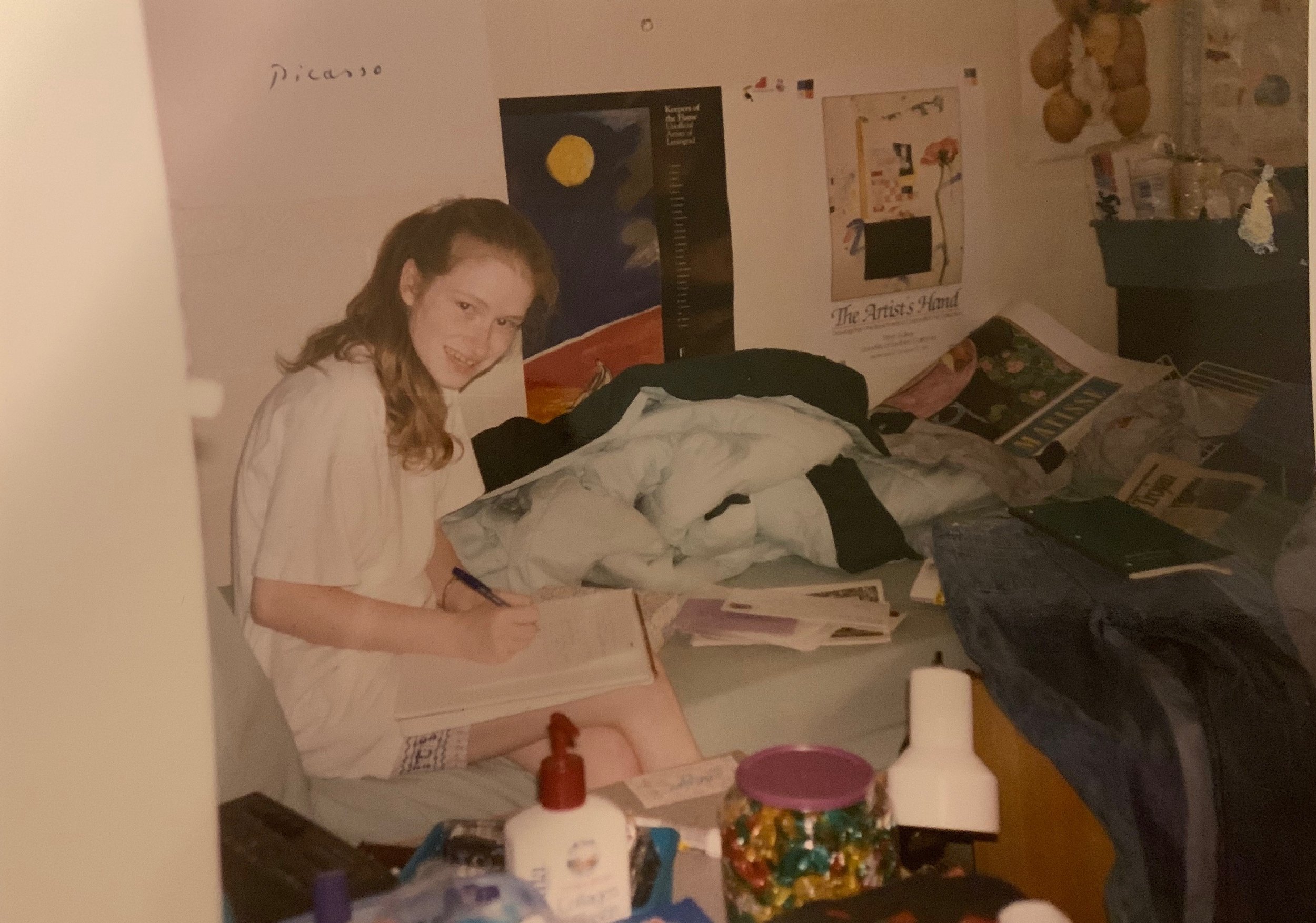
And yet—there is a photo, taken by a floormate and given to you, of you on your extra-long twin, shorts and an extra-large t-shirt, so any time of year, really, writing something (a letter, a bad poem, homework) and smiling in surprise if nothing else.
If you kill yourself
How many variants of “Sappy”? How many models, how many archetypes, of the voice of your generation, of you? How do you separate the voice of your generation from the voice of your mental illness? Is each alternative track equally valid? Does each fill some essential need of some particular audience? Is “Sappy” simply an amalgamation? Are you? Can you substitute, change, the lines to make yourself happy? Does what you repeat, replay, make you who you are?
If you heal yourself
All your memories are suspect. Did your sister teach you to pull the legs off daddy longlegs? Were you repulsed but tried anyway? Did you pull the abdomens off lightning bugs? The 80s were a different time. Did you ever put them in a jar? The summer night air smelled always of grass cuttings, your father home after dark, the rolled-up legs of his overalls shedding clippings.
There was no dividing line like a divorce. There was simply a slide or maybe a sudden onset, but memory blurs. There is a before time, so little you barely remember, memories that burst with the brightness of a camera flash. The fair outside Head Start, the summer sun burning. The polaroid of your blonde bowl cut in kindergarten. There’s a sense of being happy, of before. But even then there’s the Saturdays you wouldn’t get out of bed to watch cartoons. There’s you, eight, staying up and watching sitcoms about alcoholics in the quiet still dark of the living room without anyone else in it.
If you kill yourself
What does it mean to be the voice of your generation? How much did it weigh? What must it be like to never get old, to never have to see the teenagers who raged with you turn puffy and saggy and sick at heart to have done nothing?
If you save yourself
In the end, the choice to live wasn’t a choice at all. You just kept waking up.
If you cut yourself
For years and years and decades, you wanted to die when your life sucked, and you wanted to die when your life was undeniably beautiful. You felt the same at heart, sick without a fever, just a way of existing.
If you fuck yourself
A week of celebrity suicides—a handbag designer, a chef—begins you being more honest with your therapist. You were afraid of being hospitalized, but you also badly wanted it. The rest, the break. You imagined nothing being expected of you. You had a fantasy it’d be you in bed all the time. You had no idea how these things worked. You didn’t want to get better. You just wanted to be able to sink into your depression further without having to worry about the people around you, work, bills, any commitment to the world or the people in it. You wanted to wallow until you died, which you felt you would.
If you fuck yourself
You never took yourself as seriously as when your therapist said if you didn’t do something, you were going to kill yourself. Somehow it was different being told as a premonition, as a promise, than it did when you thought of dying and it filled you with relief.
If you cut yourself
Every battle, you’re only fighting yourself. You’re fighting only yourself. Order and precision matter—all you have are words, the same source material as your thoughts.
If you save yourself
Press fast-forward and years later, the correct, the magic, pills stop your bad thoughts like a light switch flipped. It turns out that everything you thought was you was just a disorder. In the space where you hated yourself, there is only space. The pills inflate your body, wreck your blood sugar, hijack your heart rate, but you don’t care. You’ll take the space over the hole, the jar. It’s white space in your head, that time between chorus and chorus where the guitar plays. You don’t know what to do with yourself.
If you fuck yourself
Sometimes you think what gives you the right to write when so many people dream of hurting themselves, when so many people do. You’re just another dreamer pumped with good drugs.
If you kill yourself
You, (like) the voice of your generation, never thought you’d be happy.
It is for the voice of our generation to tell us now to live, what to hope for and rail against.
It is himself.
If you save yourself
Build a memorial to the voice of your generation through your midlife, medicated and screeching. Line the ground, the glass bottom, with grass from an untended graveyard which struggles.
If you heal yourself
And once you get well, you have to go on living by living for the first time. You have to go on living without many people, rock stars and friends and childhood bullies and your mother and your father.
There is only so much you can retrieve from the past. Less than there is nostalgia for. You are nostalgic for the girl who was depressed and anxious and washing her hands too much, the girl who sat on the floor of the laundry room. You didn’t know your brain was wired wrong—differently—you didn’t know that anyone or anything could help you.
You didn’t think you could be happy.
If you save yourself
The work of midlife is to redefine saving yourself, since you lived. You take your replacement hormones and go to therapy on your work computer. You say things like we’ll get through this and all we can do is our best, even though you have never thought you’d get through anything or that your best was good enough for anyone, including you.
Somehow, you’re fifty. You’ve saved yourself for decades, even when you didn’t mean to. So many things in life aren’t on purpose. So much craft is instinctual, is punishing, is pushing its way through you. You are perpetually surprised by how old you’ve become. You never thought you’d.
If you fuck yourself
The voice of your generation has been dead since adolescence. Since the ivory room of Marks Hall, the basement laundry room. Did his death mean the end of childhood? You couldn’t know this death meant death would keep coming for you, person after person after person, while you kept living.
If you kill yourself
The voice of your generation speaks from scattered ashes, from scratched technology, from the past. The voice of your generation still speaks to you from scattered ashes. The past is a skein overlaying every moment you move through.
It would be a mistake to say
Conclusion came to you
Jennifer Gravley is an assistant director at an academic library during the day (and occasional evenings and weekends). At night, she reads and writes and eats snacks and sleeps, the usual stuff. She has recently acquired a "Maman" pin and hopes to scare people with it.
andrew arthur on Sinead O'Connor’s “The Last Day of Our Acquaintance”
With the transcendent vulnerability of the “Nothing Compares 2 U” cover and the resigned political sorrow of “Black Boys on Mopeds,” Sinéad O’Connor’s I Do Not Want What I Haven’t Got is an album full of feeling—so “The Last Day of Our Acquaintance” stands out for being almost emptied of it. Where the other songs overflow, this one sounds like what’s left after the tears have dried. Its sadness runs quieter, more inward. Here we find O’Connor (for the sake of simplicity, I’ll be assuming autobiography here) examining a different emotional entry: a relationship post-mortem in progress.
From the first lines, it feels like a business meeting: “This is the last day of our acquaintance / I will meet you later in somebody’s office.” There’s no begging, no broken voice, just the cool language of matter‑of‑fact scheduling. The heartbreak may be ongoing, save for this last formality. If there’s any residual suffering to be done, it’ll be done separately. On the surface, it’s calm, procedural—but beneath that civility is the deeper loss, the creeping recognition that she’s possibly been the only one still mourning a relationship gone cold.
Still, beneath the restraint, emotion builds—not through the melody, but through the conjunctions that structure the lyric. “I’ll talk but you won’t listen to me / I know what your answer will be.” That but cuts the line in two. It’s the sound of connection giving way to distance, hope thinning into certainty. The next line, “I know what your answer will be,” still carries an ache of anticipation: she knows, but she’s not ready to accept it. It’s prediction, maybe, or a door she’s left open a crack.
Later, though, something shifts.
After a drum intro that rivals, for emphatic switch, the Phil Collins acoustic punctuation from “In the Air Tonight,” the lyric repeats, almost unchanged, except now she sings, “I’ll talk but you won’t listen to me / And I know your answer already.” That one change—from what the answer will be to knowing the answer already—transforms the whole scene. The will be belonged to the future, to waiting. Already lives in the present. She’s stopped projecting. She knows. The conversation is still happening, but it’s already over. And deeper still, she’s realizing it’s been over—that the love she thought she was still in, and maybe is, isn’t reciprocated.
That’s the knife twist of the song. The repetition doesn’t soften the moment; it hardens it. What began as plaintive becomes firm, even defiant. Early on, she’s trying to understand what went wrong. By the end, she’s simply stating what is—a truth she didn’t ask for but now owns. The emotional movement from will be to already marks the shift from resignation to awareness, from waiting to finality.
The repetition carries her through something like the stages of grief, though non-linearly, as is often the case: bargaining first (“Two years ago there just seemed so much more”), then something close to acceptance (“Our friendship has been stale”), then a whole lot of anger (“Oh, oh, oh”), then something approaching release by the time the second, amended verse cycle ends. Vocally, the cyclical structure—the office, the stale friendship, the once-full relationship—stays mostly intact, but the delivery evolves. It’s as if she’s forcing herself to repeat the words until they lose their sting, until she can say them without flinching. Until she can say them and mean them.
That’s what makes the song’s emptiness so striking. It’s the opposite of melodrama. It doesn’t sound like someone clinging to love; it sounds like someone learning how to say goodbye to a version of herself who still believed the love was mutual. The emotional arc runs from quiet to angry to almost celebratory—not because she’s happy it’s over, but because she’s relieved to have finally caught up to the truth.
Maybe it’s better to have loved and lost than never to have loved at all. But O’Connor’s delivery suggests another truth: that getting what you didn’t want can break the spell of self-delusion.
The door wasn’t cracked. It was closed.
It had been for two years.
Andrew Arthur is a writer and designer living in Tucson, Arizona.