
first round game
(6) Billie Myers, “Kiss the Rain”
outlasted
(11) Bob Dylan, “Tryin’ to Get to Heaven”
108-96
and will play on in the 2nd round
Read the essays, listen to the songs, and vote. Winner is the song/essay with the most votes at the end of the game. If there is a tie, we will play a one-hour overtime (and repeat until we have a winner). Polls close @ 9am Arizona time on 3/3/26.
“It Feels like You’re So Far”: Allison Renner on “Kiss the Rain”
Yearning carries a tinge of sadness, of desiring what you can’t have but wanting it anyway. I’ve always been obsessed with yearning to yearn, to experience the feeling, not necessarily to eventually be with someone. This is why my favorite yearnings stem from books, shows, and, of course, music.
Enter: “Kiss the Rain” by Billie Myers. This song EMBODIES yearning. The circularity of the echoey “Hello” sets the scene, making you feel how yearning begins with a sadness of something you want but don’t have and ends with a sadness of it not being what you imagined. Add in the guitar solo, the bridge, the power and emotion in her voice as she pleads, “think of me, think of me, think of me, only me.” Or… if she’s the one pleading, is it a reverse yearning? Wanting to be yearned for?
Maybe. But for seventh-grade me, that didn’t matter. This song is a ball of emotion, and so was I.
I had a few crushes: the trumpet player in the row behind me, the percussionist my friend called “Encrated Crust Bust” after an unfortunate everlasting pimple… Oh, did I mention I was a Middle School Band Nerd (™)? Music was my thing, ever since my dad taught me to use his record player and I’d spin the Saturday Night Fever soundtrack on repeat when I was alone.
For me, music wasn’t something to share. It was mine. If I wasn’t alone in the house with free rein over the record player, I was in my room listening to the radio, pretending to oversleep so my mom wouldn’t make me go to church on Sundays, and I could listen to all of Casey Kasem’s American Top 40.
“Kiss The Rain” stayed on Billboard’s Top 100 for over six months—long enough to be the soundtrack of several yearnings. I loved trying to predict how it would rank on the charts based on how many times I’d heard it on the radio that week.
When I listen to “Kiss the Rain” now, I see myself in my closet, boom box cord stretched under the bifold door so I can listen in ultimate privacy, feeling the things the song stirs up without anyone witnessing the sadness of yearning. I can hear the opening notes, feel the buttons beneath my fingers as I press “record” and “play” at the exact same time to capture the song.
Because, despite being an antisocial band nerd, I had yearnings. Yearning for the future, when everything would certainly get better. Yearning for adulthood, when I’d finally know who I was meant to be. Yearning for someone who would yearn for me. That’s what relationships were to me: mutual yearning.
*
“Laughter on the Line”
My first real “relationship,” if you can call it that, happened the spring we got home internet, as “Kiss the Rain” climbed the charts.
I was a Saturday Night Live superfan during what was, in my opinion, the post-Sandler peak: Cheri Oteri, Molly Shannon, Ana Gasteyer, Chris Kattan. “Kiss the Rain” wasn’t the only thing I captured on cassette tape—I’d hold the recorder to the TV during some of my favorite sketches (Mango, Mary Katherine Gallagher, the Celine Dion Show) and memorize them Sunday. Then I’d reenact them for my friends when we waited for the first bell on Monday morning.
My yearning for the future included getting out of Tennessee and “making it” on Saturday Night Live, preferably at sixteen to make my life better that much sooner. So I spent my free time studying nbc.com/snl, the first web address I ever memorized.
At the time, the site was sparse, with short cast bios and the most basic message board imaginable. Username, password? Nope. Type a name and message, then post. And post I did, making friends with fellow comedy fans, including Josh. I think he was from Connecticut, but I can’t remember enough to attempt a light stalking. All that mattered was that he was closer to NYC than I was and loved SNL just as much as I did. That was all I needed for—you got it: yearning.
I didn’t have to yearn for long before Josh was mine, probably because we were the only twelve-year-olds posting on the message board. (Or, I realize as an adult, the only two people claiming to be twelve, but let’s not go there because the whole premise of this yearning is innocent and wholesome.)
I knew Josh and I would be together once I ran away and acted on SNL, but until then, even though we were “official,” the distance meant I yearned for him. When you’re in a long-distance relationship, remembering that you’re under the same sky, and “the night’s as empty for me as for you” is sometimes the strongest connection you have.
To me, “Kiss the Rain” is the sadness of yearning and hope of possibility in equal measure. But I wanted to know what others thought, so I asked ChatGPT… just kidding. This song existed before you could pull it up on YouTube or have Spotify create an obscure “Haunted Yearning” playlist for you.
This song existed when you had to catch it on the radio and press the record button in time, or save your allowance for the album. In that spirit, I wanted to keep my approach to research low-tech. Instead of ChatGPT, I decided to ask my friends: What does this song make you feel?
*
“We’re Under the Same Sky”
As Melissa Fite Johnson and I struck up a friendship over, of all things, Celine Dion sheet music, I knew I had to ask her about this song. It felt taboo to ask a fellow Sadness competitor for input, but her response gave me something to look into:
“At the risk of sounding like such a dork, Dawson’s Creek made that song absolutely iconic for me.”
—Melissa Fite Johnson
I was such a dork that I wasn’t even watching Dawson’s Creek when it aired because I knew I’d never be that type of teen: popular, social, in and out of relationships. Instead, I jumped ahead to adulthood and watched Friends, Mad About You, and NewsRadio, where lifestyles seemed more attainable since I’d have time to get it all together by then.
I decided to watch Dawson’s Creek in the name of research. I only made it nine episodes in; I think it’s one of those things like Catcher in the Rye where, if you don’t consume it at the ideal age, you miss your chance. I searched in vain for the “Kiss the Rain” scene before I discovered they changed some of the music for Netflix. I found a clip on YouTube, but the episode now features “If You Came Back” by Tommy Holmes, which is nowhere near as intense as Billie Myers’s yearning.
As I mentioned, I was watching Friends in middle school, so I associate “Kiss the Rain” with Ross and Rachel’s first kiss. (Early Ross and Rachel were the epitome of yearning to me.) They go together perfectly in my mind, but when I rewatched the episode for this essay, I discovered that it was actually just Ross and Rachel kissing while it rained. Oh well, the association was still strong enough to impact middle school me.
Not everyone I asked connected this song to a dramatic moment on TV. Suzanne remarked that the lyrics of “Kiss the Rain” make her think of “Somewhere Out There” from An American Tail. Her association made me think of Troy and Abed singing that duet in Community, which then spiraled to the Sophie B. Hawkins dance in a later season. I’d argue that “Damn I Wish I Was Your Lover” is another ‘90s haunted yearning song.
Reddit user waxmuseums made a similar connection: “I listened to this album [Billie Myers’s Growing, Pains] recently, it seemed like a cd Anne Heche would have owned. There’s something very Sophie B Hawkins about this song. I’d absolutely put it on a comp of songs with a one-sided telephone conversation as the lyrics.” Once I got over the perfection of the idea of a one-sided telephone conversation playlist, I felt pleased that someone else made the Myers/Hawkins correlation.
*
“Think of Me”
It used to be standard that, when I made a phone call, I only heard the person’s voice. I couldn’t see them or track their location. I’d stretch the cord as far as it would go to get some privacy in my room and picture the person on the other end likewise hunkered down, but the specifics were in my imagination.
That was a major part of the mystery with Billie Myers and “Kiss the Rain.” Julie said, “I love that song!” But she was always confused about the singer’s gender from the voice. It reminded me that people used to think Hanson were girls. Even I wasn’t sure if Tracy Chapman was a man or woman after hearing songs on the radio.
You couldn’t just get online and find out everything about an artist. I’m a major proponent of “we should all know less about each other” (I say as I write a personal essay), but honestly, there was a sense of beauty in having to discover things on your own, instead of Googling and getting an immediate answer.
Even the way the song came to be is a sign of its time: misheard lyrics. Desmond Child, co-writer and producer, got the idea for the title after hearing the Bush song “Glycerine” (another song in this competition). He thought Gavin Rossdale was saying “Kiss the Rain,” but when he realized he wasn’t, Child decided to use that phrase for a song of his own.
But this song wasn’t written as a manufactured hit, meant to overpower the radio airwaves for fame. Myers has always been outspoken about mental health, showing that there’s true emotion behind these lyrics. In an interview, she says, “Some songs I’ll look back at and think, ‘God, did I really put that in a song?’ But airing emotions in public is what I do, and I don’t think that’s a bad thing. When it comes to other people’s music, I like to hear raw emotions.” I definitely think that’s what she accomplished with “Kiss the Rain,” and Reddit user Chilli_Dipper agrees, deeming Myers “the original Sadgirl.”
*
“Can You Hear Me?”
With a song like “Kiss the Rain,” I think it’s too hard to separate what the song makes you feel from how it sounds musically, because the sadness is ingrained in every second. For many people I spoke to, they’re one and the same. But others replied to my question with song recommendations, which, to me, spoke more to the musicality than to the feeling:
“I loved it. My memory of it is filled with haunting desire… something akin to ‘Stay’ by Shakespear’s Sister.”
—Janet Dale
I had to look up “Stay,” but completely agree with this assessment, and was intrigued to see that Marcella Detroit (a Shakespear’s Sister herself) co-wrote “Painfully Happy” on Billie Myers’s “Tea and Sympathy” album! Definitely a sign of the connection.
I wish I could remember the first time I heard “Kiss the Rain” to pinpoint exactly what I felt and thought. Instead, I decided to look for a video of people recording their first listen. Rob Squad Reacts struggles to remember the name, but ultimately compares Billie Myers to Alanis Morissette. I don’t personally hear it, but it made me smile because I’d already heard that name in my research, though in the opposite context. Lauren said, “I never overly vibed with ‘Kiss the Rain’. I feel like her voice and music and lyrics weren’t really my jam. I had Alanis Morissette to fill my… not emo, but that mood.”
The funny thing is, I never thought of “Kiss the Rain” as emo, or even especially sad, when it was in constant rotation. All I felt was yearning, making it romantic in my mind. It became a stepping stone in my musical journey, which started with my dad’s oldies before progressing to disco, then pop starring Hanson and the Spice Girls, before realizing FM100, the adult contempo station, was the one playing what I liked. It’s the station that introduced me to “Kiss the Rain.”
Though I didn’t make the connection then, the emotions the song stirred up definitely led me closer to emo territory, but louder. I changed my dial from FM100 to 96X, the alternative station, and got more into rock. I remember feeling so down in eighth grade, disbelieving that I had been happy and carefree in seventh. It’s like “Kiss the Rain” broke me, splintered my musical path off in another direction.
Josh and I also went in separate directions. Some other girl, or perhaps Josh himself, or anyone else, considering the lack of password-protected usernames, started fawning over him, and he ate it up. Thanks to my constant replays of “Kiss the Rain,” I knew better than to let myself fall apart from “jealousy and insecurity and vulnerability over a long-distance lover,” so I let him go.
Besides, the yearning was the best part.
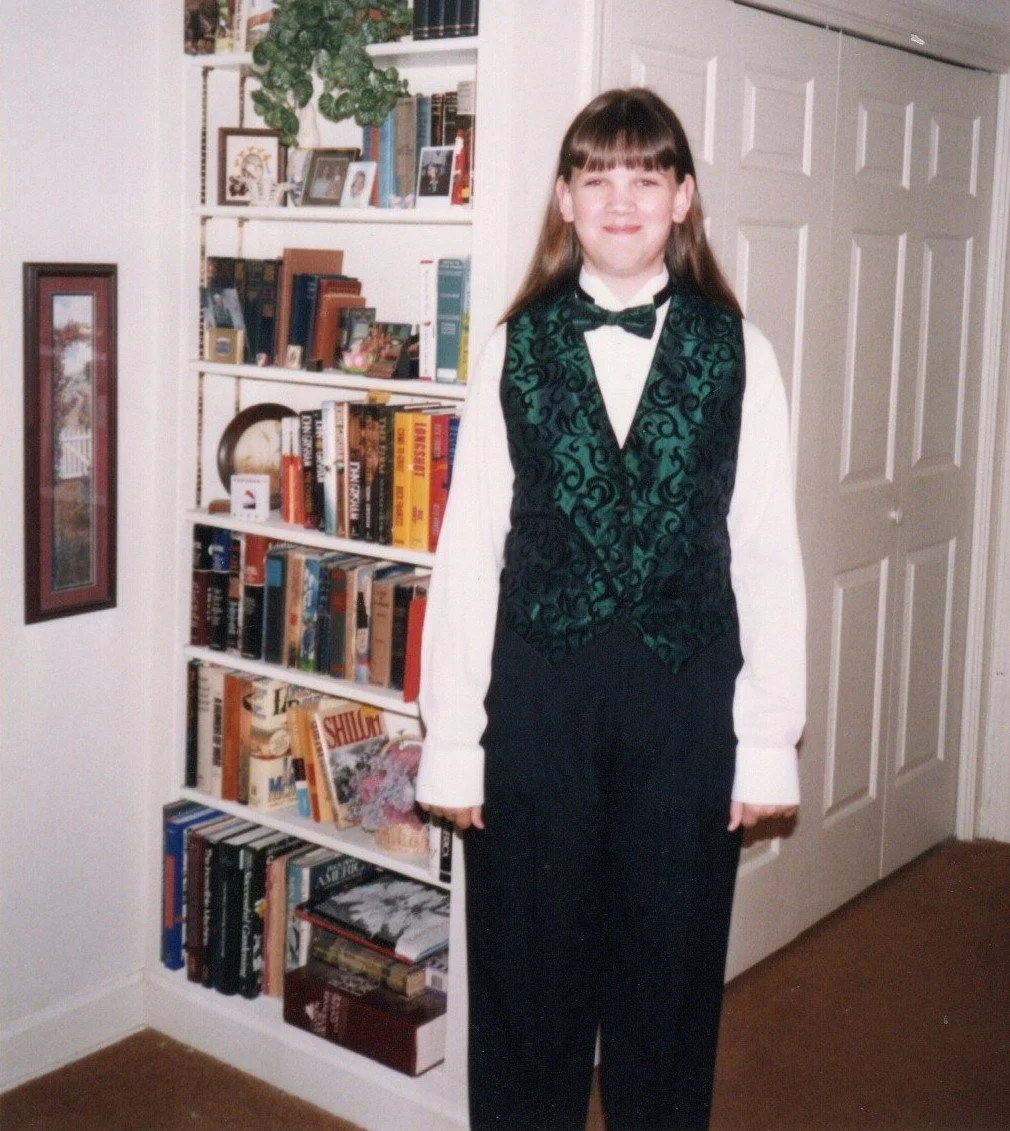
Allison Renner, pictured here as a Middle School Band Nerd (™), is the author of flash fiction chapbooks Green Light: The Gatsby Cycle and Won’t Be By Your Side. Her fiction has appeared in Ghost Parachute, SoFloPoJo, Ink in Thirds, Gooseberry Pie, and others. She can be found at allisonrennerwrites.com and on Bluesky @AllisonWrites.
DIGRESSIONS ON GETTING TO HEAVEN, MEMORIAL, AND ASKING YOUR FRIEND FOR MONEY SO YOU CAN SEE BOB DYLAN PLAY IN SAN FRANCISCO: leah mensch on “tryin’ to get to heaven”
On the late, great Kate Braverman’s list of 25 Antisocial Things Your Character Can Do—which she distributed to her fiction students in the 90s—there are many gems. Your character can wrap dog shit in candy wrappers and pass it out on Halloween. Your character can read someone’s fortune and prophecy disaster. Your character can go to a friend’s boss’s party and proceed to get violently drunk. Your character can walk down the street in Los Angeles and pull mail out of random mailboxes and throw said mail away. Your character can discuss suicide with a depressed person as a legitimate option. Your character can tell a friend they need money—desperately—and then, a week later, casually mention that they saw Bob Dylan live in San Francisco. Of everything on this list, the last—asking for money only to go see Dylan live—is the only item I am positive she did. Several times, probably. The women Kate wrote—reflective of the woman Kate was, or at least the woman Kate wanted to be—would be damned if they were wasting their time trying to get to heaven. They had other priorities.
If you have not heard the story of Kate Braverman, then you have heard one like it: the woman on the margins who wrote brilliance, who lived a short enough life that she never really grew old, but a long enough life that she did not die young. A woman who, with better support, better policy, better care, would still be here. A who trespassed gender and social niceties and literary convention, whose boundary violations are used as a defense, by institutions of power, to persistently deny her life and art memorial. But I digress.
Once, famously, someone on Los Angeles public radio asked Kate Braverman to list her literary influences. This was 1988. She’d just published her second novel, Palm Latitudes, after nearly a decade of soul-crushing literary rejection, and this quasi-success came with no assistance from the literary industry. (It was her hairdresser in Los Angeles, ultimately, who mentioned he knew a guy who knew a guy at Simon & Schuster, but that’s a story for another time). On the radio, wishing to pay no homage to a literary lineage, Kate growled. “My influence,” she said, “is pulse of rock ‘n’ roll.”
Recently, I was asked if Kate Braverman had a contemporary literary community. The question was sincere, after a job talk, after I read from my book, after I spent forty minutes in front of twenty academics discussing Kate and how little she left behind following her death in 2019. She had little respect for her contemporaries, Kate, sometimes for obvious political and feminist reasons, and sometimes out of sheer jealousy. Intimacy seemed to send Kate into a crippling spasm of jealousy and self-abandonment. To know Kate Braverman was to be stunned by her brilliance and wounded by her all the same. I almost told the room the story of 1992, when Kate called the acclaimed Kathy Acker’s work “pseudo literature” for “anti-readers.” But I just shrugged.
“She had a posthumous Sylvia Plath,” I said. “And Bob Dylan.”
When I was researching archives in 2022, I was surprised to learn Dylan was still living. He’s 84 years old. Sure, I am twenty-six. A pine tree my age knows more! I grew up listening to REO Speedwagon and the Eagles on an endless loop with my dad—a CD he’d burned and labeled “Greg Greatest Hits” with a paint pen—and some weird admixture of Taylor Swift, Lady Gaga, and Eminem on Pittsburgh’s pop hits radio station. And yet, let me clarify that several people in my age demographic, people far more musically inclined than me, people like my friend who is a bass guitarist and taught me most of what I know about Dylan’s music, also were surprised to learn Bob Dylan was still alive. I wonder if 2016’s rapid succession of music icon deaths created a Bob Dylan microcosm of the Mandela Effect—at least for those of us who were, at the time, seventeen years old, so sure, for the final time, that we knew exactly what we wanted to squeeze out our precious lives, lives which still felt long, the days a series of vertebrate that hadn’t yet begun to swell under the thumb of time, bad health news, history held within the body. My body was still only mine, or else, I had not yet felt the weight of the other bodies around me, within me.
In 2016, the George Kaiser Family Foundation partnered with the University of Tulsa to purchase Bob Dylan’s papers. For twenty million dollars, the Bob Dylan Archive was shipped to Oklahoma, not only the contents, but the name Bob Dylan Archive itself copyrighted. The archive has its own Wikipedia page. His memory is so secure, so accessible, it feels politically inconsequential that I assumed he was dead. My friend reminds that Dylan was awarded the Nobel Prize in Literature in 2016 for his music, and I am therefore obligated to remain informed about his status. Not only that, my friend continues, but without Dylan, we’d have had not the Beatles. Or the Rolling Stones. Or Jimi Hendrix. Nobody’s life is politically inconsequential, of course. Especially not Bob Dylan, whose music chronicled social unrest and became a kind of anti-war anthem. But I write and create within the fissures of marginalized memories and histories, and if Bob Dylan’s alive-ness slipped through my fingers, what else does, too, every day?
Some things, other than several thousand dollars in medical bills, Kate Braverman did leave behind: a Mazda that couldn’t legally be sold in the state of New Mexico because it was never registered in the state of New Mexico, two unpublished manuscripts (though only one was legible), undated dental x-rays, a small collection of annotated books, more undated dental x-rays, broadsides signed in 1989, tender letters she wrote her old graduate thesis advisor after his cancer diagnosis begging him to pursue chemotherapy, an iTunes library at maximum capacity with Bob Dylan and the Grateful Dead’s entire discovery. Every single song. And “Tryin’ to Get to Heaven” was the first one on the list.
On a cerebral and neuro-muscular level, music is memory. I wrote most of my first book listening to the same three songs on repeat: one was an instrumental by an acoustic group called the Paper Planes, the second was a song that I am fairly sure was an advertisement for the city of Buffalo, performed by a dude who has fewer listeners per month than my childhood neighbor who briefly decided he was going to surpass Mac Miller and become the most legendary white male rapper born in the city of Pittsburgh before pivoting to a more lucrative career in engineering. The third, I’m embarrassed to admit, was the 1975’s “It’s Not Living If It’s Not With You.” I’ve always been a song-repeater, but this habit of practice, of compulsion, started in 2020, the year after Kate died, when I was a senior in college, most days too tired to stand up straight, trying to write about the mythic woman refusing to show herself to me. By the time I realized I didn’t actually The 1975, it was too late. The neural pathways had been carved. I needed the voice of Matty Healy in my ears to physically write. This practice is always in the periphery. It’s what makes you and me shudder when we hear our morning alarm go off in the library as someone’s study timer; it’s why musicians trust their hands. It’s why, when someone asked Bob Dylan how he continues to perform so pristinely after years of touring, he responded: I could do it in my sleep.
When I listen to music, I am also summoning ghosts. I tell my students that it’s difficult, probably impossible, to have a neutral relationship to any art. Everything we touch becomes ours, and it exerts a force, and sometimes we feel that force right away, and sometimes we don’t notice until decades later, until we can no longer bear the weight. Sometimes, not at all. I don’t love Bob Dylan’s music, but I love his words, and I love Kate Braverman, and she loved Bob Dylan, so I listened to her Bob Dylan playlist a lot during my last year of graduate school because she was dead and there was a tangible reality where she was not dead, which made her being dead even worse. Sometimes, I cried about her being dead; sometimes I cried when I heard Bob Dylan because Kate Braverman was dead. I knew her words so intimately I forgot that I did not know her. Is this true, that you do not know somebody if you know their words?
Despite my questionable taste, music was also my first writing teacher. In school I learned parts of speech and subject verb agreement, but music taught me how to listen and pay attention. How to be a good steward toward my landscape, I suppose, and also a good steward to the page, to memory. Which is, to slightly digress, precisely the reason I seldom entertain the idea of artificial intelligence truly colonizing artistic spaces: it’s all bones and no heart. A bot inside a data center sucking water from the Colorado River cannot stand at the bus stop in awe listening to a phrase, the way it exerts a force while hanging in mid-air. Music cannot prompt it to fall to its knees and remember, because, while it can store information and learn, it cannot, fundamentally, forget.
And it cannot be touched by the fragility of ordinary life, which Kate insisted was the nature of the modern short story and the modern lyric: One moment we are standing there, at full attention, picking up the kid at soccer practice, picking up our clean shirts, picking up our sins, picking up the clues left to us by our loved ones, and the next, without warning, we are picking splinters from our flesh, she wrote in 2006. And I’d have to imagine Dylan would agree. “Tryin’ to Get to Heaven” is a splice of memory flashing before an aging man’s eyes—when all the bodies you’ve touched in your life become your body and you can no longer bear the weight. “Every day your memory grows dimmer / It doesn’t haunt me like it did before,” he sings. “When you think that you’ve lost everything / You find out you can always lose a little more.” (And here’s a Braverman poem, written a decade before Dylan’s song: “When you have lost everything / your worst softens / your youth barricaded behind a locked door.” ) They had the same teachers. One got famous and one fell through the cracks. Both were here. Both are here. They’re both trying to get to heaven before the doors are closed.
Bob Dylan shows up, if only as a merely quick reference, in almost every one of Braverman’s books. A character bikes around rural Pennsylvania and listens to Tambourine Man, a woman turns up the Dylan on the stereo to drone out her useless husband, who spends most of his time watching Star Trek. And yet, for as monumental as their respective work feels to me, neither sprung from the earth as a full-fledged artist created by a fastidious god, unless the fastidious god was the culture of the 60s. Both Kate and Bob Dylan were heavily influenced by the Beat poets—Allen Ginsburg’s Howl, specifically. (If I’d never read Howl, if you told me “I’ve seen the best minds of my generation destroyed by / madness” was a Dylan lyric or something Kate said an interview, I’d believe you.
If it’s not clear by now, I know far more about Kate Braverman than I do Bob Dylan. I’m not going to wax poetic about the way Dylan’s music has changed over the course of his life, even though I can recognize, just by listening to Kate’s playlist, that it has. But I want to tell you that the women in Kate Braverman’s final book are not asking their friends for money and going to see Dylan in San Francisco. They are not discussing guns in the airport or getting violently drunk. They’ve outlived suicide as a viable option. (Every hand is seppuku, one of them says). They’re the people on the platforms / Waiting for the trains. You can hear their hearts a-beatin’ like pendulums swinging on chains. They don’t know what all right means. They just know the end is coming.
I’m writing this essay from the window of a microbrewery in the Mountain West. I’m listening to Kate’s Dylan playlist, and I am also having a text argument with my younger sister about one’s ideal proximity to the Yellowstone Super volcano upon its inevitable explosion, which google tells me could happen at any moment, though my sister, who is a geochemist, assures me the explosion is likely, at least, thousands of years away. (Google also assures me that the Super volcano explosion is not a death sentence unless I live within 200 miles of it. Otherwise I will just experience a volcanic winter and worldwide famine and extreme lung and nerve damage from the ash particles, to which my sister argues immediate death is preferable). This debate is interrupted by a cold call from a good friend who usually does not call without warning. My good friend is calling to tell me that her dad’s slipped disc is malignant. It’s not a slipped disc at all. It’s spinal carcinoma that’s spread to his brain. It’s in his bones too, a whole mess, cancerous spots lighting up his scans like a birthday cake. When she shares the details, I’m watching a kid pull another kid along the snowy sidewalk in a sled, the dusk sky a bruised plum. “Tryin’ to Get to Heaven” plays from my computer for the entirety of the conversation, and when she hangs up, I think to myself that I do not care how beautiful this song is, or that I am writing about it. I never ever want to hear Bob Dylan’s voice again.
Being Jewish, I have not thought much about the variables of the afterlife. I just know that I want to be kind, and I want to grow old, and I also fear the variables of growing old. I am afraid of my parents dying, and yet, the only way to avoid bearing witness to their deaths is if they bear witness to mine. I am afraid of my partner dying, of getting sick and leaving me at thirty-nine, or merging wrong on the interstate, and I accept this fear in lieu of its alternative, which is having never loved at all. I wonder if I feel this way mostly because I am young, if my terror will soften into the shape of a different kind of grief, a different kind of love, the older I get, if I will read Kate Braverman and hear Bob Dylan differently twenty years from now. And I wonder if I fear growing old because for the past six years, the entire circumference of Kate Braverman’s life has been spread out in front of me. And I know that memory cannot reconstruct a life. Memory is a life, inside me, characters and songs, my heart is theirs, beating like a pendulum swinging on a chain.
Dylan wrote “Tryin’ to Get to Heaven” for his friend, the Grateful Dead singer Jerry Garcia who died in 1995, so the story goes. Kate Braverman died estranged from most of the people who loved her. The person who gave me her old playlists, who spent several years caring for her: helping her with taxes, taking art classes in San Francisco, updating her website and drafting book proposals, ultimately learned about Kate’s death the same way I did. He googled her name and found an obituary. It was winter in the Salinas Valley, where he settled and built a life decades after meeting Kate in Rochester when he was an undergraduate. He wanted to remember. So, he told me, he drove to the ocean and turned on Dylan and Jerry Garica. He walked along the shoreline of the Pacific, and he wept.
Leah Mensch still believes in love. All the rest is lies.