
first round game
(7) Alanis Morrissette, “Uninvited”
SQUEEZED
(10) Elliott Smith, “Between the Bars”
100-80
AND WILL PLAY ON IN THE SECOND ROUND
Read the essays, listen to the songs, and vote. Winner is the song/essay with the most votes at the end of the game. If there is a tie, we will play a one-hour overtime (and repeat until we have a winner). Polls close @ 9am Arizona time on 3/7/26.
Mother Rage: Lela Scott MacNeil on Alanis Morissette’s “Uninvited”
It’s 1998. I’m fourteen and poorly contained, spilling out everywhere, hoping no one notices. I’m waiting for Mom to pick me up from school. She’s late, which she is a lot, but I understand, because she has a lot of important things to do. While I wait, I listen to Alanis Morissette on my Discman. I don’t understand most of her lyrics but when I listen to her voice, to the feelings it holds, I feel held. Leaning against the brick schoolyard wall, I sink down into the protection of a woman who can say what she wants and feel what she feels. I’m full of her spirit, eyes closed, headbanging a little. I open my eyes. My breath catches as I see Mom pulling up.
I get in the car and say, “Hi Mom!” with a big smile.
“You’re so lucky,” says Mom. “My mother would never have picked me up from school like this.” I nod. Mom likes to tell me how lucky I am to have a mother like her. Not like my grandmother, sitting in the dark living room consuming only vodka and cigarettes after my grandfather divorced her. I know I’m lucky. I’m fiercely loyal to Mom. I take her side in every argument. People never understand her like I do, how hard a life she’s had, what it takes to make her happy.
“Grandma’s a bitch,” I say. Mom beams. I love making her smile. When she smiles, a light turns on inside her that fills me up too. Her happiness is the main thing I worry about. I ask how her day was. She likes when I ask her questions. She tells me this morning my dad was an asshole for absolutely no reason and then the woman checking her out at the grocery store gave her a nasty look. I ask a lot of questions, but even so, as she pulls into the garage, there’s a shift in her weather: pressure drops, clouds turn a sick green gray.
“You know, it’s your job to make me happy,” she says in a tight, wavering voice. “And I have to say, I’m not feeling very happy right now.” My muscles tighten. My mouth is dry.
“And what pisses me off most is you can’t fathom how much I gave up to be your mother.”
“I know.” I say. I hope she believes me. I know I’m a bad daughter and I know I’m lucky to have a mother like her and I’m willing to do anything to show her that I love her, that I’m grateful, that I understand her pain. “I know,” I say again.
“What do you know?” she hisses. Her face is red. My pulse is loud in my ears. “You have no fucking idea what it’s like to be me.” She’s right. I’m a piece of shit. A wave of gray green shame breaks over me.
Inside, she tells me Dad has called to say he’s working late and to have dinner without him.
“Isn’t that just like him,” she says. “And on a day when I’m feeling so lonely.”
“We could go out to eat,” I say hopefully. This often cheers her up.
“Ooo good idea! Where should we go?” She’s smiling. Good. I relax a little.
“Let’s get Indian food!” I say, because I know it’s her favorite. As the words leave me I see on her face it was the wrong answer. She rushes me, pins me to the floor.
“HOW CAN YOU SAY YOU WANT INDIAN FOOD WHEN YOU KNOW I’M TRYING TO LOSE WEIGHT??" she screams. My ears ring. I close my eyes. I can feel droplets of her spit hitting my face but I don’t hear the rest of her words. I’ve retreated inside myself.
In my mind, I’m in England, where I go each summer with my best friend Zoe to visit her Granny. Zoe’s Granny lives in Bovey Tracey, a picture postcard village on the edge of Dartmoor. In my mind, Zoe and I are standing on the bed in her Granny’s guest room, shouting along to Alanis. We’re about to get in trouble, for standing on the bed and for shouting about going down on someone in a theatre, but that’s not the part I remember.
I love every minute I spend in England. Zoe’s Granny is strict and proper. We practice our table manners for weeks before each trip so we don’t disappoint her: absolutely no elbows on the table, bring the soup to your mouth, not your mouth to the soup. Her rules make me feel safe, cared for. We spend our days exploring Tolkienesque landscapes with names like Hound Tor, Gara Rock, Fairyland. At night we eat baked beans on toast, courgettes and runner beans from the garden. Then Zoe’s mother reads to us from The BFG or Danny the Champion of the World and we fall asleep.
I come back to my body, to the room. Mom is in the corner, curled around herself, sobbing. I take her in my arms. Her tears soak my shirt but I don’t care. I love feeling so close to her. Too soon she pulls away, says she’s tired, crawls up the stairs to her bedroom.
I retreat to my room and get my Discman out of my backpack. Flipping through my 12 disc CD case, past Ace of Base, The Bridge and The Sign, I take out the City of Angels soundtrack. I liked the movie okay but mostly I bought the soundtrack because it has the new Alanis song on it, “Uninvited,” the first song she’s released in three long years since Jagged Little Pill. I press play and skip past track one (some dumb U2 song). The piano starts soft and sad. I feel a hard tug in my chest. Alanis’s voice comes in, telling us she’s flattered by our fascination with her. I turn the volume up loud enough to drown out the sound of Mom’s sobs. I let Alanis fill the space between my skull and the world. Her voice swells; she’s a hot blooded woman who wants things; she can uninvite you if she changes her mind. Here in the safety of my headphones Alanis sings everything I’m feeling, no judgement, no conditions. She doesn’t ask me to be smaller or quieter. Some long clenched thing inside me loosens a little. The tears I’ve been holding back spill out. I bite my tongue to keep myself quiet. If Mom hears me crying she’ll come yell at me again, call me sensitive, inconsiderate, a baby. Deep below my crust a molten core of rage begins a slow push towards the surface. I turn on one track repeat, dig my nails into my palms, let myself dissolve. Eventually I don’t exist outside of this song, this tender cave of feeling.
There’s a loud knock at my door. I jump, pull off my headphones. The door opens.
“Lela?” Mom’s voice is soft, childlike. I try to wipe away my tears before she notices. Her face is swollen but her eyes are clear. The storm has passed, for now. “Want to go to the Hard Rock Cafe?” she asks.
There’s only one right answer but I hesitate. I know she’s trying to make it up to me. Part of me wants so badly for things to be good between us. Part of me wants to escape and doesn’t know how. I pull on a smile.
“I love the Hard Rock Cafe,” I say. “We deserve it.” I don’t really love the Hard Rock Cafe but I’m good at pretending. At the restaurant we sit in a big round vinyl booth beneath photos of Metallica and order pulled pork sandwiches, onion rings, vanilla malts, all of Mom’s favorites.
“You know sweetie,” says Mom between bites of onion ring, “I think it’s important you understand something about me. I’m what’s called a highly sensitive empath, one of only two percent of the population.”
“What’s a highly sensitive empath?” I ask. I’m good at asking questions.
“It means I feel things more deeply than other people do. And I don’t just feel my own emotions, I actually absorb everyone else’s emotions around me. It’s a gift.” I nod. It’s true her feelings are bigger than everyone else’s. “And I don’t have the same filters other people have. I feel everything at once and sometimes it’s all just...too much.” She takes a loud slurp of her malt. I take a loud slurp of mine to show her how much fun I’m having. I eat until I feel sick.
As we’re finishing our food, she says, “Well, this is delicious. But after today, we have to pull ourselves together and stop eating like this.”
“We do?” I ask. Her eyes flash gray. Shit. That was the wrong question. I brace myself.
“Lela, now that you’re becoming a young woman you have to be careful about what you let inside your body. One day you’re going to fall in love with a man and want to get married. And that man isn’t going to want to marry you if you’re overweight.” She sucks up the rest of her malt. I take a sip of mine but the flavor is gone, it’s liquid cardboard.
“You know, I was barely eating anything when your Dad fell in love with me.” I do know, because she loves to tell this story. She wasn’t eating because of the stress of her divorce from her first husband. She divorced him because he told her she’d make a terrible mother.
“All I could force myself to eat each day was a smoothie,” she says now. “I made sure to eat that one smoothie every day. It’s important to take care of yourself.” I nod. “And that’s why your father saw me and fell for me. He said I was so skinny, he just wanted to feed me.” In all the times she’s told the story it’s never had such a clear equation: skinny = love. Walking out of the restaurant, I’m dizzy with fear and sugar and shame. Soon, with Mom’s strong encouragement, I start to starve myself.
In 1998, Alanis Morissette was twenty-four and still reeling from the treatment of a man who managed her teen pop star career back in Canada. He started sexually abusing her when she was fourteen, telling her things like If you weren’t so wise beyond your years I would have been able to control myself and I might want to marry you someday if you watch that weight and you keep your firm body. He controlled everything she sang, wore, ate. During music video shoots she’d get so hungry she’d sneak out to the fridge in the middle of the night and eat cold Velveeta slices. The next morning, he’d count the slices and she’d be in trouble. Of course she developed an eating disorder, of course.
I wish I’d known we had this in common back in 1998, as my anorexia bloomed and enveloped my life, as my mother’s vines of self loathing wrapped so tightly around my throat it was hard to breathe. I’m grateful I had Alanis’s music, at least, an emotional room of requirement where I could feel things I needed but wasn’t allowed to feel. Rage, at my mother, at my mother’s mother, at a world that filled us all with pain. Grief at not getting the mother I needed. Joy, because I was alive, and there were times when being alive was wondrous, like standing on Zoe’s Granny’s bed shouting out Alanis, like eating courgettes and runner beans fresh from the garden, like getting so lost in a book or a song I forgot I hated myself.
It’s 2025. It’s my birthday. I’m forty-one. I’m in Las Vegas, at the Colosseum, watching Alanis perform. I’ve never seen her live before. I’ve read she calls her concerts “a space where if you want to cry through the whole thing, punch the air through the whole thing—whatever you need to do, I’m doing it with you.” Being so close to her voice fills my blood with a feverish thrill. I want to rush the stage and give her a hug. Therapists have told me my fourteen year old self still lives inside me and it’s important to listen to her, to give her what she needs. She needed this concert.
Alanis’s hair is long and wild. Her vibe is maternal. Her voice is exactly as I remember it. I feel my fourteen year old self behind me, a ghost tickling my shoulder, breath hot on my neck. I take a video for Zoe. I take a hundred blurry photos. I put my phone away. I want to be here for this.
“You like snow but only if it’s warm,” sings Alanis. “You like rain but only if it’s dry.” I sit next to hundreds of women my age and shout the words we learned as children. Time wobbles. The past presses down on me like a weighted blanket. What gives her voice this power to dissolve time? My inner fourteen year old jumps up and down to the beat, sings YOU YOU YOU OUGHTA KNOW.
This music opens up to me the way it used to, like a magic door in a fairy tale, but this time I can feel my fingertips, my guts. Her voice is supernatural. It creeps inside me, explodes from my chest, pin balls around the room, then pulls back into her throat, connecting her to us. To me. I needed this. The fourteen year old, yes, but also the forty-one year old. For so long I told myself I needed nothing, but it wasn’t true, and I’m grateful I don’t listen to that voice anymore.
Alanis tells us rage is her favorite feeling. We cheer. She tells us she’s a highly sensitive empath, one of only two percent of the population. My stomach drops. She says highly sensitive empaths and narcissists can look the same from the outside. I think about my mother and the Hard Rock Cafe. In the years since, I’ve looked up the term highly sensitive empath and learned it’s not an official diagnosis. It’s a pseudo-scientific self-applied label my mother used to make her inability to regulate her emotions sound like a superpower. I want to ask Alanis how she knows she’s a real highly sensitive empath and not just a narcissist who believes she’s a highly sensitive empath. Sitting in the dark I feel betrayed, beyond all logic and proportion.
It feels like a betrayal to realize the real fifty-one year old Alanis is not the same Alanis who imprinted on me at fourteen. Even so, her same voice twists, dives, carries all her (and my) many parts: sick/pretty, high/grounded, lost/hopeful. Sometimes she has to unhinge her jaw to let the full sound out. Her hair undulates like a fifth limb. As she told the Guardian, “my hair is a band mate. It’s a way of expressing and flailing and raging. It’s like a typewriter, it speaks on my behalf.”
She plays “Uninvited” as the first encore. I squeal at the familiar melancholy opening. I’ve been waiting all night. The song is deliberate, almost menacing. It knows what I don’t want to admit. Alanis calls it her fear of love song. The piano builds, builds until it’s shaking my teeth, the notes hanging thick and heavy as smoke. It’s almost too much, too much feeling, but I love it, I love her, I love her voice folding in on itself, half concealing lyrics that form a cave or a womb or a bottle of wine or a body. Her longing becomes my longing, our longing for the thing we fear most. Is she the shepherd or the uncharted territory? Am I?
Later, telling a friend about the concert, I say Alanis’s betrayal feels much easier to forgive than my mother’s.
“Of course,” says my friend. “Alanis owes you nothing.”
My mother used to love to brag that one time, at Esalen, Alanis kissed her on the mouth. It always made me angry in a way I didn’t understand until I started writing this essay. I needed the Alanis who raised me to exist apart from my mother. After I got over the betrayal at the Colosseum, I realized Alanis did me a favor by showing her true self; I saw that the Alanis who raised me was my own creation, an imaginary mother pieced together from glue and lyrics and chords and need. I feel less broken knowing even back then, some part of me was dressing up in Alanis’s voice to tell myself: hold on, there’s a whole life out there waiting for you.
I keep being confronted by a choice: learn to re-parent myself or let my pain hurt everyone around me, like my mother and her mother before her. I haven’t spoken to my mother in seven years. They’ve been full of rage and grief and joy, each new uninvited feeling more terrifying than the last. But I no longer feel shame when I eat, or when I’m sad, or happy. I still flinch at loud noises and I still have the daily stomach ache that started when I was fourteen. The body takes longer to re-parent than the mind I guess. These days I’m letting my body feel it all: hot/cold, loud/quiet, heavy/light, dark/bright. Sometimes my body feels so full of loss and love for the world I find myself crying on the street in downtown Los Angeles, fat ravens circling overhead, quoting poetry, asking me what I’m going to do with my one wild and precious life. I put on my headphones and press play on “Uninvited” one more time. The opening notes crawl through my ears. I shiver in the sun.
x
Lela Scott MacNeil was born in Los Alamos, like the atomic bomb. Her writing has appeared in Gertrude, Essay Daily, and Trouble in the Heartland: Crime Fiction Inspired by the Songs of Bruce Springsteen. Her March Vladness extracurricular essay is included in Hit Repeat Until I Hate Music: The March Xness Anthology. She lives in Downtown Los Angeles.
jamison crabtree on elliott smith’s “between the bars”
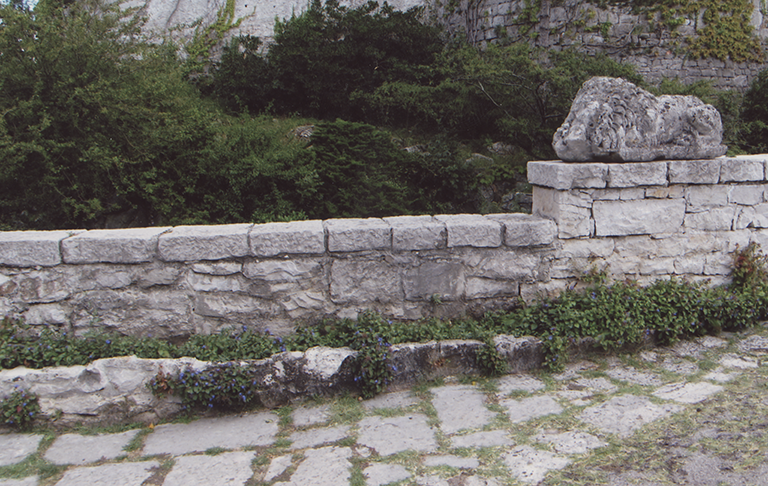
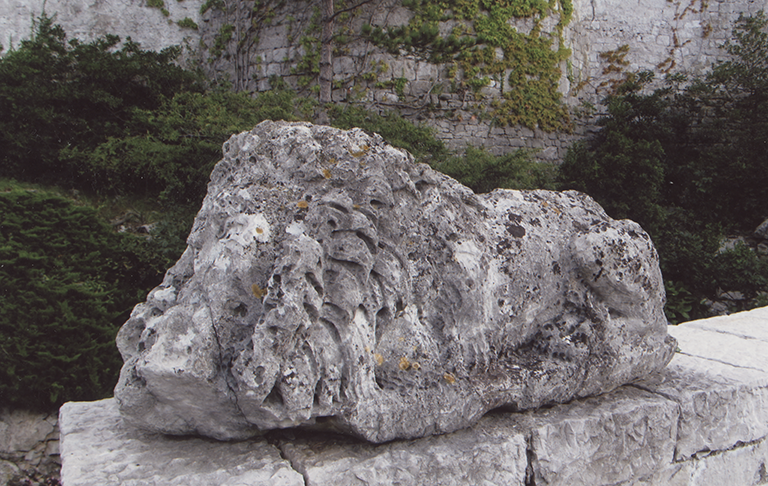
Do you still think about the lion statues you photographed at Duino?
By the time you’d found them, the pair had mostly returned to stone. An implication of a lion, long after all of its details had been erased. If you’d told me they were igloos, or sponges, or tumors—for each, I would have believed you. That’s how little of the actual lions remained.
Each passerby erasing them as they caressed the carved faces, patted the chiseled manes. The proud heads, slowly, slowly crushed. Storm-pocked by half a millennium of coastal winds and rain, with parts rubbed smooth by the hands of tourists. Victims of the rituals of touch.
You sent me a hundred photos, exactly, from that trip, but I wasn’t sure what they were meant to communicate. Three were of the lions. On the back of one, you wrote:
promise me you
will try + keep on
breathing?
I cannot, let’s go
look out @ trees...
We never talked about any of them; neither the photos nor the captions. Were they meant to speak to me, or where you speaking to yourself, hoping I’d take something from it? What’s unsaid: does it accumulate?
I’ve been trying to translate the experience of listening to a song, “Between the Bars,” into language but I can’t extricate my feelings about the song from my feeling about us—whatever we were. When I listen to the song, I see the lions’ faces staring out, towards something out of frame.
We haven’t spoken in eight years. The last time we did was in a taco shop in Tucson. I told you I’d started dating someone. You changed the subject. Started telling me about the meaninglessness of poetry and, in turn, how meaningless it was for me to practice it. Either you were right, or you weren’t. That is, if the world can be broken into binaries.
You finished your burrito and walked out into the cruelly bright summer evening. As I drove home, I saw you walking down an alley, going in the opposite direction from where you’d asked me to drive you.
In fairness, this isn’t speaking. It’s not a conversation, not even a letter. It’s me talking to an idea of a you. Softening the shards of memory until only the flat stone of it is left, one that I might be able to absent-mindedly reach for, skip across a pond, and think of nothing but the sound of it moving away from me, across the water.
I went back to the taco shop a few years ago, but they’d renovated. I wanted to sit in that booth again, for some reason. It had been replaced by a counter. The long plexiglass window had been replaced by framed panels of glass. I felt out of place.
Our histories ran parallel to each other: lifetimes of struggling against suicidal ideation, tendencies to fill up the lack of meaning in our lives with alcohol or sex. Behaviors that were self-destructive, enacted with the hope that they’d be self-transformative. There wasn’t a need to talk about things when we could simply recognize them in each other. We both had a desire to live for something, but whatever that something was: it was far beyond us.
Was that what brought you to Elliott Smith’s music? How, no matter what he sang about—addiction, loss, capitalism, depression, it always sounded sweet?
So far, everything I’ve written about the song devolves into a point, which feels wrong. When Carson Daly asked Smith about the difference between folk and pop on an episode of TRL, Smith emphasized the lack of a message in his work. He argued that folk music tends to make a point, usually a moralistic one. It’s a style of songwriting built around making an argument. The folk song tells, the folk singer informs. There’s a pretense of weight, as if the songwriter knows something about the world that their listeners don’t, and the song is the only way to communicate it.
In contrast, a pop song “can mean nothing or it can mean lots of things; no one can be sure which [...].” The pop song offers enough space for the pop singer steps back and lets us project ourselves into the music. It’s disposable; there for us to do whatever we choose to with it. Dance to it. Cry to it. Forget it.
My associations with “Between the Bars” are not solely connected to you. There is a shared trait: people who seemed to operate under the hope that if they could be understood by someone else, then they might understand themselves. You’re the only one I feel compelled to talk to, though.
Trauma is difficult to translate into everyday conversation, especially when it lingers. It was easier for us to talk about the things that inspired feelings—music, books, art, than it was for us to talk about the feelings themselves.
It gets tiring, trying to be understood. How many times did you open up to someone, only to discover that their experiences were so far removed from yours that all you’d done by trying connect was to overwhelm them? To walk away feeling, at best, listened to? At worst, judged?
I stopped trying. Instead, I do what we did: go for a drive with them, ask “hey, have you heard this,” and play on a song that fits my feelings. Either someone hears something similar to what you ‘re hearing, or they don’t. And if they don’t, nothing’s lost. There was still the moment where you were listening together, moving down the road towards nowhere in particular. And there are always other songs. You can always try again.
Because we talked around the most difficult things, I’ve realized that most of our relationship was inferred. When you sang “shoot-uh me up, it’s my life,” I didn’t hear Smith, I heard you trying to talk about your past. I looked at the liner notes while writing this, only to realize that those aren’t even the lyrics. The actual lyric, “sugar, lip me up, it’s my lie” sounds goofy in comparison.
I’ve been reading Smith biographies this year without learning much from him. My favorite parts are all in the analysis of individual songs, and the ways the authors reveal so much of themselves without noticing, distracted by their love of a particular song. But it’s interesting to see the gaps between how Smith talked about himself, how his friends talked about him, and how media portrayed him. More impression than person.
In 1997, the same year that the album with “Between the Bars” was released, and the same year that the inclusion of “Miss Misery” in Good Will Hunting caused his fanbase to surge, he jumped off a cliff. He and his friend had driven from New York to North Carolina for a merchandising and production company’s tenth anniversary party. His friends say he was having fun, and he’d stayed out drinking with folks after the party wrapped up. But afterwards, dropping off another musician at their house, Smith jumped out of the car and ran into the dark.
In his version of the story, his actions were intentional: he saw the cliff, and made the decision to jump. His friends frame it as an accident: it was too dark to see the cliff and he hadn’t meant to jump, he’d simply fallen off of it. He landed on a tree, and his life continued. Language makes it seem simple: either he jumped or he fell. Neither feels true.
Every sadness is a burden; a burden we hopefully figure out how to put down and walk away from.
Sometimes, we hold onto our sadnesses for so long that it’s easy to misconstrue them as something intrinsic to our sense of ourselves. Sometimes, sadnesses claw onto us, like someone drowning in deep water who, panicked, pulls their rescuer under as they struggle to breathe.
Sometimes, with the help of reflection, we grow from it. Sometimes, we simply forget about it, and it slips away. Regardless though, in order to be sad about something, you have to care about some aspect of it. Whether this is awful or not, I don’t know; it entirely depends on the aspect.
Before we’d met, I obsessed over Metric’s cover of “Between the Bars” without having listened to Smith’s original. After a bad breakup and a pair of root canals, I was homeless and renting a cheap trailer in Bisbee, Arizona. During the days, I commuted to Tucson looking for a cheap apartment. There wasn’t any internet or phone service at the trailer park, and nowhere to walk to besides an old cemetery that closed its gates at dusk.
In the evenings, I’d place my tv on the stairs leading into the trailer, sit outside in the metal glider, and play video games as the sun dropped down below the mule mountains The still air of the afternoon would grow restless, and stir through the dusk. At night, I’d drink beers alone in the trailer, and try to play “Between the Bars” on my mini-banjo. I never learned it, though; it was just fun trying to.
In Elliott Smith and the Big Nothing, Smith’s friend Marc Swanson talks about promoting the musician’s first solo album: “...people were like ‘whatever, it sounds like Simon and Garfunkel, not my thing, really boring, all the songs sound the same...’ I could never get anybody to listen to it, and then I figured out this really funny recipe: The time to get someone [...] was as soon as they broke up with someone... I’d be like ‘you should listen to this,’ and it’d be the same person I’d given it to six months earlier who said it was boring, [...] and they would come back to me, like, ‘your friend’s amazing.’”
There’s something to that, something about the ways our lives primes us for the music we fall in love with, and how we find it. Do you think people come to sad-sounding songs when they have a reason to be sad, or because they want to hear something that doesn’t feel discordant to their experiences?
You once told me “we are low people, jamison.” In the moment, it felt like you were telling me something about what we shared—something in our histories too big to be held in language. Later, when you burned a copy of Things We Lost in the Fire by the band Low, I realized that you’d meant that we were the sort of audience people had in mind when they wrote sad songs.
Maybe if I’d met you before running off to the edge of the state, I would’ve been listening to Smith’s version instead of Metric’s. But, at the time, I listened shallowly, paying more attention to the tone of what was being said, rather than the actual words.
As a result, Metric’s performance felt romantic. Haines, blocked off from the viewer by a pair of large, dark sunglasses directs all of her attention towards the microphone. Shaw, the band’s guitarist, watches her closely as if the song would break if he looked away, even for a moment.
The song is full of promises. I wanted to be a “you” that was worth making those sorts of promises to. For someone to speak to me in a tone that made me feel like they cared, even if what they were saying was horrible.
The technique of direct address, which Smith uses on every track of Either/Or, the album that “Between the Bars” appears on, feels more like a tool for creating distance than for closing it. Two people could listen to it, the use of direct address means that the song changes depending on whether a listener identifies with the speaker, or with the addressed, voiceless, “you.”
When I want to feel wanted, I listen as the “you.” When I want to want, I listen as the speaker. Both still manage to devastate me occasionally.
Outside of the music of it all, the speaker offers nothing to the “you” but the comfort of erasure. Instead of wanting to be a partner, the speaker demands subservience. In place of support, they offer control. Reduced to language, commands like “do what I say and I’ll make you okay,” are the opposite of romantic. It’s about trapping the you. Saying “the people you’ve been before, [...] I’ll keep them still,” undermines the real issue: the “you” doesn’t need to be saved, they need to process their past.
Instead of recognizing the “you” as whole person, the “you” is a collection of failed, past selves. Lived through, then discarded, again and again. The speaker’s insights about the “you” are insulting and dehumanizing. You will never fulfill your potential. You will never make good on your promises, no matter how sincerely you feel when you make them. You cannot handle the pressures of daily life. You can’t connect your past to your present; you are fragmented.
The lyrics, stripped of the song’s waltz tempo and its minor key, are clearly harrowing. Commanding, controlling: drink, drink, drink. The closing verse ends with the speaker’s attempts to isolate and control the “you,” employing the language of ownership: “I’ll make you mine.”
Not, “I’ll be yours” or “we’ll belong to each other.” No. This is a one-sided promise. The speaker wants to isolate the “you,” to keep them “apart [...] separate from the rest.” And why? Because, it’s not about what the “you” wants, it’s about what the speaker wants. About taking, presented under the dulcet guise of giving.
When we were together, I thought the song, and your love of Smith’s music, was a way of trying to address things you wanted to share, but couldn’t bring yourself to revisit. “Between the Bars” felt like a secret message; your way of acknowledging something vague about the self-destructive cycle of alcoholism, along with our places in that cycle.
Given the role alcohol played in our lives, I don’t have many memories of us drinking together. It was more fun being sober. Getting through the afternoon heat by playing records. Thinking of Bear, your old dog, waddling back and forth across the yard as Beach House played from inside your mom’s guesthouse still makes me smile.
Two years after your trip to Duino and the couchant lions, to where Rilke mistook the wind for the voice of god and took it as inspiration for his devastating Duino Elegies, you and your sister took me to see the Elliott Smith documentary, Heaven Adores You. It was after you’d told me that you’d had a boyfriend when we’d started dating, after you said you’d been using me to cheat on him. And it was before one of your friends told me that the same boyfriend had been out of the picture, in another state, for a long time before we’d started seeing each other. After your sent the letter apologizing for breaking down, but before you joined alcoholics anonymous. It was at a time when I felt like I knew you, and a time when I obviously didn’t.
You’d mentioned Smith, but I’d gone into the screening blind. The documentary made me think more about the ways people talk about each other than about Smith, or his music. Dead musicians documentaries aren’t my genre. People that want to make music tend to find ways to do so. But the film made me keenly aware that, even though we were listening to the same thing, you heard something I couldn’t. I wanted to hear it, too.
So I ended up doing the same thing that I’d done since high school when someone I cared about loved something I didn’t understand: I tried to learn by listening over and over again. Nirvana was the first band I did this with, and it was just because B, a tall, straight-haired guy who wore plastic barrettes in his shoulder-length hair, and showed up to school in dresses and oversized sunglasses wanted me to like Cobain’s music.
While passing notes in French class, I told him I hadn’t listened to Nirvana. The next day, he handed me a mixtape, mostly of concert recordings, as if passing drugs. He told me not to get caught with it. It felt important.
B’s older brother had committed suicide sometime before we’d met, though B didn’t talk about him. It took me a year to make the connection that the tapes B had made for me were most likely from his dead brother’s collection. That B’s fanaticism for Nirvana might extend beyond the music, and function as a way of connecting to the memory of his brother.
B and I were both unhappy. Both cutters. Both genderqueer in 1996, at a time before the term was known, even to us. Both trying to navigate the concept of family in the face of trauma. But, as high schoolers in a culture that made a taboo out of grief, we didn’t know how to talk about these things explicitly.
So we talked about music instead. Even though I heard more static than music in B’s mixtapes, it was something we could connect through. We had different sadnesses, but we were in similar places, dealing with similar issues. Like I felt when you talked about Elliott Smith, I could tell he found something in Nirvana that I couldn’t hear, something that brought an intense brightness into his life.
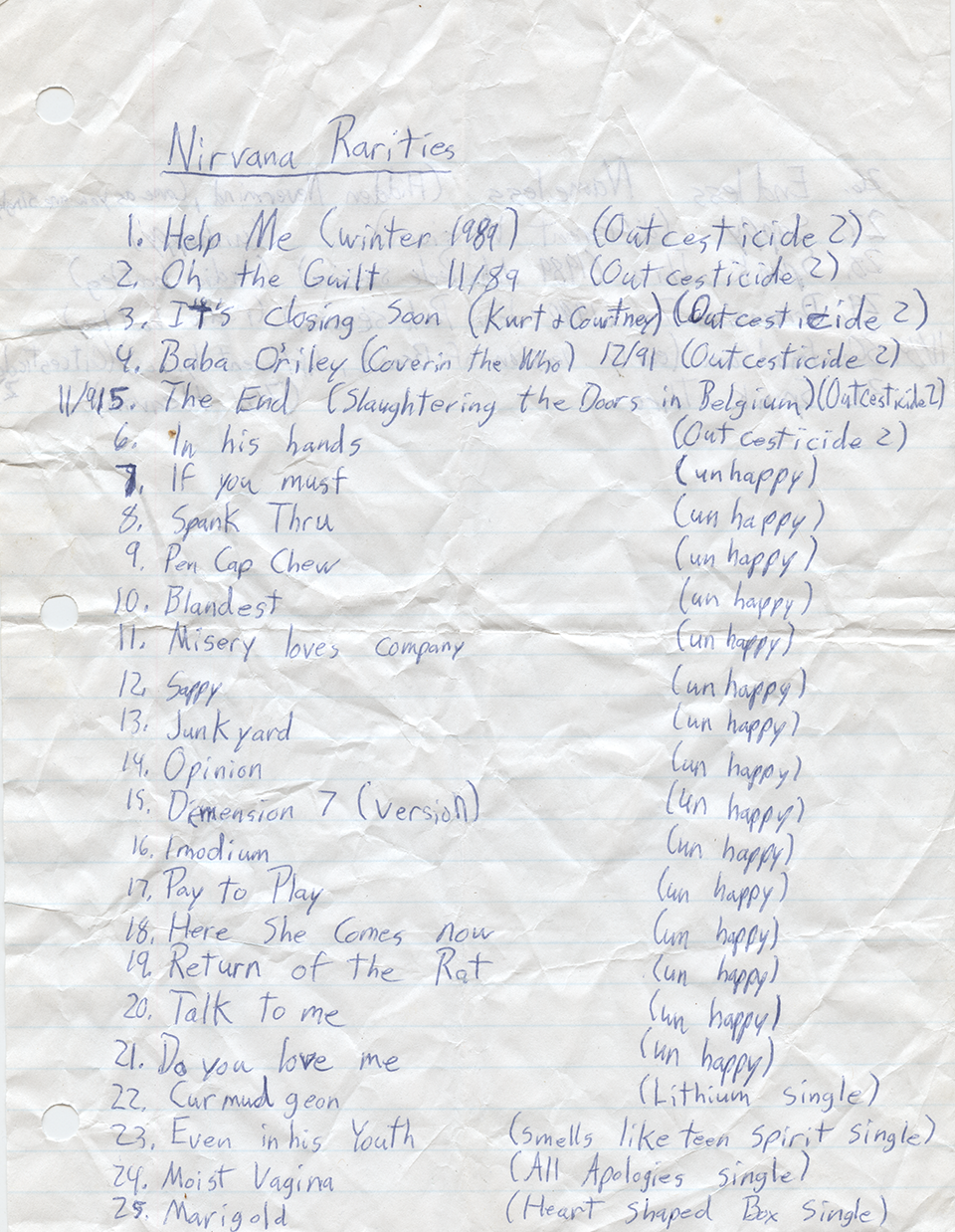
If my mom found the mixtapes, she’d have taken them from me. I was only able to listen to them while away from the house—on a boxy, durable, black cassette player that clipped onto the top of my jeans.
I’d rollerblade the same loop around the nearby hospital’s parking, keeping pace to their covers of songs from the Velvet Underground, Wipers, Kiss, The Who, Vaselines, and Shocking Blue. All of which I mistook for originals. I’d blast Bleach through my headphones while biking back-and-forth between the subdivision’s borders, stopping on the side of the quiet roads every forty-five minutes to flip the tape. The cassette player poked my gut in rhythm with my leg.
I didn’t have much experience listening to music; I still don’t feel like I do. My mom bought into the satanic panic, and believed rock music (or any music she didn’t personally like) would turn me into a blood-drinking thrill-killer. So, for most of my adolescence, I fell asleep listening to my parents’ old tapes: a two-cassette Time Life Treasury of Christmas Songs, the soundtrack to Stand By Me, or the soundtrack to The Big Chill (a movie I still haven’t seen).
In retrospect, my introduction to sad songs was never embedded in the music. Rather, it was embedded in the situation surrounding the act of listening. “All I Want for Christmas is my Two Front Teeth” isn’t a sad song. But try listening to it in July, using it to drown out the noise from the rest of the house so you can relax enough to fall asleep.
I hoped, if I could understand Nirvana, I’d be able to connect with him more deeply. Or to at least be more like him, and to be less like me.
Then, it happened. Listening to Bleach for the umpteenth time, alone, in a culvert a mile from my house, sweaty, tired, and dreading the return home, something finally clicked. The feedback stopped sounding discordant, started to sound like punctuation. The mood wasn’t in the content of the lyrics, but in their delivery. The songs were angry and frustrated and playful and mean; things that I wasn’t allowed to express at home. Suddenly, I heard the music of it.
The album had stopped sounding foreign, and suddenly became incredibly comforting. My frustration, my sadness, all my difficulty living—while listening, those things didn’t feel like something I had to be embarrassed about, or to even acknowledge in thought. It sounded like it fit my life. For as long as the music continued, I could live in the emotion of the song.
That’s how I listened to Elliott Smith; over and over again. Eventually, I stopped listening for what I wanted to hear and started paying attention to what was there, in the song. I wish I’d asked you about when you first heard Smith, who introduced you to his music, why you kept listening. Even if the answer was as simple as “I liked his performance at the Oscars,” it’d have been a satisfying one.
Listening to “Between the Bars” in 2026. I find myself aligned with both the speaker and with the addressed in the same way that someone might feel as they break a promise to themselves.
The album that “Between the Bars” appears on takes its name from Kierkegaard’s philosophical novel Either/Or. After we stopped talking, I tried to make sense of things using that stupid binary mode of thought. Either you were lying or you were honest. Either it you were manipulating me or you were always sincere. Either we were destructive for each other or we were cared for each other. But it’s not either/or, it’s all sometimes, sometimes, sometimes.
I spent most of October and November hanging out at bars in Minneapolis, making my way through Kierkegaard’s book and drinking whatever seemed to match the weather. When I hit a wall, I’d switch to memorizing poems.
You’ve probably read it; I feel the need to describe it anyway. The bulk of Either/Or focuses on correspondence between two characters, A and B, as they try to convince the other of the righteousness of their individual value systems. In my favorite section, A, a seducer living a life dedicated solely to himself and his desires, compares the effect of Mozart’s Don Giovanni with other versions of art based on Don Juan.
A praises Mozart’s Don Giovanni as a product of sensuality, wavering between idea and embodiment, rather than as a manipulative force. Don Giovanni works, according to A, because his passion is tied to the audience’s experience of the music itself. Music is sensual; experienced in a way removed from description. Don Giovanni desires in the same way that we might listen to a song.
A explains:
In continuing to call Don Giovanni a seducer, therefore, I am not at all imagining him slyly drafting his plans, craftily calculating the effect of his intrigues. His deception is due to the genius of sensuality, whose incarnation it is as though he was. He lacks shrewd circumspection; his life is effervescent like the wine with which he fortifies himself, his life is excited like the tones which accompany his joyous feast, he is always triumphant. He needs no preparation, no plan, no time, for he is always ready, the force is always in him and the desire too, and only when he desires is he in his proper element...The spoken word is no part of him, for that would straightaway make him a reflective individual.
Yet, A’s section concludes with an account of a man who, unlike Don Giovanni, views seduction as conquest. The man is a liar and a manipulator. He plots and plans, and his goal seems less sensual than it is an exercise in control.
B, a retired judge, makes the same error in judgment. After making a thorough case for the value of duty and marriage, B quotes a sermon that highlights duty’s biggest flaw: it’s inherited. It has no inherently positive or negative value. The dutiful husband and the dutiful ICE agent can praise themselves for having done what they felt was expected of them without ever needing to question the nature of those expectations.
In both the song “Between the Bars” and Kierkegaard’s Either/Or, the audience is presented with a false binary: that if one thing isn’t true, the other must be. But neither Kierkegaard nor Smith promote those binaries. Smith’s speaker offers a cessation to pain, at the cost of dependency: “either you let me save you, or you will always suffer.” Kierkegaard’s A and B hold onto their beliefs so righteously that they can’t even recognize when they’re contradicting themselves.
The subtext of “Between the Bars” are its missing options: instead of being erased, or needing to be saved by someone else, the “you” could try to heal, and grow, and to fix the problems they might have. As Smith said in a 1998 interview with The Big Takeover, “The purpose of unhappiness is to point your life in a better direction, where you make things better. Otherwise, there would be no point in being unhappy, [the world] would just be a place that is brutal.”
Language has never felt adequate to me. It’s best at communicating superficial things; concrete details. It points. But when it comes to conveying experience, the only place to point is towards the empty sky. I point to my love and someone mistakes it for a heart. I point to my sadness and someone mistakes it for theirs. That kind of thing.
I kept the two letters you sent. I still reread them sometimes: the one with the photos of Duino, and the one apologizing, in which you told me “You know what it is to be overwhelmed and push people away.” You weren’t talking about dancing, not literally, when you wrote that. But it makes me think of dancing—of how dancers lead each other, and how they follow.
The year that Elliott Smith released his first album was the same year I learned to waltz. My mom signed me up for cotillion at the last minute, and an hour before the first lesson, my mom took me to a Burlington Coat Factory to get a suit. The only one they had in my size was made of black corduroy. It swished as I moved my arms. It swished as I moved my legs. In regular clothes, I was neurotically anxious and self-conscious. The suit announced my every movement, and intensified those feelings dramatically.
The first dance they taught us was the waltz. The chaperone they paired me with complimented my suit as she took my hand, using the word “different” in a way that sounded sincere, and made something inside of me melt, just a little.
The box step made sense; I liked it the way I like drinking. Following the steps, I didn’t have to feel worried about taking up space or being in the way of someone. I had permission to move through the world without worrying that I was doing something wrong.
I moved dutifully, with the sole purpose of moving for the sake of moving. As long as the song continued, as long as I followed the steps, everything was going to be ok.
Swish, swish.
Sad songs offer that kind of space to move through feelings, unencumbered by the details surrounding them. We never danced together, though we both wanted to. An extended hospital stay in 2011 destroyed my mobility. For most of the time we knew each other, I had to consciously think about each step or risk rolling my ankle, or hyperflexing my knee, or tripping over my own foot. Watching you dance made me feel as if I were moving too.
“Between the Bars” gives me a similar sense of movement and intimacy where, as long as the song continues, I can spin, and I can feel things that contradict each other without needing to reconcile them. Repeating the same steps, the room revolving around me as we were its center. I don’t know if we were good for each other, or if our connection ran deeper than shared traumas and an inability to deal with them.
There are songs about pushing people away, and songs about keeping them close. “Between the Bars” is both. It reminds us that it can be good to push people away, dangerous to be held closely. That both can sound as appealing as the other.
After thirteen years of listening to “Between the Bars,” I am thankful that I take no message from it. It has no meaning. It’s just one person talking at another one, feigning intimacy. I listen and feel.
It opens a space where I can waltz through feelings without needing to make sense of them. Where, in the moment, I feel close to the people I’ve pushed away, and still connected to the ones who pushed me away. What makes a song sad is that you can’t vanish into it, while it promises you that you can.
On the back of the photo of the other stone lion, you wrote:
Lions in real life
are like royalty
in real life. Symbols.
faces are precious.
this one was more beautiful.
I see it.
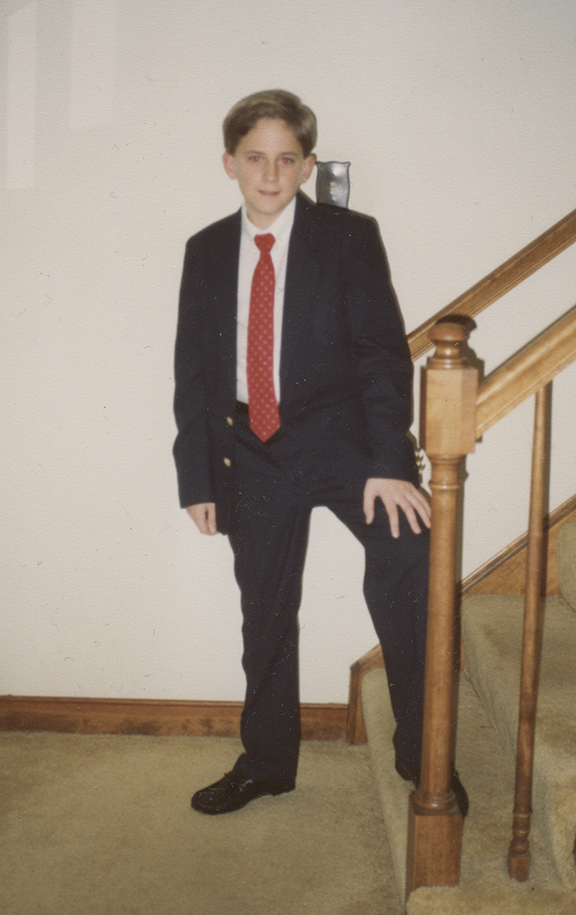
Jamison Crabtree lives in Saltville, Virginia.