
first round game
(9) Neutral Milk Hotel “the king of carrot flowers pt. 1”
dug up
(8) Annie Lennox, “no more i love you’s”
164-61
and will play on in the second round
Read the essays, listen to the songs, and vote. Winner is the song/essay with the most votes at the end of the game. If there is a tie, we will play a one-hour overtime (and repeat until we have a winner). Polls close @ 9am Arizona time on 3/2/26.
“DO BE DO BE DO DO DO, OH”: ron hogan on “no more i love you’s”
I have a confession: Annie Lennox’s “No More I Love You’s” is not “my” version of the song.
I remember when it came out in the spring of 1995 and I first heard it on the radio, which would probably have been KROQ in Los Angeles. It’s possible that it was on KCRW, the Santa Monica NPR station which had famously eclectic music programming, but thirty years on, who can say? What I can be certain about is that my reaction to hearing it was along the lines of “she’s covering The Lover Speaks?!?”
The Lover Speaks was a New Wave band who released one album in 1986, also called The Lover Speaks, from which “No More I Love You’s” was the first, and as far as I know only, single. It’s most likely that I heard it that spring on WFNX, a Boston-based station connected to the city’s alt-weekly, the Boston Phoenix. It was exactly the sort of artistically brilliant but commercially marginal music WFNX loved to bring over from England.
A demo tape of the song had made its way to Dave Stewart, Lennox’s partner in Eurythmics, who became the band’s music publisher. At some point, the two bands toured together, and that would seem to be how Lennox became familiar with it. Eventually, she decided to add it to Medusa, the album of covers she put out in 1995, and explained her decision in an essay for a British newspaper:
“It made a mild murmur in the charts, but I don't think it ever really became a hit. There are quite a few songs floating around which should have touched the consciousness of the nation—they should have made their mark, and this is one of them. I thought, well, I might be sticking my neck out to do this, but I really wanted to give it another chance because it's a magnificent song. The lyrics are extraordinary, poetic and abstract—the perfect sort of vehicle for me.”
No argument from me there—but I have to admit that the Lennox version leaves me cold. It’s very polished; as The Lover Speaks frontman David Freeman would write in 2015, expressing gratitude for “[Lennox] has the ability to be camp and soulful.” Her rendition of the song is indeed very soulful; the video is indeed very camp, and reminded me why she was one of my first adolescent crushes when Eurythmics hit the scene in ’83. (Why, yes, I did turn out to be queer, but I didn’t figure that out until my twenties. Long story.) But it’s somehow too smooth. I prefer the jangly sound of the original version, which I never quite realized at the time was a nearly pitch-perfect imitation of Cocteau Twins, right down to June Miles-Kingston’s backing vocals.
(“I don’t find myself bouncing home whistling buttonhole songs to make me cry”? That’s exactly the kind of nonsense lyric you’d find on a mid-80s Cocteau Twins song, if they’d decided to sing in English that day instead of launching into glossolalia mode.)
If I had actually retained any of the Roland Barthes I’d read in college and grad school, I could probably tell you something about the significance of Lennox changing the original “A language is leaving me exiled” line in the chorus to “The language is leaving me in silence.” Every song on The Lover Speaks was a reference to Barthes, you see, although that flew completely over my high school sophomore head in 1986, and I don’t think Annie Lennox said anything about it in 1995, either. But I barely know enough to be able to namecheck Barthes, so all I can tell you is I like the tortured goth way that Freeman booms “exiled” as opposed to Lennox’s seductive “in silence.”
Because, deep down, I’m really more of an emotionally tortured 1980s adolescent (though I was never particularly goth) at heart. And in all honesty I was much sadder in 1986 than I was in 1995. Not that I was all that happy in 1995; I was living alone in a crappy one-bedroom near the border of Los Angeles and Santa Monica, about a ten-minute walk from the site of the Nicole Brown Simpson/Ron Goldman murders, and I did in fact have to walk past the house two or three nights a week after I got off work at a bookstore in Brentwood, because I didn’t have a car. But at least I wasn’t in high school anymore. At least I’d been able to box up that socially ill-equipped section of my life, and could look forward to never having to revisit it. (My family, yes. Just about everybody else, not so much.)
In 1986, I was desperate to get away from my life, couldn’t wait to graduate from high school and go to college as far away from my hometown as possible. (I made it nearly halfway across the continent, which turned out to be far enough.) I never bought The Lover Speaks, but I’d managed to tape “No More I Love You’s” off the radio, so I’m sure it was a background presence during those last years of high school, reinforcing my angstful self-image through the headphones of my Walkman. I don’t remember listening to it much after college; by then I’d gravitated more towards other bands, other types of music.
By 1995, I still wasn’t satisfied with where I was, but I had a better idea of the trajectory I was on, and I’d gotten more patient, more confident that there was some sort of payoff ahead. I never saw the video Annie Lennox made for “No More I Love You’s” then; I did have a television, but I’d dropped cable, so no MTV. If I had seen it in my mid-twenties, I can’t say that its queer cabaret world would have had much appeal for me then—still hadn’t quite figured out my deal—though it feels much more alluring to me now, a sort of hyper-baroque version of my favorite downtown burlesque shows. (Except for that part during the bridge, where they dress the wealthy patrons up as infants, and Lennox inserts that weird childlike monologue, which is not in the original.)
Should I have been sadder about being stalled in my mid-twenties? Maybe. But things got better soon enough. I’d learned how to code—HTML, not much, but enough to launch a rudimentary website, which was enough to get me some freelance dotcom work, which eventually got me to Seattle, where the combination of a full-time salary and a genuinely walkable city did as much for my self-esteem as they did for my material condition, plus I was finally able to sort out the exact parameters on the queerness thing (to the extent that when I met the woman who eventually became my wife, she was positive that I was gay). By the time the job ended two years later, I was finally ready to come back east—not all the way home, but New York City—and I genuinely liked myself, maybe a little too much, some people might say, and they wouldn’t be entirely wrong, but therapy eventually sorted that out as well.
So I look at 1986 and 1995 as places I needed to be to get to where I am today. As I was preparing to write this essay, I added both versions of “No More I Love You’s” to my iPhone. I like the Annie Lennox Essentials playlist well enough as a soundtrack for subway rides, and the original version of the song has joined the ranks of other one-near-hit wonders from the ‘80s, like C Cat Trance’s “Shake the Mind” or the Comsat Angels’ “Independence Day,” a quick burst of nostalgia to make a trip to the corner market a little more fun. If I let it, listening to those songs might feel a little bit like biting into a madeleine, unleashing a flood of teenage memories. But usually I’ve got enough adult things to occupy my thoughts, and that’s fine by me.
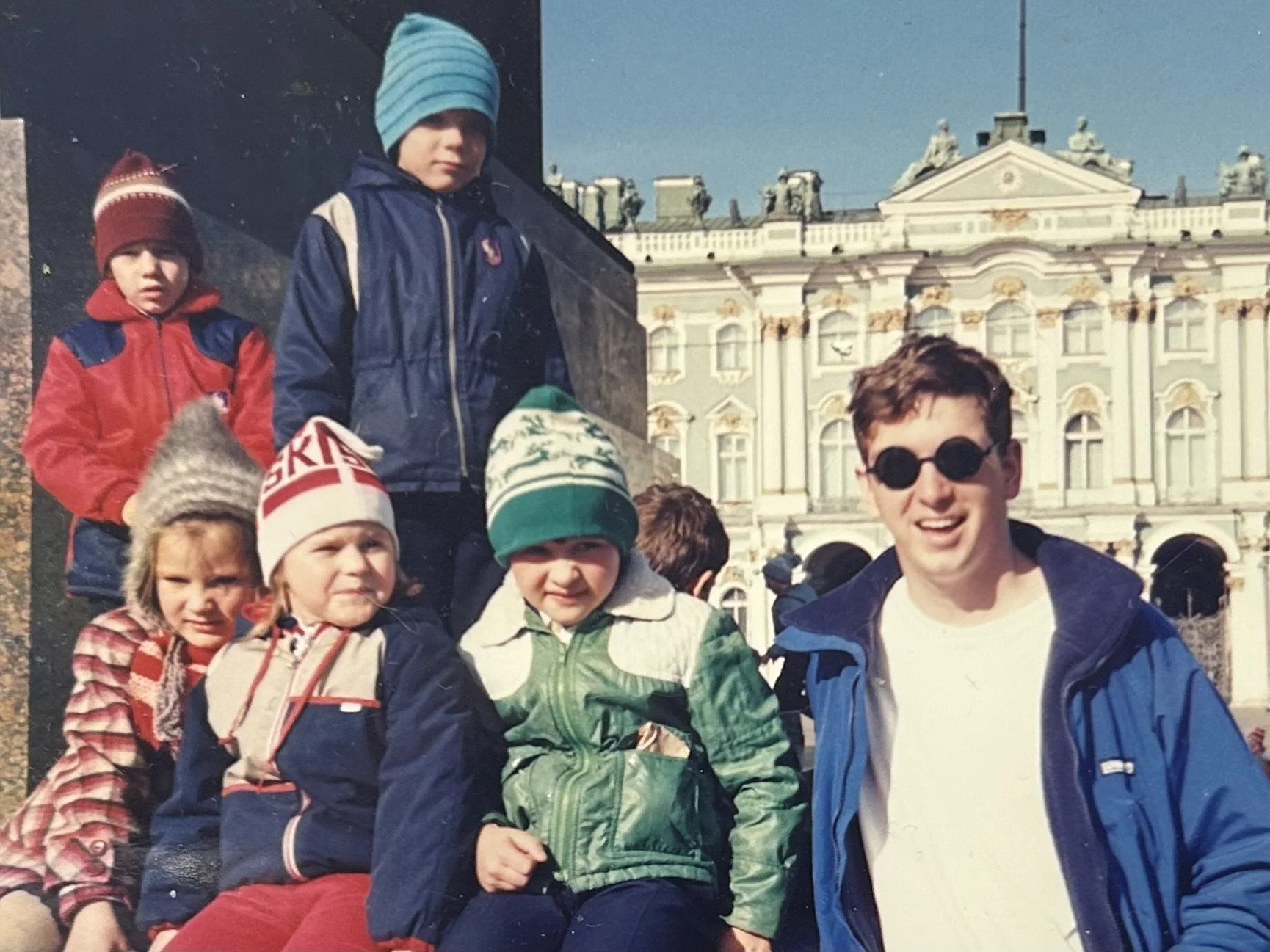
Ron Hogan helped create the literary Internet by launching a website called Beatrice in 1995, which could be why the Annie Lennox version of “No More I Love You’s,” great as it is, didn’t land with him as firmly as it could have. His most recent book, Our Endless and Proper Work, came out from Belt Publishing in the summer of 2021. You can find him online at @ronhogan.bksy.social.
It Can’t Ever Burn Down: aaron wolfson on “The King of Carrot Flowers Pt. One”
“I don’t necessarily think everyday life is reality, anyway. But there’s only so much you can say about that without sounding like a cheeseball.” —Jeff Mangum, 1998
I’m imagining our stuffed animals—the Guys, we call them—engulfed in flames.
I focus on the ringleader of the Guys: a little Totoro the size and shape of a Pop-A-Shot basketball. His head melds seamlessly into his blobby body. Protruding straight up from there, two short, ovally ears. At his sides, a pair of poofy arms. He is mostly grey, with a wide white belly. He has penetrating eyes, a black button nose, and no mouth. He’s the one we take on all our trips; he’s been to LA and New Jersey and Santa Fe and Florida and Prague. We play-act with him, pretending he has a mind of his own; he participates in our difficult conversations and in our leisurely Sunday mornings in bed.
I become aware I’m actually practicing an ancient Stoic exercise called negative visualization. Also known as “picturing the worst.” The idea is as it sounds: think of the worst thing you can imagine happening. In life, the worst thing could happen at any time; it goes a little easier, says the theory, if one’s prepared.
The conflagration exists only in my mind, but it’s viscerally painful. I’m blitzed with fear, watching the flames consume Totoro’s “fur,” watching his cute face blacken and disappear.
I progress no further in the visualization; it feels like enough. I don’t take the next logical step. I do not imagine anything bad happening to the person lying next to me in bed: my wife Ashley.
This isn’t a regular habit of mine, though I do often feel, especially at the end of the night, vaguely unready. Have I ever considered what I’d grab first if the house was on fire? What could I stand least to lose?
I’ve always worried I’m too sentimental. I definitely worry my sentimentality for the Guys is holding me back somehow. Is this childish? Naive? Overly romantic? I worry my affection for these fluffballs—my reliance on them—makes me irrational and deluded. Not real enough to handle real life. Is that why my psyche is apparently trying to destroy them?
I don’t judge myself this harshly for employing other modes of imagination. Society, too—the respectable part, at least—prizes certain flights of fancy. There is a band I’ve loved most of my life called Neutral Milk Hotel. They wrote an album dripping with sentimentality and invention and dread called In the Aeroplane Over the Sea, whose opening song, “The King of Carrot Flowers Pt. One,” is nothing if not exaggeratedly tender. With this album, the band seized the hearts of an entire artistic generation forever. They likely would’ve catapulted to mainstream success, if their leader, Jeff Mangum, hadn’t vanished from the scene overnight.
Tenderness, in both senses, overflows in Mangum’s lyrics. Aeroplane’s songs are suffused with surreal, incendiary images—“pianos filled with flames, on empty rings around the sun”—like romps through infinite meadows of giant mutant ornamental grasses and carnivorous bird-mammal-worm hybrids. I suspect Mangum can’t help his sentimentality; this is how the muse comes to him. Nor can he tolerate repressing his knowledge of darkness. Rather than disavow one or the other, he gives us the whole of both: music with boundless originality, welling up and out from every direction, refusing to neglect beauty or shrink from terror.
I know stuffed animals aren’t sentient. If the choice was between saving the Guys from the fire, and saving myself, I’d let them burn. Totoro, yes, and Cooper, the one-eyed alligator, and Booky the rabbit, and Squiggles the frog, and Gorilla of my Dreams, who’s been Ashley’s since age four. Right? Wouldn’t I? I would miss them so much. I would feel like… like it’s harder to feel. It’s like they express something I can’t express in any other way. “How strange it is to be anything at all.”
When Ashley or I travel solo, Totoro tags along. We text a photo of him from the road: at a pizza shop; tucked into the hotel room covers; wedged into the passenger seat between a notebook and a box of Lorna Doones. He stands in for the absent other, keeping us in tune, as if he emits a frequency, vibrating across the physical distance, that only she and I can receive. The Guys represent us. Somehow they are us. Maybe they’re the parts of us too close to the source to show each other directly.
All people have an unbridgeable gap between them. Even two people in love. Being people, we try to bridge it anyway. Because people are lonely, and creative, and restless, and we just can’t help it.
I first heard Neutral Milk Hotel during sophomore year at Wash U in St. Louis, in 2003: the beginning of my Pitchfork era. Elementary school was Top 40, middle school was pop punk, high school was radio-friendly alternative, and freshman year was catching up on the classics (The Beatles, Led Zeppelin) and riding the wave of the garage rock revival (I preferred The White Stripes to The Strokes, but I hated “Fell in Love With a Girl”).
Pitchfork, the online magazine, leveraged the still-democratic digital media environment to become an ascendent tastemaker, laying out a map of quality independent, underground music in all its bewildering glory. Diving in, I felt exhilarated. The common thread connecting my favorite music to that point: it was a little safe. I was more than a little safe myself, cautious to a fault. I never volunteered first for anything. I’d never dated anyone, endlessly fantasizing instead about whoever was subject to my current infatuation. Plagued by wicked anxiety—tightness in my stomach, clenching of my jaw and neck, flushes of heat filling my chest—I intellectualized all other feelings. I was cheerful on the surface, in easy situations; underneath, I carried a heavy, wistful melancholy I had no idea how to express.
My first year away from home pried me open just enough. I made a few close friends, fellow obsessives who’d rather get high in the dorm on Friday nights—watching Family Guy, listening to Radiohead, playing chess in the hallway and Tony Hawk on the Dreamcast—than get hammered on boxed wine and Natty Light at the frats. After getting dumped by my prospective sophomore roommates—and crying for days—I lucked into a suite with an eclectic crew of well-liked guys from my floor who needed to fill an extra spot, who I felt basically took me on as a charity case.
Over the summer, back in Omaha, I diagnosed myself with social anxiety disorder, and started an SSRI. Returning to campus emboldened, I gradually broke through my fear of rejection, proactively engaging my suitemates, and anyone I met besides—with the exception of every girl I ever liked, of whom I stayed scared shitless as a rule.
What I’m telling you is, I was more than ready for 90s indie rock.
That fall, a new piece of software made the rounds: Direct Connect, which allowed anyone on the university’s network to offer up their MP3s to anyone else for their downloading pleasure. It was a perfect storm: newfound social confidence, sophisticated music nerds all around, Pitchfork’s “Top 100 Albums of the 1990s”—plus the rest of its seemingly bottomless well of news and reviews—and the ability to immediately check out almost any band I ran across.
I got smitten by three bands who each reached their apex in the mid- to late 90s. With Belle & Sebastian and Pavement, it was a natural marriage. Never could have gone any other way. Neutral Milk Hotel, far less so. I knew they were “weird.” I’d listened to a lot of stuff that was a little offbeat from what I’d heard before. I was getting used to it, and gaining assurance generally. I was by then a PBR-drinking, clove cigarette-smoking, used paperback-collecting, budding hipster. In 2003, Neutral Milk Hotel was still certifiably out-there. But their Pitchfork imprimatur deified them in my eyes, and it was good to have permission. (Aeroplane was rated an 8.7 at the time. Two years later they raised it to a 10.0.)
There’s no way I could have been prepared for In the Aeroplane Over the Sea. It’s as singular as the day it dropped. Accordians, organs, singing saws, horns nobody’s ever heard of, multisyllabic instruments probably invented on the spot by Julian Koster to play five notes and never used again. Jeff Mangum’s vocal onslaught: stark, plaintive, stately, howling, straining, haunted. Lyrics with semen-stained mountaintops, ghosts, two-headed boys, Jesus Christ, and Anne Frank.
I don’t remember what I thought of “The King of Carrot Flowers Pt. One” on the first listen. (The title is written various ways in various places. Here I’m copying Holly Brickley’s spelling from Deep Cuts, because that’s good company.) The actual memory has receded over the years. Only the reverberations remain. I know for sure my initial experience of Aeroplane was all of a piece; one song was inextricable from another, as if the entire album had sublimated into an undifferentiated diffusion of neuroactivity, the way pantheon-level musical encounters tend to feel when you’re 19 years old.
With more listens, I succumbed to the romance, these two kids finding each other, becoming each other’s worlds. Such a triumphant-sounding vision, with guitar and accordion and something called a zanzithophone. A vision of the precise thing which I, a never-been-kissed college boy, wanted more than anything else. I zeroed in on the intimate scenes of young love and sex and took the rest—the ill-fated relationship of the narrator’s parents, the inauspicious associations of the tumbling tower and the rattlesnakes—for colorful scene-setting, or as the kind of poetics—irreducible to any specific meaning—frequently found in a Jeff Mangum verse.
You can find all manner of interpretations and word-by-word parsings of the song online, in books, in documentaries, and probably in real time, in college dorms and parents’ basements to this day, though the ways in which kids discover music have changed irrevocably. I hope there are still misfits and sensitive rebels out there putting on In the Aeroplane Over the Sea for the first time, mesmerized and searching, hearing that acoustic guitar, hearing that klaxon of a voice sing “When you were young…”
The only thing I can find Mangum ever saying publicly about “The King of Carrot Flowers Pt. One” is that it’s a true story.
It’s not as though I didn’t register the lines about drinking and fork-stabbing and dreaming of death. They didn’t resonate. Life was pretty restrained. My parents weren’t alcoholics; they weren’t violent. They didn’t let me watch PG-13 movies until I was literally 13. I can count on one hand the number of times I did my own laundry at home; when I went off to school, my parents paid a service to do it for me. I played by myself in my room for hours and hours and hours, not because I needed to hide, but because I could take calmness for granted.
You can’t fully relate to a song about loss of innocence when you haven’t yet lost it yourself.
Totoro, of course, comes from the 1988 Hayao Miyazaki film My Neighbor Totoro. He’s a forest spirit, an inscrutable protector, albeit a mildly threatening-looking one at first appearance. He appears to a pair of sisters, Satsuki and Mei, as they settle into a new house in the woods with their father. The girls are missing their mom, who’s in the hospital nearby, recovering from a serious ailment. They’re in limbo, on an invisible bridge between the world of children and a strange, formless, grown-up world of ambiguity and disquiet.
It’s a world of loss; it’s also a world where everything is spiritually alive. Totoro is sturdy, making measured, decisive movements. A benevolent, eerie presence, who affirms: there is more out here than what you have seen. It’s scary. But it’s OK, because you won’t be stranded, and you won’t be alone. When the girls’ mother postpones her visit home due to a setback with her illness, four-year-old Mei gets lost trying to reach her. It’s Totoro who answers Satsuki’s plea for help and hurries to the rescue. The film is restive but warm, and unbearably cute. You can’t help but love Totoro. You can’t help but believe.
Ashley introduced me to My Neighbor Totoro pretty soon after we met, in 2008, in Omaha. She was a 20-year-old Creighton pharmacy student from Minneapolis, and I was 24, going back to grad school for computer science. We bonded over the cuteness of Totoro. We bonded over cute things of all kinds: birds, Animal Crossing, stickers, pareidolia, Seth Rogen movies. We developed a cutesy way of speaking to each other, used only in private. We had cutesy nicknames for each other. We both grew up with pet bunnies, so Ashley and I would rub each other’s heads and shoulders and thighs using our chins, the way rabbits claim their territory. I bought her a stuffed rabbit she named Booky after Booker Woodfox, the star of the Creighton basketball team.
It was my first relationship of any kind. Ashley’s first since high school. My boundaries were non-existent; I wanted to hang out at her place on campus all the time. When she’d kick me out, because she needed to study, I’d put up a fight, always lose it, then slink back to my room in some guy’s basement I found on Craigslist. Early on, I tried to tease Ashley the way my guy friends teased me, by mock insulting her, but instead of firing back, or blowing me off, her face would fall into a frown, she’d go quiet, and I quickly stopped saying anything critical at all.
I was so desperate for intimacy for so long, I spent so much time imagining it and so little time living it, that when it finally arrived, my body couldn’t handle it. The first time we tried to have sex, I got so anxious I had to run to the bathroom to throw up. I’d learned to tolerate those exhausting sensations, like they were unpleasant housemates who always paid the bills on time: the tightness in my stomach, the clenching of my jaw and neck, the flush of heat filling my chest. Would they ever end? I was so enamored with Ashley. We’d already shared so much. How could I be so afraid
We were patient with each other. Ashley didn’t shame me for my physical inhibitions. She encouraged me, allowing us to go at my pace. When I started getting too handsy in public, Ashley had no trouble instructing me to cut it out.
We enjoyed each other, needed each other, needed to enjoy and share all the cuteness and whimsy we saw all around us, and found within ourselves. We built our tower tumbling through the trees.
We moved in together. We got married.
We were pretty much happy.
One morning, lying in bed together, Ashley reached for Totoro, in his customary spot between our pillows. I watched him wobble toward me, climb onto my stomach, and peer into my face.
“... Maars?”
This was one of her nicknames for me, an evolution of “my Aaron.”
Totoro spoke to me in a pregnant version of Ashley’s voice, hesitant and weighty, but gentle. I wish I could remember the rest of what he (she) said. I see the setting clearly. But the audio track cuts out; I can intuit her tone, but the words are somehow missing. Whatever it was, Ashley’d been sitting on it. She couldn’t find any other way to broach it with me, except through Totoro.
It was in our condo in Chicago, which makes it 2019 at the earliest: after the five years Ashley worked overnights as a retail pharmacist in Omaha and Council Bluffs, Iowa; after she landed a one-year residency at the specialty Walgreens in Northwestern Hospital; after she leased, sight unseen, a tiny, drab Ravenswood apartment with a rent payment higher than the mortgage on our three-bed, two-bath house in Omaha; after I spent the year traveling back and forth while Ashley worked 60-hour weeks; after Walgreens made her a manager at a different Chicago specialty site before she even finished her program; after I packed up and sold the Omaha house on my own; after Ashley’s dad died of a heart attack; after we drove to Minnesota and spent two weeks sorting through the mess he left; after we spent another two years in probate for his estate.
Was it during the pandemic, when she had to keep going to the pharmacy, logging extra hours to boot, while I and everyone else in our friend group worked safely from home? Was it about her feelings of isolation after she finally took a corporate work-from-home job? Was it about finding a new couples therapist?
It could have just as easily been any of the other hundreds of concerns married people stumble into, the kind of concern that winds up on the cutting room floor of life’s highlight reel, the kind that usually turns out to be not much of anything, unless it’s the kind that comes roaring back at you years later out of the blue.
The harder I try to remember, the further it seems to slip away.
Kafka said a book must be the axe for the frozen sea within us. Far be it from me to modify Kafka. Can I just add one little thing? For me, music does the same, and in a much shorter time.
Music is easy access now. It’s wonderful to partake in the full majesty of a century-plus of human sonic ingenuity, all from a search bar in an app on my phone. (Less wonderful for the artists making thousandths of a penny per stream.) The same phenomenon, however, sets music up to get taken for granted, to fade increasingly into life’s background. I’ve listened to hundreds of songs while writing this; many of them came and went with zero conscious awareness on my part. Even great songs, songs I love. It’s partly what I’m aiming for, using music as a creative aid, but still. Very few songs will jerk me into the present moment every time without fail.
“The King of Carrot Flowers Pt. One” is one of them. It’s not like the sounds it makes when it comes on are all that discordant with whatever was on previously, especially when compared with the rest of the wild stuff on Aeroplane. It’s really as simple as an opening could be. Strumming the acoustic guitar. Exceedingly standard; frequently boring. In this case it’s distinctive enough to be unmistakable.
I’m not a musician, let alone a guitar guy, so here’s what I can tell you. For a man who loves his noisescapes and his lo-fi recordings, Jeff Mangum (and producer Robert Schneider; never shortchange him!) figured out how to produce the cleanest, clearest acoustic guitar sound I’ve ever heard.
As soon as I hear that riff, it becomes the one thing in the world. It sounds like it must be in perfect tune. It sounds like four guitars playing at once. It is loud and ringing and revelatory, like a church bell. Like a religious vision.
It creates a threshold. It’s purifying, wiping away almost everything which came before. Like a fire. Like a death.
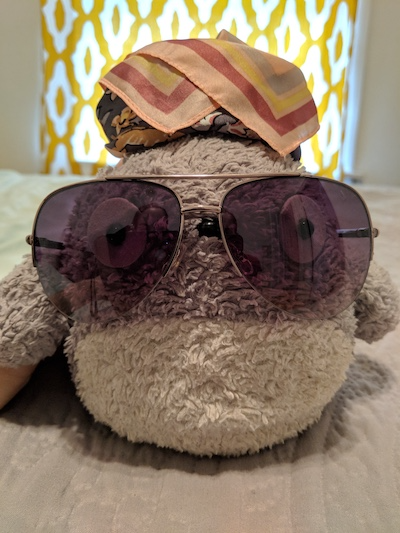
The Totoro, as styled by Ashley; July 2018
Ashley died by suicide on November 11, 2023. She was 35 years old.
What happens after your partner dies is, you can’t escape them. They’re everywhere you look; everything reminds you of them.
The one thing you want most is to have them back. Failing that, the second thing you want most is to have a moment, one moment, of not having to think about them.
Your brain begins a process of shutting out all your memories of them. All of them, with equal and extreme prejudice: good and bad, happy and sad, extraordinary and mundane. This happens automatically. It’s not ideal, but it’s fine. It needs to happen so you can survive the first weeks, the first months.
And then… and then. Your brain incrementally accustoms itself to reality: they are gone. Not coming back. That’s when—at some point—you don't even notice—their spirit starts to fade away.
When I realized her spirit was fading away, I started looking for her everywhere.
I found her in music. Any song, every song, was about her, or about me and her, or about me without her, until proven otherwise. When a song did not prove itself otherwise, I added it to a Spotify playlist. I didn’t listen to the playlist all the time, or even very often. I couldn’t allow those songs to become background. In my tryingest times, when I needed them the most, they were there.
Something compelled me to listen to “The King of Carrot Flowers Pt. One.” I don’t remember what it was; or maybe I heard it randomly. It was September 2, 2024. Spotify knows all; that’s the date I added it to my playlist. I’m pretty sure I added it before the song was even over. I bet you I added it as soon as I heard that acoustic guitar.
It’s incredible, the lives a song can have. I’ve known “The King of Carrot Flowers Pt. One” for over 20 years. (Truth is, I went most of those years hardly listening to Neutral Milk Hotel at all.) According to my last.fm charts, I listened to it 37 times before Ashley died. The real number is probably dozens higher; the data only goes back to 2005. It certainly doesn’t include the night in 20-year-old Ashley’s dorm suite, when three of her high school friends drove down from Minneapolis and two of us stayed up super late listening to In the Aeroplane Over the Sea on the living room floor, drunkenly singing along, hitting like 3% of the notes.
Through all that time, I never perceived the song to be about us. And now it is. Ashley’s that “you.” My King of Carrot Flowers. She’s also the dad…
It’s pretty devastating—and cute, too, I think. Ashley was never a huge Neutral Milk Hotel fan. But she did appreciate black humor, and she’d get a kick out of it.
I know people who don’t care for earnest music. Neutral Milk Hotel is maybe not for them. In the Aeroplane Over the Sea is fun, it’s whimsical, it’s bizarre, and it’s about as earnest as they come.
I said the guitar in “The King of Carrot Flowers Pt. One” was like a religious vision. I could characterize my reaction to it as a form of ecstasy, a word we once used to describe someone in a trance, a person “beside oneself.” Ecstasy is “an extraordinary elevation of the spirit, as when the soul, unconscious of sensible objects, is supposed to contemplate heavenly mysteries.” (Webster’s Dictionary, 1913.)
This sense lives on in filmmaker Werner Herzog’s notion of ecstatic truth, in which certain not-quite-reality-based artistic techniques produce a great amount of explanatory power and meaning, surpassing anything gained through a narrower dependence on the easily quantifiable. For him, facts are “a superficial truth, the truth of accountants.” Other things feel truer than true. They get at something underneath or beyond our experience, something we can’t comprehensively describe with any language we have available. Ecstatic truth is “mysterious and elusive, and can only be reached through fabrication, imagination, and stylization.”
In his book Endless Endless, a history of the Elephant 6 recording collective which spawned Neutral Milk Hotel, Adam Clair attributes part of the Aeroplane’s ongoing adoration to the fact that nobody can explain why they love it so much. Instead they insist everyone else listen to it for themselves.
In the Aeroplane Over the Sea is like a religious vision in a second way. Clair suggests one reason the album inspires such deep devotion is its “negative space, created by impossibly abstract lyrics, unfamiliar instrumentation, and other bits of psychedelic mystique.”
“The vast negative space creates a blankness onto which the listener projects their deepest anxieties and scars,” Clair writes. “The album becomes an anthem for the damaged, agnostic toward the particulars of a given listener’s trauma… No matter the intensity of your troubles, Aeroplane can refract them through its many facets into something jarring, comforting, terrifying, and enlightening.”
Not to be too precious about it, but, ahem, doesn’t that kinda sound like god? What is religious belief, if not a response to negative space?
“The King of Carrot Flowers Pt. One” feels truer than true. “Let go,” it says, “of what you think you know, and put your faith in what you don’t.” So I listen. Some kind of portal opens up within me, and I enter. From above me, how I sink into my soul.
I used to be tremendously ashamed to let on about the existence of the Guys. They seemed like a hazard on my quest for maturity. If I told anyone our stuffed animals talked to us, had personalities, helped us make it through the tough times, those people would see me for who I feared I might secretly be: a scared little boy.
I know now it’s OK to be scared; it's being afraid of fear that causes me trouble. I know it’s important to share what scares me. To put my faith in what I don’t yet know. That was the whole key all along. Maturity? It’s the courage to release the fearful boy from his prison, and let him finally breathe some air.
After In the Aeroplane Over the Sea, Jeff Mangum killed his own career.
Frazzled by a demanding year of touring and interviewing to support the record, Mangum started passing up opportunities to play shows, even low-stress local gigs for friendly audiences. Where once he'd been an enthusiastic core member of the Elephant 6 collective, he became scarce. Slowly those around him accustomed themselves to reality: nothing more was going to happen with Neutral Milk Hotel.
From the fans’ perspective, it was much more abrupt. As Adam Clair writes, “There wasn’t a press release announcing a breakup… He just went silent. Where once stood a shambolic indie rock quartet, there was now only space.”
What shocked me most was learning Jeff couldn’t find a way to tell his friends, his bandmates. Maybe he couldn’t articulate why he had to stop, and it scared him. He definitely didn't want to break their hearts. But he understood in his mind what he needed to do.
I find myself wishing Mangum had a Totoro to speak for him. Maybe he did. Maybe there are some things even a Totoro can’t say.
In his book, Clair extends the idea of negative space to Jeff Mangum’s absence from public life. Its very fact forces those of us who miss him to create our own meaning.
“The one thing more difficult for the human mind to conceptualize than infinity is a pure void. No sound deafens like silence. Our imaginations rush to occupy the empty spaces.”
With Ashley, I believed in the Guys—mostly.
I wish I could ask her what she thought. I can’t recall us ever talking explicitly about what the Guys were. It felt delicate, because I had my doubts.
And then, when she died, the Guys went silent.
That’s how I knew they were real.
Some sadnesses are so large, they threaten to overwhelm the psychic system. Evolutionarily speaking, we need a way to deal with that; otherwise we’d become totally incapacitated. We need to contain them in order to keep functioning, but we don’t want to feel contained.
What we need is an infinitely expanding container, into which we can pour more and more and more and more significance and ecstasy and hurt.
A container you can keep in that secret place where no one dares to go.
A container that isn’t really real. So it can’t ever burn down.
Conjuring that container is the gift of music, the gift of art, the gift of imagination.
“The King of Carrot Flowers Pt. One” is expansive, it is resonant, it is teleportational. Such a numinous, exalted realm it provides—a two-minute escape to the reality beyond everyday life—and such inspiration it provides to return to life fortified and renewed. It’s contained everything I’ve needed it to contain. And I’m just one guy.
For a long time, it’s been there.
From “the room one afternoon” I knew I could love her. And every day since.
One morning, lying in bed alone, I reached for Totoro, in his customary spot between my pillows. I watched him wobble toward me, climb onto my stomach, and peer into my face.
He chinned me, just like Ashley and I used to do. He bounced on my chest, clowning, tossing his blobby head this way and that. He hopped back down onto the sheets.
He edged over to her side of the bed.
He gazed at the empty space there.
He bowed three times, and kissed the pillow.
He returned to me, and gave me a hug.
He loves me, I thought.
Who loves me? This stuffed animal? Ashley? Myself? God?
Does it matter?

Aaron Wolfson is a writer and an editor. You can find his work in the Chicago Review of Books, and in his email newsletter. You can find his Green Day fan site in the Television City neighborhood of GeoCities in the year 1997. He lives in Chicago, Illinois, with a number of wild and crazy Guys.