
first round game
(12) Belle and Sebastian, “get me away from here, i’m dying”
CROSSED OUT
(5) Lauryn Hill, “ex-factor”
89-22
AND WILL PLAY ON IN THE SECOND ROUND
Read the essays, listen to the songs, and vote. Winner is the song/essay with the most votes at the end of the game. If there is a tie, we will play a one-hour overtime (and repeat until we have a winner). Polls close @ 9am Arizona time on 3/6/26.
You Let Go, And I'll Let Go Too: jendi reiter on “ex-factor”
Two months before I lost my virginity, the 23-year-old frontwoman for the hip-hop group The Fugees launched her first and only solo studio album, The Miseducation of Lauryn Hill, in August 1998. A fusion of hip-hop, soul, reggae, and gospel, Miseducation won five Grammys including 1998 Album of the Year, beating out 90s pop divas Sheryl Crow, Shania Twain, and Madonna. Hill was the first rap artist to win this category, and the last Black woman until Beyoncé's Cowboy Carter in 2025.
What is it like to do one perfect thing? What is it like to be the one perfect thing that someone else has done?
In the summer of 1998, I was planning my wedding to the first and only man I loved. We had spent the year fielding our families' dysfunctional outbursts without the benefit of therapy, which was rather like Dr. Maturin in Patrick O'Brian's Master and Commander performing surgery on himself on a storm-tossed ship. He had a score of cousins who were investment bankers and retail millionaires and an embittered mother who'd expected him to marry into the Martha's Vineyard set. I had Jesus and a bad attitude.
That autumn, Lauryn Hill delayed her album tour to give birth to her second child, Selah. I was crying in a phone booth on Place Saint-Sulpice while impatient Parisians scowled at me through the smudged glass. On that honeymoon I ran up an $800 phone bill to my mother in Manhattan, including a call from the plane. Or should I say, we did, as our money was one flesh now.
This is not the story you think it is.
Hill, Pras Michél, and Wyclef Jean formed the band that would become the Fugees in 1990, when Hill and Michél were still in high school. The name, short for "refugees," referenced the members' immigrant and Haitian roots and their interest in writing socially conscious music, an alternative to the gangsta rap that dominated the genre. They shot to commercial success with their 1996 sophomore album, The Score, which included the hit singles "Fu-Gee-La," "Ready or Not," and a reggae/rap cover of "Killing Me Softly".
This last song, popularized by Roberta Flack when I was a year old, is about a man whose sad songs mirror a young woman's deepest feelings. But although the music understands her, he doesn't notice her at all. He does not make her exclaim for joy, like the Samaritan woman at the well, "Come, see a man who told me everything I ever did. Could this be the Messiah?" (John 4:29)
A seven-times-platinum album is not the same as life abundant, it turns out.
Hill's tumultuous affair and breakup with Wyclef Jean helped precipitate her exit from the group. She gave birth to her first son, Zion, in August 1997 with then-partner Rohan Marley (son of reggae legend Bob), though Jean claimed she had lied that the child was his. Adding to the complexity, Marley was still married to another woman when he and Hill started their relationship. Rohan would end up fathering five of Hill's six children, not quite up to his father's record of a dozen children with at least eight women (sources disagree on the exact number). The Samaritan woman's five husbands start to look like a conservative number.
My mother had one child, who never grew up. She believed in that child's existence till the day she died, or at least I expect she did, because I wasn't there. She was a little girl who would never leave.
After we paid off the caterers, slammed the limo door on our families, shed our gown and tuxedo respectively, and ruined a mattress depriving each other of our virtue, I expected to feel like an adult. I was 26.
In January 1999 the Miseducation tour commenced in Tokyo. I was down on my knees spackling a hole in the plaster wall of our studio apartment from a geode paperweight thrown in anger the night before. Marriage had brought me the upward mobility of a cable package that included MTV and a stereo with a 5-disc CD changer. Miseducation was in there next to WOW 1998: The Year's Top 30 Christian Artists and Songs and a $5 bootleg Eminem CD. When Hill's "Ex-Factor" came on, I didn't need the liner notes to sing along:
Tell me who I have to be
To get some reciprocity
See, no one loves you more than me
And no one ever will
This is not the story you think it is, either.
Miseducation opens with a spoken audio track of a Black male teacher calling the roll in an elementary school classroom. Treble voices chirp their names in response, until he asks into the silence: "Lauryn Hill…Lauryn Hill…?" In interludes between her weighty songs of heartbreak and faith, we overhear the warm male voice asking the children for their thoughts about love, and their giggly replies. We almost forget that young Lauryn was left out of this idyll. Either the lessons of her childhood didn't include love, or what she was taught proved too naïve. This implied "miseducation" underlies the album's blistering call-outs of shallow lovers, false promises, and her own vanities and obsessions, balanced with songs of devotion to her children and God.
Feminist philosopher bell hooks wrote in her book All About Love:
How-to classes exist for every dimension of sexuality, even masturbation. Yet schools for love do not exist…Despite overwhelming evidence to the contrary, we still accept that the family is the primary school for love…[We] spend a lifetime undoing the damage caused by cruelty, neglect, and all manner of lovelessness experienced in our families of origin and in relationships where we simply did not know what to do.
hooks makes the uncompromising claim that love and abuse cannot coexist. What we thought was love in an abusive family was some combination of attention, being taken care of, and intermittent moments of pleasure and (always conditional) affection. She states several times: "There can be no love without justice." On this, she and Hill would be of one mind:
It could all be so simple
But you'd rather make it hard
Loving you is like a battle
And we both end up with scars
The stories my mother told about love ended sadly, except for the one about me. She kept trying to rewrite that one, until I was no longer in it.
The video for "Ex-Factor," which I watched for the first time for this essay, struck me as bland and repetitive compared to the power of Hill's vocal lamentations. The scene opens on a David Hockney-esque white luxury apartment with a wraparound picture window facing the sea, where Lauryn is singing while either sitting on the white couch or walking through the sparsely furnished rooms. Then she's in a crowded room that is dimly lit all in blue, which could be a memory of the same place before she was all alone, or a different place that her loneliness keeps compelling her to visit, even though she knows she won't find happiness there.
A bearded Black man occasionally sits across from her or slow-dances beside her, but the two figures don't interact so much as superimpose upon each other. Is he here or is he a memory? Was he even present when he was here?
Yeah, where, where were you
When I needed you?
Where were you?
Throughout the video, the shots of Lauryn are constantly morphing into shots of her from other angles or at discontinuous points in time, so you never get a clear focus on her for more than a few seconds. Perhaps I am reading too much into this disorienting stylistic choice; it may simply be an unimaginative 1990s video where they picked one semi-interesting effect and repeated it for five minutes. But it is also undeniable that when you're stuck in a cycle of trying to make a toxic relationship work, it does feel very repetitive and disorienting. Your selfhood never comes fully into focus because hypervigilance sucks up all your energy for introspection.
Miseducation has a sharp moral point of view. It's a sermon in the form of a concept album. Another one of its hit singles, "That Thing," chastises both men and women for irresponsible casual sex. "When you give it up so easy you ain't even fooling him… Now that was the sin that did Jezebel in." The clean, empty "Ex-Factor" apartment and the white outfit she wears represent the sexual blank slate that the singer wishes she had.
Whiteness is a double-edged symbol in this video, though. The windowed apartment is a panopticon, decorated with the unbearable whiteness of the music industry. Hill broke away from a Black ensemble to go solo, and "Ex-Factor" is widely understood to be about Wyclef Jean. She could be saying that without this man, as emotionally unreliable as he is, there's no one around who understands her experience.
My mother didn't have anyone but me, in any way that she cared about. When Lauryn Hill sang about her firstborn son, "Now the joy of my life is in Zion," that was the story I had been told about myself. The purest love songs on Miseducation are for her children. Like my mother, she had rejected everyone's advice to have an abortion: "I knew his life deserved a chance, But everybody told me to be smart." Whereas her relationships with men had been traumatic and chaotic, her love as a mother was pure and godly.
So how could I leave her?
Cry for me, cry for me
You said you'd die for me
Give to me, give to me
Why won't you live for me?
I was praying with my eyes closed, in a New York City courthouse, in that silence that was mine before the great bell rang to begin the official day. Our marriage may have been a year old. Maybe less. If I didn't do what was demanded of me, I would be a wicked girl. If I did do it, keep doing it, whatever part of me was myself would die.
For I have the desire to do what is good, but I cannot carry it out. For I do not do the good I want to do, but the evil I do not want to do—this I keep on doing. Now if I do what I do not want to do, it is no longer I who do it, but it is sin living in me that does it. (Romans 7:18-20, NIV)
An undergraduate religion major and occasional guilty church-going Jew—I wouldn't be baptized until two years later—I had a mental grab-bag stuffed with recollected Bible verses, mainline Protestant hymns, and T.S. Eliot quotes. But St. Paul's torment had never made sense to me until those verses reappeared in my consciousness that morning. I recognized our kinship with elation. Someone other than me had had this problem, so there must be a solution! Therefore, there is now no condemnation for those who are in Christ Jesus (Romans 8:1).
The New York State Appellate Division was a good place to have a nervous breakdown. Our cloistered chambers on the top floor housed only the elderly judge (an old-school ACLU Jewish lefty), his prickly secretary (a Charismatic Catholic), and me, his clerk. My mother felt free to drop in regularly and tell me how my abandonment of her was making her sick. She didn't realize that now I answered to God.
There could be no way around the paradox that she hated me for killing the person she loved, who was also me. Simul justus et peccator, as Martin Luther said when he invented salvation by faith to cure his OCD. Notwithstanding all the smiting and floods, the Father to whom I transferred my allegiance was at least capable of being placated. That had to be a step up.
And when I try to walk away
You'd hurt yourself to make me stay
This is crazy
Lauryn Hill could have gone on to do what was expected of her, too. The success of her first album could have launched a popular career releasing more straightforward reggae-rap songs about love, motherhood, romantic betrayal, and self-sabotage in the Black community. Instead she followed up with the live recording of her 2002 MTV Unplugged special—a two-hour set of folk and soul songs that leaned harder into her Christian commitments. And then…no more.
The MTV Unplugged set was panned by critics at the time as rambling, self-indulgent, and divisive. Peripherally aware of this take, I never listened to the album. I assumed it was another embarrassing celebrity breakdown, like Britney Spears' shaved-head era.
This, too, is not the story you were told it was.
It is 2025. My mother is dead. I am a witch, and also a man now. My husband is a Buddhist, which explains why he stuck around for me to develop better anger-management strategies than gouging holes in the wall. I am driving to Whole Foods and listening to Hill's MTV Unplugged on Spotify for the first time in preparation for the essay you are now reading.
What I hear is the opposite of a woman not in control of her material. In her conversational bits between songs, Hill sounds relaxed, warm, and at peace with her decision to hew to her own values as an artist. The song lyrics manage to be both witty and severe, showcasing the same high-concept wordplay as on Miseducation but with the emphasis on preaching rather than autobiography.
In “Mr. Intentional,” she denounces materialism and status-chasing. The title is a play on the axiom that the road to Hell is paved with good intentions. Mr. Intentional is the prince of this world, a/k/a the chief executive of Hell's record company. “Adam Lives in Theory” continues the theme of worldly delusions, particularly unchastity as a cause of disease. It's also, unfortunately, queerphobic:
Eve was so naïve, blinded by the pride and greed
Wanting to be intellectual
Drifting from the way, she got turned down one day
And now she thinks that she's bisexual
The album isn't an easy listen. I wasn't able to make it all the way through. That's because, critics be damned (literally?), it is a powerful work of art—one that happens to condemn the way I live now as a sexual and spiritual person.
While she still commanded the spotlight, why didn't Hill cross over all the way to be a Christian hip-hop star? Every musical genre that was popular in the secular world had its parallel artists that were deemed safe for conservative Christian listeners. Some of them even didn't suck. During the Y2K era, Factors of the Sevehttps://www.hellomagazine.com/celebrities/201107285848/lauryn-hill-rohan-marley-baby-daddy/n and Grammatical Revolution by the Christian rap duo Grits were in regular rotation on my CD player. Like Hill's musical jeremiads, these hard-hitting songs promise vindication for those who feel crushed by the powers of this world.
I can only speculate that Hill didn't pursue this alternate route to success because she was both too burned-out on the perfidy of the record industry, and too outspoken as a Black woman for the white-majority fan base of Contemporary Christian Music with their patriarchal theology.
At a Vatican Christmas event in 2003, Hill performed “Damnable Heresies,” a song she wrote to denounce sexual abuse by Catholic clergy. Columbia Records was pressured to keep her from recording after that. Convicted in 2013 of tax evasion, Hill protested that she had run out of money after she dropped out of the music business to protect herself and her children from backlash.
Lauryn Hill and I both seized on the gospel as a lifeline to drag us out of toxic relationships. In our God, we found someone big enough to stand with us against the pressures on her as a Black mother in the spotlight of a bigoted society and on me as a not-really-daughter who dared to grow up.
No matter how I think we grow
You always seem to let me know
It ain't workin'
This isn't the only way to tell our story.
I've framed Hill's disappearance from the music scene as a fall from grace, projecting my disappointment as a fan onto what I imagine she feels as an artist without a platform. But that's about what I want from her, not what she chose for herself. Is that so different from my mother wishing I'd stayed her little girl forever? Looked at another way, Adam and Eve's departure from Eden is maturation, not failure. Change requires loss, but loss doesn't have to be a tragedy unless you refuse to let go:
See, I know what we've got to do
You let go, and I'll let go too
’Cause no one’s hurt me more than you
And no one ever will
When I left the church, it wasn't because of my gender transition. For a long time, I'd had one foot in the evangelical world because they took sin and grace seriously, and one foot in the Episcopal Church because "Shine, Jesus, Shine" is no competition for Bach's Mass in B Minor. Episcopalians are good-hearted, social gospel, rainbow-flag-waving folks who really know how to bake.
But I outgrew picturing the divine as a parent who was always right, and myself as the flawed child. The intractable sense of sinfulness that had brought me to tears reading Romans 7 turned out to be a by-product of emotional incest. My slow slide out of the faith began when I went through volunteer training for a domestic violence center, learned what non-physical abuse looked like, and became angry that nothing in my 25-plus years of deep engagement with Christian doctrine and church life had given me the tools to recognize that I was a victim. Joining the queer community in midlife, I discovered that the heteropessimism of Miseducation's love songs has more than one possible solution.
Maybe I'll always be a little sad about realizing that my Christian fervor was a trauma response. Witchcraft is great but we don't have much of a discography. (No, "Sympathy for the Devil" doesn't count.)
I'm living as a gay trans man in Trump’s America now. The kingdom of heaven is within me, or it’s nowhere. Sometimes I can’t face another day unless I sing. One day at a time, sweet Jesus, that's all I'm asking from you. Let goods and kindred go, this mortal life also. With Lauryn, I cry, "Oh Jerusalem!"
Make you a new heart and a new spirit
For why would he die? Oh Jerusalem, please tell me why
I have no pleasure in the death of him to die
Says the Lord God where forth turn yourselves and live
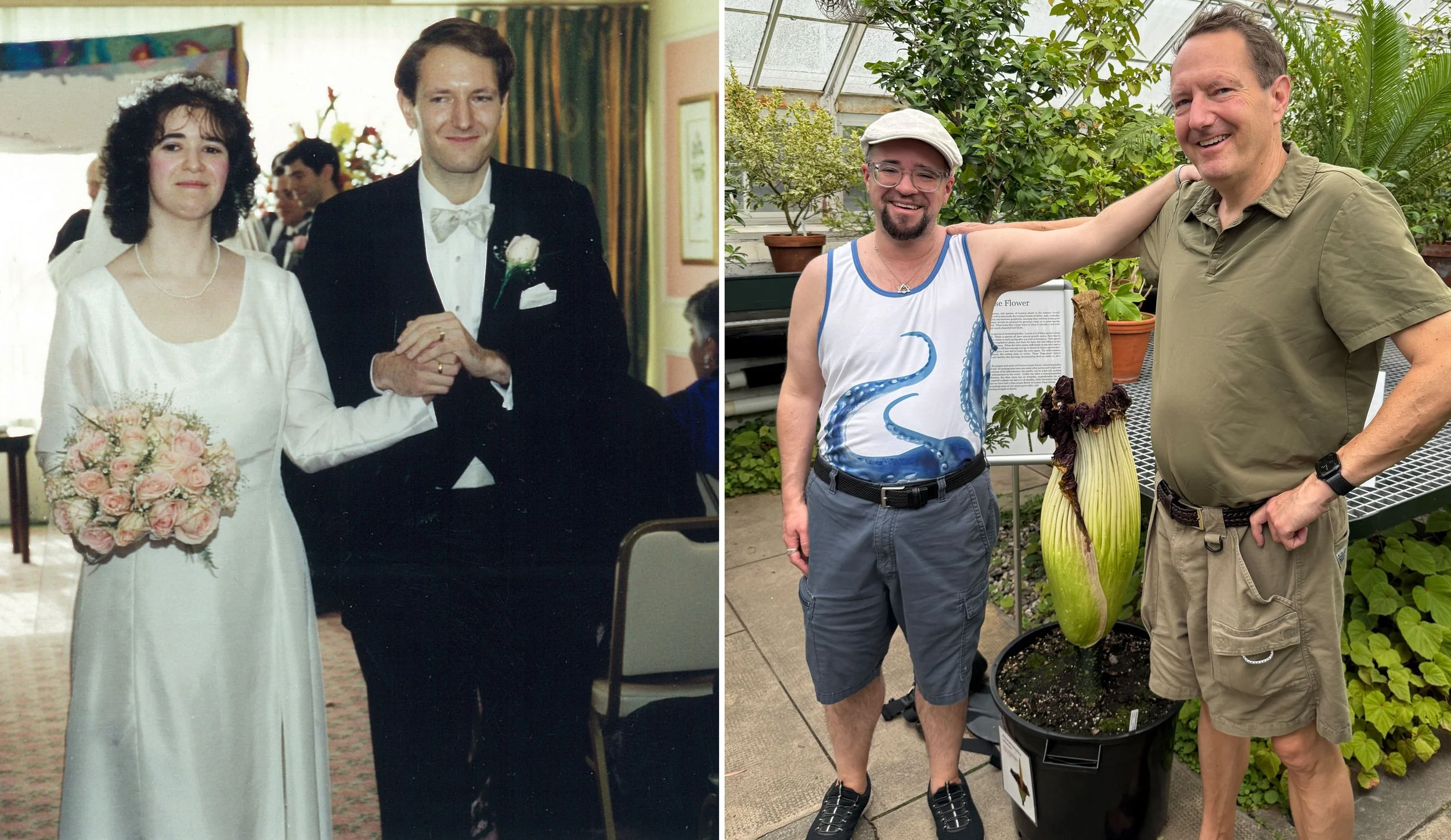
Jendi Reiter is a professional transsexual, licensed witch, and parent to a teenage boy and a hyperactive cat. Their poetry collection Introvert Pervert will be published this month by The Word Works. Their other books about butts and sadness include the novels Two Natures and Origin Story, both from Saddle Road Press, and five poetry books and chapbooks. They are the editor of the writing resource site WinningWriters.com.
The Lonely Tenement, or How to be Sad: Andrew Schumacher Bethke on “get me away from here, i’m dying”
A few vignettes, to set the scene and the tone:
It’s the summer of 2005, and a boy is sitting, alone, in the darkened lighting booth of a community theater. He’s listening to B&S’s “Slow Graffiti” on repeat, eating a sandwich before the show. He’s aware, vaguely, that the rest of the crew tolerates his presence at best, but he can’t shake liking the work, or feeling good at being part of something like this. He’s put aside some tickets for a few school friends, and is excited at the prospect of them getting to see this impressive hobby. They will not show up. They haven’t shown up before, and they never, in fact, will.
It’s a little less than a year later. The boy’s dad has, despite being an AC/DC fan, selflessly agreed to drive him and his (new, first) girlfriend and another friend to see Belle & Sebastian and The New Pornographers in San Francisco. Scouting out the venue for parking reveals the entire band out front. The boy absolutely chickens out of meeting them, a regret that he’ll probably carry for as long as he can carry regrets. The show is magic, despite the green wool sweater he’s wearing to look “cool” becoming absolutely disgusting. The future is bright and open and full of erudite, intricate pop songs that are almost all sad. His dad preferred The New Pornographers.
Summer of that year, and the boy is in Chicago, a place that has often been the focus of his dreams of escaping the agricultural cultural hinterland. The whole family is in the basement of his aunt and uncle’s Lincoln Park house, watching High Fidelity. He recognizes the sad strains of “Seymour Stein” even before it becomes the butt of Jack Black’s callout. “It’s the new Belle & Sebastian” becomes a good-natured ribbing for the rest of the trip. Later that night, he’ll stare at the ceiling and listen to Tigermilk as he tries to navigate a relationship that has deteriorated past dysfunctional into something approaching emotionally abusive. It’ll be another year at least before he realizes that maybe this isn’t love and he can just leave.
Fall of 2006, and Dear Catastrophe Waitress is the soundtrack to the great college application season that will finally extricate the boy from the desperately uncongenial environs of the San Joaquin Valley. He is so much the protagonist of “Wrapped Up in Books” and so obviously destined to finally be among his own kind, whatever that means, that he doesn’t even seem to notice how alienating and strange the application process is, and how woefully unprepared he is. It won’t be Glasgow (yet), but the daydreaming is better when it’s set in Chicago or Portland or Berkeley.
It’s spring of 2007 and it’s the kind of warm bath golden sunshine full color saturation day that only California can provide. The window is open and a soft breeze is adding to the analog rinse of If You’re Feeling Sinister on vinyl (!!!). Chicago was a no, Berkeley was a no, Reed and Bard and who knows where else were all in fact long abandoned, and the boy confronts that he won’t actually be leaving home any time soon. He’s felt sadder than this, but never before felt so resigned. Get me away from here, I’m dying.
Sadness as the Solution of the Now
If you’re the kind of person who’s voluntarily reading this essay, you probably have some more or less informed assumptions when I tell you that I was a teenage boy in Fresno who sometime around freshman year of high school decided (and proclaimed) that my favorite band was Belle & Sebastian.
Introverted, “bookish,” glasses-wearing, sad? Yes. Skinny, vintage-draped, “tragic air,” destined for SLAC glory? No. The thing about being a B&S (always the ampersand) fan across the pond and then across the continent and then 180 miles south of the civilization of San Francisco is that it really was the music that spoke to me, and not all the trappings. Now, this is true of a great many fans of a great many bands, but it is at least mildly strange for this band, a group so Aesthetic (après Wilde et avant Tik-Tok) that whole debates were raged in the British music press about whether the band that invented twee could be called twee. To a more read-in fan, Belle & Sebastian was a deeply emplaced band, rising from the ashes of founder Stuart Murdoch’s Chronic Fatigue Syndrome on the wings of the NHS and whatever public arts education programs Thatcher hadn’t been able to rip out of Scotland. It was the kind of group of people who were always willing to stick a finger in London’s eye on behalf of Red Clydeside, while filming themselves on jerky 16 mm film traipsing around the decaying Glaswegian hinterland wearing Breton stripes and berets and smoking. It’s helpful to have seen The Umbrellas of Cherbourg and have a (nouvelle) vague sense of the kind of place where you could get stabbed near Charles Rennie Mackintosh’s School of Art.
I didn’t know about any of that shit at the beginning, and even when I sort of learned about some of it, I didn’t want most of it. For all that, Belle & Sebastian got me through high school. I suspect that much of this has to do with how B&S as a group, and Murdoch as a lyricist, understood just how delicious melancholy was, and how the place of sadness was always better as a place you built in your mind.
A childhood you never had, an adulthood with real problems that are never quite real. Similar to golden age Wes Anderson, the best B&S songs evoke time in a kind of always/never way, disavowing the present in favor of a past and future lived simultaneously. It would be facile and quite incorrect to say that B&S are lionizing sadness, rather, in a Marxist mode, they’re valorizing it, showing all the sad boys and girls and enbies out there how to use it to ironically escape the crushing eternal horizon of the present.
The sadness that pervades much of the B&S catalog, and reaches a kind of anti-fever pitch on “Get Me Away From Here I’m Dying,” is very much a sadness of the external. What B&S understand, and what this song so perfectly conveys, is that sometimes you’re sad because shit you can’t directly control sucks. Sometimes your home town is crap. Sometimes people bully you. Sometimes you’re poor. Sometimes the people you love hurt you or leave you or both. Sometimes you can’t find a crowd to run with who fit your whole deal. Sometimes your plans don’t work out. Sometimes your dreams were stupid. Now none of these topics are revolutionary, and indeed most sad songs probably fall into these buckets, but where B&S truly excels is understanding how sadness often specifically is melancholy, rather than mourning.
Freud (oh boy) famously argues that there are two general approaches to grief (which I’ll here transmute to sadness): mourning, which is the working through of the pain of a specific loss, and melancholy, the pathological grieving of an undetermined object. I’d argue that most sad songs fall into the mourning category here. You had a bad break up, you miss your ex, you lost your job, so on and so on. This might be healthily contained, but it does tend to miss what often is the gerund of it all, the way that sadness sometimes just is undetermined. As a teenager, I didn’t miss my ex, I was lonely and waiting for something I had no way of accurately knowing about. I hadn’t gotten fired, I was just living with the consequences of not being rich. Even if nothing particularly, specifically bad had happened to me, I was existing in a present where nothing particularly good was happening to me. B&S, here and elsewhere, speak to the consequences of sadness as a general lack, rather than a specific loss. Here’s Stuart Murdoch putting paid to dear old Sigmund by pointing out that sometimes your here and now sucks and there just isn’t anything specific about it! Can’t get over the ex you never had, so what now?
Fortunately, GMAFHID offers not just a moment of recognition for the melancholic soul trapped in a present that just kinda generally sucks, but also a way to live in that present in a way that’s bearable. The secret is to recognize the power that living in melancholy gives you. It turns out that you can be melancholic and be hella cool. You can have catchy songs, and be photogenic, and even have some lovers. What doesn’t help is adopting some kind of cynical posture. Cynicism is the balm for someone who’s been hurt, not really for the person who is hurting. The narrator discovers this as he seeks to poke the psychic wound by reading a story with a similar naive, sensitive hero. Ready to see the character come to ruin, he’s shocked when everything turns out okay. What a reverse! But on the outside, in the real world, things are still sad. So what now? Crying is cool, actually, is what now. The secret, the answer, the way to live in this currently-inescapable melancholy now, is to be a little bitchy and superior about it. You’re the sensitive, sad boy looking moodily out of your rain-washed garret and you know what? That absolutely fucking slaps, actually. You’re sad and lonely and that’s so Aesthetic it hurts in the best way. You’re gonna wear a scarf even though it’s 65 degrees and go for walks in the fog looking sad and blasting “Fox in the Snow” and you’re gonna know, because B&S told me so, that the same constant melancholic navel-gazing about how everything sucks is cool and good and makes you at least a little better than all those people stuck with banal happiness. I could only make you cry with these words, indeed.
Now is this healthy, is this true, is this the kind of attitude that one should perhaps inculcate as a true way of life? Of course not. As B&S amply demonstrate, melancholy, especially a melancholy that’s been given the aesthetic imprimatur of some cool-ass Scots, is deeply seductive. Freud’s not wrong that there’s a danger to living in the eternal now of sadness, but sometimes imperfect problems only have imperfect solutions. When the sadness in your life is of the “get me away from here I’m dying” variety, you do just need to make it through until those conditions change. For now, you’re not gonna be less sad. You’re not gonna get over it; there isn’t anything to “get over” or “work through,” you just have to survive until something external to you changes, and if you need to do that by aesthetically collapsing the shitty present under the weight of a past and future that are both better places to be, and then being a superior little shit about it, the hope is that we can get a little grace once we’re out the other side.
The irony of finally coming out the other side of a present that seems inescapable is that, even if you now see those once-infinite horizons of sadness as quite small and even trite, the melancholy of it all is a trace that never stops being sadness, unlike the mourning of more specific hurts. As I finally live (and to some degree reject) the life that sad little teen me wanted and couldn’t seem to ever grasp, as I add experiences and happiness and knowledge and hopefully some wisdom, I’ve moved on from exes and lost jobs and personal mistakes but clearly will never quite move on from the pull of how good it felt to be sad in the lonely tenement.
Andrew Schumacher Bethke is now almost fully post-academia. This essay was partially written and fully revised in bits and snatches in St. Paul during an unprecedented fascist occupation. There doesn't seem to be much else to say autobiographically beyond fuck ICE, no one is illegal on stolen land.