
first round game
(14) Tom Waits, “Hold On”
HELD OFF
(3) Backstreet Boys, “Show Me the Meaning of Being Lonely”
121-81
AND WILL PLAY ON IN THE 2ND ROUND
Read the essays, listen to the songs, and vote. Winner is the song/essay with the most votes at the end of the game. If there is a tie, we will play a one-hour overtime (and repeat until we have a winner). Polls close @ 9am Arizona time on 3/3/26.
Walk with Me, and Maybe: Lydia Pudzianowski on the Backstreet Boys’ “show me the meaning of being lonely”
“Show Me the Meaning of Being Lonely” was released as the third single from Millennium, the Backstreet Boys’ second/third album (it’s complicated, not that interesting, and dependent on the country you’re in), on December 14, 1999. I was in middle school—an institution that saw the song’s title and said, “You got it.” Even as a 12-year-old, I listened to it with one eyebrow raised. “The hell are these lyrics,” I wondered while cutting out pictures for my Seth Green scrapbook, which was exactly what it sounds like; my English teacher showed me the meaning of being lonely by taking it away from me during class because I wouldn’t shut the fuck up about it.
Other things I wouldn’t shut up about: computers, video games, cable TV. My family purposely had none of these, I believe partially as some sort of exercise in building character. I composed book reports on an electric typewriter. At some point, I finally had enough and went to the public library to abuse word processing software and access the World Wide Web, but I unfortunately had no idea where to navigate other than the website for the PBS TV show Zoom. If you asked me today about the best video games ever made, my answer would be Twisted Metal 2 and Crash Bandicoot 2 on PlayStation, which I played in 1997 in my friend Liz’s basement, next to a framed poster of Bruce Springsteen’s ass from the cover of Born in the USA that her mom hung up. And I only ever watched Nickelodeon or VH1 at sleepovers. I never had any idea what was happening on Total Request Live, AKA TRL, AKA the news. To me, Carson Daly was basically Santa Claus: sure, I believed in him, but maybe he only existed in my heart, or he transmitted his countdowns when all the good little kids were asleep. I never saw the girl standing in Times Square talk about why she requested “Show Me the Meaning of Being Lonely,” as quoted in a March 2000 Entertainment Weekly article by Ken Tucker: “because my boyfriend recently dumped me on my birthday, so I know the meaning of being lonely!” Me too, friend. Me too.
But in this era—in Swedish songwriter Max Martin’s pop landscape that reaches as far as the eye can see, from Britney Spears’ “Baby One More Time” in 1998 up to and including Taylor Swift’s “The Fate of Ophelia” in 2025—the song is the video is the song. So you cannot talk about “Show Me the Meaning of Being Lonely” without mentioning that it spent January through April of 2000 battling *NSYNC’s “Bye Bye Bye” for the number-one slot on TRL’s top ten countdown.
So, because I never saw these headlines for myself in real time, and because I’d like to put something together on a laptop rather than an unironic typewriter, here’s a linked, ranked list of ten videos, as voted on by me, of or related to “Show Me the Meaning of Being Lonely.” Welcome to Total Request Lydia.
10. *NSYNC: Bye Bye Bye (Official Video)
You can’t talk about the songs without the videos, and you can’t talk about the Backstreet Boys without mentioning *NSYNC. We all had our preference. My best friend Megan was an *NSYNC girl (specifically JC); I was BSB or GTFO (Kevin > everyone).
Of course, both groups came out of the same machine run by a convicted criminal who died in prison (the less said about him, the better), so pitting them against each other was a financial exercise that benefitted mainly him, especially because he essentially made himself the sixth member of both groups.
The music also came out of a factory, but this factory is like if Willy Wonka wrote pop songs. Here, the candyman is Max Martin, whose work is peerless. The crème de la creme—the Everlasting Gobstopper—is “I Want It That Way,” gifted to and perfected by the Backstreet Boys. (For the record, the “Bye Bye Bye” music video currently has 591 million views on YouTube; “I Want It That Way” has 1.7 billion, as God intended.) In his excellent podcast 60 Songs That Explain the ‘90s, music journalist Rob Harvilla tackles this behemoth and delves into Martin’s songwriting approach. To Martin, music is math, melody is paramount, and lyrics are simply a vehicle for syllables. This explains why the words in these songs feel random, to put it politely.
9. Backstreet Boys: Everybody (Backstreet's Back) (Official HD Video)
I acquired the first Backstreet Boys CD in 1997 via a BMG promo or something similar, where they sent me a bunch of albums in the mail and then never saw a dime from me. Boy bands weren’t my preferred genre, ever, but BSB won me over (I don’t remember whether the name “Backstreet Boys” ever gave me pause, but it should have). At any rate, putting a song called “Backstreet’s Back” on your debut album is some legendary shit, and so is this Scooby Doo-ass video set in a haunted mansion. The video is as good as the song, which is phenomenal. Nick Carter is dressed as a bondage mummy, asking, “Am I sexual?” We are having FUN.
8. Backstreet Boys: Show Me the Meaning of Being Lonely (Lyrics)
“Show Me the Meaning of Being Lonely” was written by Martin and frequent collaborator Herbie Crichlow. It’s a ballad with Latin elements typical of the era—castanets, nylon-stringed classical guitar flourishes, and the like. Its lyrics are, of course, arguably nonsense.
Or: they’re the fever dream of someone rapidly traversing the five stages of grief. They are lines in a journal; filterless transmissions.
Brian Littrell, a steadfast, neutral presence, sings first: “So many words for the broken heart / It’s hard to see in a crimson love / So hard to breathe / Walk with me and maybe”
Bad boy AJ McLean comes in, an unmistakable edge to his voice: “Nights of light, so soon become / Wild and free, I could feel the sun / Your every wish will be done, they tell me”
Before we know it, Martin has whisked us to the chorus: “Show me the meaning of being lonely / Is this the feeling I need to walk with? / Tell me why I can’t be there where you are / There’s something missing in my heart”
Brian’s tall, dark, and mysterious cousin, Kevin Richardson: “Life goes on, as it never ends / Eyes of stone, observe the trends / They never say, forever gaze, if only”
Blond bad boy Nick Carter: “Guilty roads to an endless love / There’s no control, are you with me now? / Your every wish will be done, they tell me”
Another chorus, and then Howie Dorough, who is arguably the Boys’ secret vocal weapon, with the bridge: “There’s nowhere to run, I have no place to go / Surrender my heart, body, and soul / How can it be you’re asking me to feel the things you never show?”
And that’s about it. Have at it, English majors. Is the title a dare? Is it a plea for understanding? There’s a case to be made for either. A strong one.
Or: this is all garbage.
7. Backstreet Boys - Show Me the Meaning of Being Lonely (Into The Millennium Tour; 03/11/2000)
This one opens with some solid whiplash as Howie hypes up the crowd, which needs no hyping up, before introducing the song: “Do you guys wanna party?” Then: “We’d like to slow things down with a very special song to us. This song deals with the loss of a loved one, which I’m sure everybody out there can relate to somehow or another.” Howie points to the sky. He goes on to explain that “Show Me the Meaning of Being Lonely” was the last song they recorded with producer Denniz PoP, who died of cancer in 1998.
There are other factual inspirations to point to, printed by teen magazines and committed to memory: Howie’s sister also died in 1998. Kevin’s father died in 1991, when Kevin was 19.
In addition to the actual events that inspired the song, there were urban legends, and I love an urban legend. Reddit user lamest-liz posted this discussion topic in the r/BackstreetBoys subreddit six months ago: “I remember when the MV for Show Me the Meaning came out there were a ton of rumors about the meaning of it. Did your school have any crazy theories or rumors about BSB?”
The responses:
“I remember some kid being ADAMANT that Brian was dead, they said he really died and that his dad worked at Jive and they got a body double and this was how they were ‘secretly telling’ us.” This is a 9/10 in my book. My only critique is the part about his dad working at Jive. We’re gilding the lily here.
“Another person said that Kevin secretly had multiple families and that he was sad he couldn’t play with any of his kids.” 10/10. Kevin has always been the hottest and could have as many families as he wanted. He is even hotter now despite the fact (or because of it) that he primarily dresses like a Jedi master.
“My personal fave was that people said Nick’s had no real meaning behind it because he just wanted to fit in with a sad story.” I am not going to rate this and will instead caution Nick to be careful what he wishes for.
“I remember one kid told me that ‘all their dads died together in a plane crash’ and I was like what?? Lmao.” 2/10. I too am like what? Far too convenient; too many surviving fathers.
“I heard that Brian had a twin brother that died haha.” 7/10. A plausible theory referring to the fact that, in the video, Brian is watching himself in a hospital bed preparing for open-heart surgery (a real thing that happened, also in 1998). Or…is it his brother that died haha?
6. Backstreet Boys - Show Me The Meaning (Live on the Today Show)
The Backstreet Boys never broke up. The only member who took any sort of hiatus was Kevin, from 2006 to 2012. Otherwise, they’ve technically been together since 1993. In 2025, they performed “Show Me the Meaning of Being Lonely” on the Today Show to promote the 25th anniversary of Millennium. As always, Brian opens the song; here, he’s audibly pushing past his vocal tension dysphonia, diagnosed in 2011. And kudos to him for doing so, because man, is it good to see these guys back in their coordinating white fits. The three Today presenters watching from the wings—Al Roker, Craig Melvin, and Dylan Dreyer—are dancing and singing like they’ve got VIP passes. During the bridge, Howie and AJ harmonize. Roker leans his head on Melvin’s shoulder. Melvin is applauding. Dreyer is beaming. And Brian absolutely crushes his high notes.
5. BACKSTREET BOYS - SHOW ME THE MEANING OF BEING LONELY (LAS VEGAS SPHERE) 2025
This is it. Disneyland for women of a certain age. Space exploration, basically. General admission tickets for Into the Millennium, the Backstreet Boys’ Vegas residency at the Sphere, are currently $563. Based on this video, they appear to be worth every penny (RIP, penny). This is now what I want for my next birthday and every birthday after that.
4. Show Me The Meaning of Being Lonely - BSB (METAL COVER))
Before he reinvented popular music, Max Martin was in a glam metal band called It’s Alive. This is where he caught the eye of Denniz PoP, who signed the band and became Martin’s mentor. Tommy “ReinXeed” (rain seed?) Johansson, a Swedish power-metal musician with 378,000 subscribers on YouTube, posted his cover of “Show Me the Meaning of Being Lonely” in 2022. I don’t want to say this too loudly, but this is my favorite version of this song, and I sincerely hope Martin has heard it. I’ve turned into Beavis and Butt-Head throwing horns on their couch. If you only watch one of these videos, make it this one.
3. Backstreet Boys - Show Me the Meaning of Being Lonely live in Las Vegas, NV - 4/8/2022
Kevin makes it through his first line: “Life goes on, as it never ends.” Right after singing “Eyes of stone,” he stops singing and shakes his head. AJ immediately picks up where he left off.
I scroll down to the comments to see what happened. Kevin’s mom—Brian’s aunt—died in January of 2022. Tell Kevin that the lyrics are nonsense. I dare you.
2. Nick Carter breaking down during Show Me The Meaning Of Being Lonely Live in London O2 06/11/22 BSB
This video is from November 6, 2022 (UK date conventions). Nick’s brother Aaron Carter died a day earlier. Tell Nick that the lyrics are nonsense. I dare you.
1. Backstreet Boys - Show Me The Meaning Of Being Lonely (Millennium 20 Edition)
The video for “Show Me the Meaning of Being Lonely” premiered on MTV on New Year’s Eve of 1999. The reissued Pop-Up Video-inspired version puts some of the rumors to bed. We open on text reiterating what Howie said when introducing this song on stage in 2000: “This video is dedicated to Denniz POP, and to all those who have lost a loved one.” It appears to have been filmed on the set of The Crow by the same cinematographer; everything is black, gray, and wet.
We see Brian standing outside a hospital room watching himself (or his late twin…) hooked up to a heart monitor as doctors and nurses rush in. AJ is on a bus in a tank top, a single tear rolling down his cheek as he looks at a photo of a woman. She appears to him on the bus, then vanishes. Text pops up to inform us that AJ says the woman represents a friend of his who died in a car accident at 15. Kevin is sitting in a hotel room with a projector, watching old home movies; this is him reflecting on the loss of his father. Nick walks in the rain and pulls a woman out of the path of a moving bus. We don’t get any factoid about this one; the rumor is that the scene was inspired by a fan’s similar near-miss incident. Talk amongst yourselves.
Howie sits in a hotel bar as a woman in a red dress runs toward him and then disappears; this is his late sister. AJ gets off his bus at the Denniz St. stop. Kevin walks into the bar and nods at Howie, the two united in loss. Brian emerges from the hospital. The five of them find each other and walk into…the snow? The desert? A purple cloud?
I am being honest when I say that this is some of the saddest shit I’ve ever seen. It’s certainly a far cry from the Transformer mech suits in the “Larger than Life” video and the haunted house from “Everybody.” You think grunge is depressing? There are five sad stories in this video (six if you count Nick’s bus thing). Bursts of red indicate what’s been lost: red lips, a red cross, a red dress. Pound for pound, this may be the saddest song of the ‘90s, nonsense lyrics or not (I maintain not). If we can give the time of day to “Yellow Ledbetter” and “Spoonman” and “A mulatto, an albino, a mosquito, my libido,” we can let the Backstreet Boys hang out, too.
The video’s comments section is flooded with similar stories. “She was a great dog.” “Missing my covid victim father.” “I miss you Peanut.” A lot of YouTube comments sections look like this, but it’s different here. Howie said this is for us.
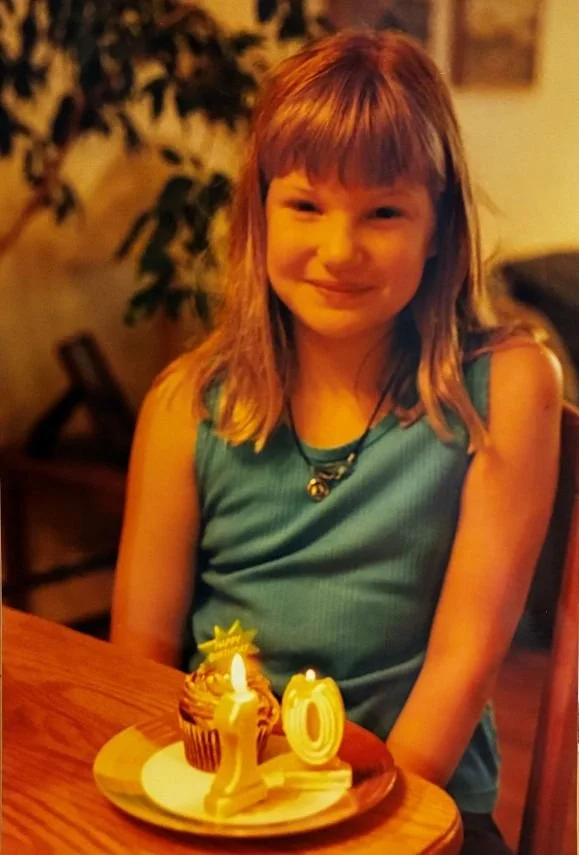
Lydia Pudzianowski is a writer on sabbatical raising a toddler with her husband in Bucks County, Pennsylvania. Kevin is her favorite. This photo was taken in 1997, the year of Backstreet’s return.
Crooked Little Heart: david turkel on “hold on” by tom waits
She’s out by the Riverside Motel. Now she’s by a ninety-nine-cent store. She must be walking. But this is hardly the night for it—it’s ten degrees below zero out there and getting colder by the minute and she doesn’t seem to have anywhere to go. She stops and shuts her eyes and she’s moving now, ever so subtly back and forth—you’d think she was dancing. She’s trying to remember a song that’s been stuck in her head but it’s too cold and the singer has to help her.
The song goes Hold on, hold on….
Kathleen Brennan—Tom Waits’s wife and chief collaborator since 1980—once said that her husband wrote two types of songs: grim reapers and grand weepers. I’m not sure into which of these categories she’d slot “Hold On”—a song that she co-wrote with him for his 1999 Grammy-winning album Mule Variations. It arguably possesses elements of both, but the song is neither grim nor grand by Waitsian standards. Most of the people I’ve talked to hear it as “sweet” and “pretty,” and none seem to share my concern for the protagonist’s fate at the end.
Certainly, in terms of both vocals and instrumentation, “Hold On” goes down easy. The Waits purist I was at the time of its release would have probably called it “Tom Waits for people who don’t actually like Tom Waits.” His voice is as normative as it gets—the song received a second Grammy nomination for “Best Male Rock Performance”—and there’s no bullhorn, conundrum or discordant guitar in the mix. Minus its length (a full verse was removed from the official video version for broadcast purposes), it’s a radio-friendly number. Given that kind of cursory listen, it unspools with a breezy romance. Lines like: “Well, the moon was gold, her hair like wind,” and “He gave her a dime store watch and a ring made from a spoon,” and “God bless your crooked little heart” weave a gentle spell. When he sings, “Come on, Jim,” before breaking into the first chorus, we’re excited for the ride ahead.
Waits himself thought the song “optimistic.” “I thought that was a good thing to say in a song,” he told music journalist Karen Schoemer at a diner in Monte Rio shortly after the album’s release. “Take my hand, stand right here, hold on. We wrote that together, Kathleen and I, and that felt good. Two people who are in love writing a song like that about being in love. That was good.”
Barney Hoskyns, writer of the unauthorized biography Lowside of the Road: A Life of Tom Waits, traces the song’s lineage through earlier iterations—like 1977’s “Burma Shave”—back to the true story of Waits’s cousin Corrinne, whom Waits said, “hitchhiked out and stood by this Foster Freeze on Prom Night. Got in a car with a guy who was just some juvenile delinquent, and he took her all the way to LA, where she eventually cracked up.” The heroine of “Burma Shave” doesn’t make it that far—dying instead in a car wreck on the way to her destination. The young woman in “$29.00,” another song in this mold, crawls out of her finale “lucky to be alive,” having “only lost half a pint of blood, twenty-nine dollars and an alligator purse.”
About “Hold On,” Hoskyns wrote: “Here was another archetypal Waits moll, another variation on the cousin who’d split from Marysville all those years before. Except that this woman had a man who stood by her, who held on like Waits and Brennan had held on.”
Hoskyns is an experienced music writer, and his biography of Waits is as close to definitive as we get. It’s remarkable, therefore, that he offers such a superficial and inaccurate description of the most prominent song from Waits’s most commercially successful record. This may be due to the elements of the song I’ve already discussed which foreground its tenderness. But my gut tells me that, in ascribing to the song the story of a ride-or-die couple, Hoskyns makes the mistake of paying closer attention to Waits’s description of the songwriting process than to the lyrics themselves. If so, he’s overlooking a defining feature of the Waits songbook. As the artist told Terry Gross in a 2002 interview, “I like beautiful melodies telling me terrible things.” This idea of a sweetly rendered nightmare, I would argue, gets closer to the heart of the song’s story than any attempt to find a Waits-Brennan level of fidelity in its characters. Otherwise, where is this man whom Hoskyns describes as standing by our moll?
Let’s see if we can find him.
In the first verse, a speaker, who addresses his listener as “son,” tells a story about a woman with “charcoal eyes and Monroe hips.” She left their straightlaced town of Monte Rio, California, with Hollywood dreams. She called out to someone named Jim to follow her, but it’s not clear if he did, or who this Jim even was. The companion in “Burma Shave” was just some stranger, after all, like the delinquent who picked up cousin Corinne.
As for the speaker, he may simply be the song’s narrator at this point, a folksy sort who calls everyone “son.” But if we’re to take him more literally, it’s possible that this is the protagonist’s father, explaining the situation to her little brother. Or maybe it’s an uncle, telling a young Tom Waits-proxy the story of his cousin. Though, to my mind, there’s too much non-familial longing in this smoldering image of eyes and hips. It’s hard not to think that the father in this verse is telling his son the story of the boy’s mother and of the day she left them both. A reversal, in this sense, of Waits’s own story, as it was his father Frank who left the family when Waits was ten.
Regardless it’s an odd launch if the song is meant to be, as Hoskyns suggests, the story of a couple who stick together through thick and thin. We’re occupying the vantage of those left behind. You can almost see the dust kicking up, as she—with or without Jim—peels away and recedes into the distance. It doesn’t feel like she’ll be coming back.
Sure enough, this speaker is nowhere to be found come verse two. The song abandons his first-person narration for a removed third person perspective that centers on an unnamed man and woman in low-rent surroundings. The woman still feels like our girl. But the man doesn’t quite strike me as Jim—he’s too naïve. He’s proposing marriage with a cheap ring. It’s quaint and cute, like something a kid would do. And his logic is like a kid’s too—he doesn’t understand why she’ll sleep with him, but she won’t marry him. For a second you think it might even be a flashback to some youthful courtship, but when she tells him, “Go ahead and call the cops, you don’t meet nice girls in coffeeshops” there’s nothing childish about that. Her suggestion is that he knew what he was getting into when they hooked up. It’s possible that she was working in a coffeeshop in Monte Rio then, already thinking of herself as a not-so-nice-girl. But I get the impression that she’s still older here and grown a little jaded. Her Hollywood dreams haven’t panned out and she’s been nighthawking—hitting those Hopper-esque diners late after the bars close. That’s where he picked her up. She says she still loves him, even tells him to hold on, but the way that she says it—“Sometimes there’s nothing left to do”—sure sounds like she’s letting go.
In the next verse, we move into direct address, as an unidentified speaker tells her, “God bless your crooked little heart.” It should be the most intimate shift in P.O.V. yet, but something’s off. She’s not actually there to hear his blessing—a fact which the line, “How I wish you were still here with me,” makes clear. He’s alone and missing everything about her, right down to that “broken China voice” of hers. Personally, I think he’s been drinking. “You build it up, you wreck it down. Then you burn your mansion to the ground,” he intones. Who else but a drunk says shit like that to an empty room?
Mule Variations’ song “House Where Nobody Lives,” offers a useful key to that line, when Waits sings, “If there’s love in a house, it’s a palace for sure.” That’s the kind of mansion he and Brennan are referencing—one transformed through love from an unremarkable dwelling into a place of opulence. The same kind of transformation that could have turned a spoon ring into a treasure. But we don’t have that sweet alchemy in this story—the ring was rejected, the house demolished.
In 1987, Tom Waits released Frank’s Wild Years—a concept album about a man named after his father who leaves home to hit the Big Time. We discover late in the record that Frank may not have gotten any further than East St. Louis. So, there’s a possible callback to that story in this verse of “Hold On,” when the man says, “St. Louis got the best of me.” What’s more, in Waits’s 1983 song “Frank’s Wild Years,” the Frank character literally sets fire to his suburban house, then sits in his car across the street drinking and laughing quietly to himself as it burns. All this is to say that not only do I disagree with Hoskyns that Waits and Brennan have given their moll a man to stick by her, I think the spirit of Frank pervades “Hold On”—these are not stick-together people, but a more restless sort; they’ve blown through each other’s lives chasing half-formed dreams. Maybe that’s what our moll meant they had to hold onto—not to one another but to those dreams?
In the last lines of this third verse, however, there’s a telling shift. I hear the introduction of a new voice. It’s speaking again in direct address but with a different sense of purpose and connection. “Oh, there’s nothing left to keep you here,” it says, “But when you’re falling behind in this big, blue world. You’ve got to hold on.” Who’s speaking now, and who precisely are they speaking to? You could argue that the ex-lovers are talking over the phone in this scene, I suppose. But I sense a deeper divide.
More than that, the line “Oh, there’s nothing left to keep you here” bears repeating. It is, I think, one of the most heartbreaking lines of any song, especially a sweet and pretty one like this. I desperately hope that no one I’ve ever cared for should have to feel this way, that there’s nothing left keeping them in this “big, blue world.” It paints a picture of a loneliness so complete and profound that it shatters the illusion of dialogue. What’s different about the direct address this time around is that it breaks character, speaking now as the voice of the song itself. As such, it’s not speaking directly to our female protagonist—or only to her—but to us, the listener, as well. When there’s nothing left, it tells us, You’ve got to hold on.
This brings us back to the Riverside Motel and the song’s final verse. Back to the brutal cold and what feels like the end of a long, sordid journey. Who knows what Hoskyns was smoking when he spied someone out there with her, because it’s clear that this woman is alone with nowhere to go. You don’t reflect on how far away your “old hometown” is on a night like this if you’ve got any other options. She may even be working the streets at this point. Sometimes when I try to save her, that’s the dubious form her “salvation” takes—a car pulling up to the curb and rolling down its window for her to lean into. But when she shuts her eyes, I get worried that she’s not even holding out for that. And that’s when the shapeshifting perspective of the song turns yet again. Omniscient now, it moves into her head, and, by extension, into ours. Waits sings: “Inside your head there’s a record that’s playing a song called ‘Hold On.’”
You should try strumming along with it, if you’re able. It’s a simple enough song. Just four chords. In the verses they roll gently, like little wheels. All the chord changes happen mid-line, often mid-word, and this creates a soft undulation, as if the verse was a little boat bobbing up and down on a gentle current. With the chorus this strategy alters—the words becoming punctuated more directly by the changes. The second half of the chorus runs: (G) Hold on, (D) Take my hand, (A) I’m standing right here (you’ve gotta) (D) Hold on. It’s a small but noticeable shift that builds a structure, like the planks of an argument, lending the chorus its air of delicate but definite insistence. And this, I think, is the key to understanding Waits’s description of the song as a love song. Because it isn’t the story in the verses which hold that promise, but rather the song’s chorus. It has a life of its own. Though not until this final verse is that made explicit.
I’ll be honest, sometimes it bothers me when songs get self-reflexive like this. As when, late in Don McLean’s interminable “American Pie,” everyone suddenly joins in on the chorus—How did they all learn the words of this song you just wrote, Don McLean??? But that’s not what’s happening with “Hold On.” I’m willing to bet that you have that room in your head too, the room where this song is playing on repeat. You may sing it differently, and the verses themselves may be different, but the words of the chorus are the same. I know I have it. Truth be told, I’ve spent more time in there this last year than ever before. Hold on in constant rotation. It plays for friends and loved ones, for communities, for my country. Staring dumbstruck at the news, I sing it to myself on a daily basis. My reasons are not as dark as hers—the woman in our song—nor as dire as so many others’ right now. I’m indoors as I write this, for starters. I’m warm. The person I love more than anyone in the whole world is close by and she loves me back. Though it’s almost too much to say that, isn’t it? I feel so impossibly lucky to be able to say that. So aware of this life’s precarity and of my own track record over the years for building things up just to wreck them down.
This, I understand, is why this Waits-Brennan “song about being in love” takes the shape that it does. Waits never meant to suggest that they were telling their own story in writing “Hold On.” The “good thing” that I think he’s referring to—the optimism which the song represents for him—is that they wrote it together, still holding on and being held. They sing the chorus for and to one another, but they’re not celebrating their love in the verses so much as offering a cautionary tale. The song, in this sense, is a prayer that those who reach for those words will be able to hear them, even on their coldest, loneliest nights.
Waits’s penchant for “beautiful melodies telling me terrible things” is certainly one reason why a cursory listen to “Hold On” might seem to support an interpretation of it as a sweet and pretty little love song. But I think he offered a more telling quote in his 2011 Fresh Air interview for the album Bad as Me, responding to Gross’s suggestion that his song “Last Leaf on the Tree” was a metaphor for death:
Well, I don’t know, you could say it’s a metaphor for death. Or you could say it’s really a song about the last leaf on a tree, you know? Because I did see a tree out in my yard that had one leaf left on it. And I…looked at that leaf and I said, ‘Hang on, buddy. If you hang on you can make it to the next season. If you can make it to the next one, you might be here next year greeting all the new ones. Hang on.’
I finally got to see Waits perform the year of Mule Variations. It was his first tour in twelve years. That period covered my entire history with the man—from a suburban high school student hearing him for the first time on the radio at the Fotomat where I worked, to a twenty-nine-year-old who had not yet figured out the difference (and distance) between the singer and his songs. I sported a catfish mustache and green-tinted prescription aviators, drove a 1971 Mach One and co-owned a roach-infested dive bar. Fittingly, as much as I’d looked forward to the concert, I stepped out mid-show to get a whiskey.
“You just missed Keith Richards,” the bartender told me, as I listened to the familiar sounds of “Hold On”—its pensive guitars and lush shaker—striking up in the auditorium. Mule Variations was Waits’s first record in six years, and the first of his discography that struck me as a step backwards. I was having a hard time accepting the idea of Tom Waits as the mainstream figure he seemed to have become in the interim. But I was also going through a breakup then, and I felt a resonance with “Hold On” that endeared me to it. It made me think of my own “California trip” at age twenty, of the dime store trinkets I’d bestowed and mansions I’d torched. In its own small way, “Hold On” gave me the cool suspicion that I was becoming less of a Tom Waits fan and more a character from one of his songs.
But when I tried to head back inside, I was told by security that I’d have to wait until the song was over to get to my seat. I moved closer to the doors and the two men flanking them shifted their weight. “I’m just trying to hear the song,” I told them. And that’s how I listened to it—out by the security, staring at the closed double doors to the auditorium, straining after every syllable. That’s when I finally heard the song. All these years later, it’s the only song from that show that I remember.
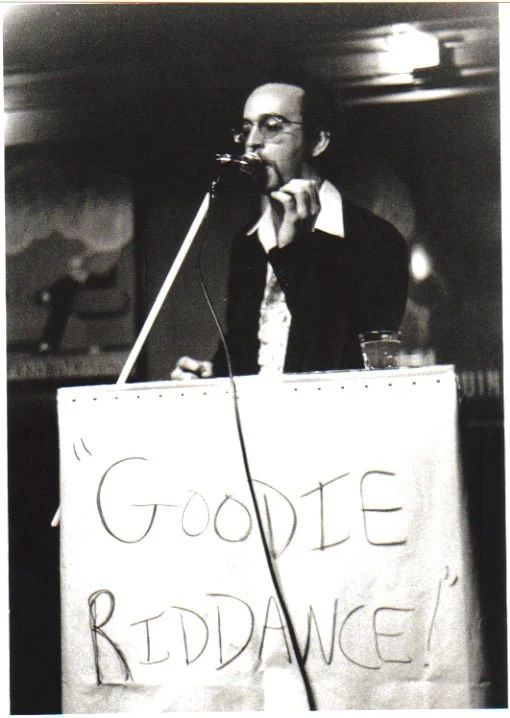
This is the author in 1999, at a going away party in Hell (the bar) for his friend Goodie, who was leaving Chapel Hill to make “that California trip.”